AI Engineer vs Data Scientist in Canada
Compare AI engineer vs. data scientist careers in Canada, including key skills, average salaries, industry trends and provincial job outlooks.
 Swagatam Sinha
Artificial intelligence and data analytics are becoming part of business operations across Canada. Companies in finance, healthcare, retail, manufacturing and technology are using these capabilities to improve services, understand customers and make better decisions. This has increased interest in roles such as AI engineer and data scientist.
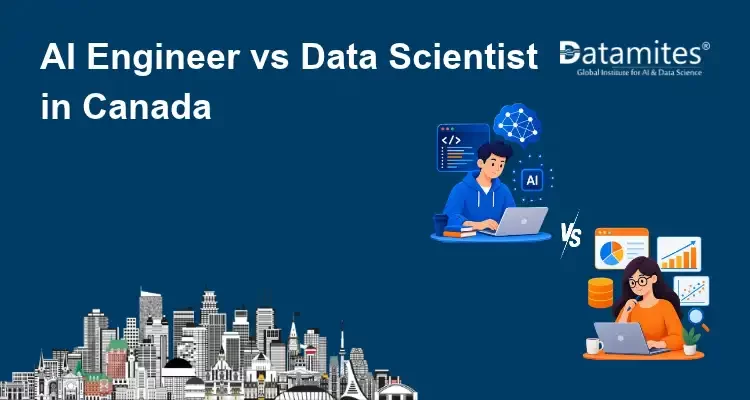
Although both professionals work with data and machine learning, their responsibilities are different. AI engineers focus on developing and deploying intelligent applications, while data scientists analyze information to identify patterns and support business decisions. Understanding their skills, salaries and job prospects can help learners choose a suitable career path in Canada.
AI Engineer vs Data Scientist: Key Differences
AI engineers and data scientists both work with programming, data and machine learning, but their roles differ in terms of responsibilities and outcomes. The following comparison highlights the key differences in their focus areas, technical skills, tools and day-to-day work.
| Area | AI Engineer | Data Scientist |
| Main focus | Building and deploying AI applications | Analyzing data and developing predictive insights |
| Key responsibilities | Developing, testing and integrating AI models | Collecting, cleaning and interpreting data |
| Common tools | Python, TensorFlow, PyTorch, cloud platforms | Python, R, SQL, Tableau, Power BI |
| Core skills | Software development, machine learning and model deployment | Statistics, data analysis and predictive modeling |
| Typical outcomes | AI applications, recommendation systems and automated processes | Forecasts, reports, business insights and predictive models |
The main difference is how each role applies technical knowledge. AI engineers turn models into working applications, whereas data scientists use data to answer business questions and guide decisions.
Refer to these articles:
- Guide to an Artificial Intelligence Career
- What Is a Neural Network? Understanding Deep Learning Basics
- Human Intelligence vs Artificial Intelligence: Key Differences and Insights
What Does an AI Engineer Do in Canada?
AI engineers design and build applications that incorporate technologies such as machine learning, natural language processing and computer vision. Their responsibilities extend beyond developing AI models to integrating them into software systems, evaluating their performance and ensuring they continue to function effectively after deployment.
In Canada, AI engineers may work with technology companies, banks, healthcare organizations, consulting firms and businesses developing automation solutions. Their responsibilities can include:
- Building, training, and assessing machine learning and deep learning models.
- Developing applications using large language models and generative AI.
- Developing AI integrations for business applications and software platforms.
- Working with cloud platforms and APIs to deploy applications.
- Monitoring model performance, accuracy and reliability.
- Ensuring data protection, maintaining security standards and following responsible AI practices.
Someone considering an online artificial intelligence course should look beyond introductory concepts. Practical learning in Python, machine learning, deep learning, model evaluation and deployment can provide a stronger foundation for this role.
What Does a Data Scientist Do in Canada?
Data scientists analyze different types of data to uncover patterns, answer business questions and guide decisions. They combine statistical techniques, programming and machine learning to interpret information and generate insights that organizations can use to address business challenges.
Their work is relevant to several Canadian industries. Financial institutions use data models to assess risk and detect unusual transactions. Healthcare organizations analyze information to support research and improve operational planning. Retail and e-commerce businesses use customer data to understand purchasing behavior.
Common responsibilities include:
- Gathering, organizing and preparing data from multiple sources.
- Using SQL and programming languages to analyze datasets.
- Applying statistical methods to identify patterns and relationships.
- Developing predictive models and evaluating their accuracy.
- Creating dashboards and reports for business teams.
- Explaining findings to technical and non-technical stakeholders.
For someone exploring an online data science course, it is useful to check whether the curriculum covers statistics, SQL, Python, machine learning and data visualization. These subjects are relevant to the day-to-day work of data scientists.
Refer to these articles:
- Career Paths in Data Science: Roles and Responsibilities
- Exploring Industries with High Demand for Data Scientists
- Data Science vs Business Intelligence: Which Path to Choose?
Skills Required for AI Engineers and Data Scientists
Both careers require programming and analytical thinking, but the depth of knowledge differs according to the role.
AI engineers need a strong understanding of software development, algorithms, machine learning and deep learning. Python is widely used, while knowledge of C++, APIs, cloud services, containerization, and model deployment can be useful. Experience with frameworks such as TensorFlow and PyTorch also supports AI application development.
Learners in Alberta comparing an online artificial intelligence course in Edmonton can check whether the program includes practical work in model development, cloud deployment and real-world applications rather than focusing only on theoretical concepts.
Data scientists need stronger foundations in statistics, probability, data cleaning, exploratory data analysis and predictive modeling. Python, R and SQL are commonly used, while Tableau and Power BI help communicate findings through dashboards and reports.
Both professionals also benefit from communication, problem-solving, critical thinking and an understanding of data privacy. As organizations adopt more advanced AI systems, the ability to evaluate model outputs and identify potential errors is becoming increasingly important.
AI Adoption and Industry Trends in Canada
Canadian business adoption figures provide a useful indication of where AI and data-related skills are being applied. According to Statistics Canada's second-quarter 2026 report, 19.2% of Canadian businesses had used AI to produce goods or deliver services during the preceding 12 months. This was three times the 6.1% reported in the second quarter of 2024.
Adoption varied by industry. Information and cultural businesses recorded the highest use at 42.3%, followed by finance and insurance at 40.4% and professional, scientific and technical services at 32.4%. Among businesses using AI, data analytics was the most frequently reported application, at 36.6%.
The third-quarter 2026 survey offers a separate view of future business plans. 25.2% of Canadian businesses intended to use AI to produce goods or deliver services over the following 12 months, compared with 14.5% in Q3 2025. Among businesses planning to adopt AI, 39.3% identified large language models as an intended application. This figure reflects planned use rather than confirmed implementation.
Canada's national AI strategy, AI for All, sets out longer-term employment and skills targets. The government projects that more than 250,000 new AI-relevant jobs could be created across the Canadian economy by 2031 through AI adoption. The initiative also aims to offer up to 90,000 AI-related employment opportunities and work placements for young Canadians. These are government targets, not confirmed vacancies for AI engineers or data scientists.
Global investment and business adoption provide further context for Canada's technology sector. Gartner's September 2026 forecast estimates that worldwide AI spending will reach USD 2.7 trillion in 2026, representing a 49.5% increase from 2025. The forecast includes spending on AI infrastructure, software, services and related technologies. It measures industry investment rather than employment growth.
McKinsey's State of AI in 2026 survey found that nearly nine in ten respondents reported regular AI use in at least one business function. It also found that 44% of respondents said AI was scaling across their organizations, compared with 38% in the previous year. The findings suggest that many businesses are moving beyond experimentation towards wider implementation, although adoption levels vary by organization size and industry.
These findings help explain why organizations need professionals who can develop AI applications, manage data, evaluate models and integrate new technologies into business operations. An online artificial intelligence course in Canada can be considered by learners building these skills, provided its curriculum matches their intended career path.
Job Outlook Across Canadian Provinces
AI and data-related job opportunities vary by province. The Government of Canada's Job Bank provides separate outlooks for artificial intelligence software engineers and data scientists. Its recent labor market trends were updated on July 28, 2026, while the three-year provincial outlook ratings were updated on December 10, 2025.
| Province | AI Software Engineer outlook | Data Scientist outlook |
| Alberta | Moderate | Moderate |
| British Columbia | Moderate | Moderate |
| New Brunswick | Moderate | Moderate |
| Nova Scotia | Good | Moderate |
| Saskatchewan | Moderate | Moderate |
| Ontario | Very limited | Limited |
| Quebec | Limited | Limited |
| Manitoba | Limited | Undetermined |
Source: Government of Canada's Job Bank outlooks for AI software engineers and data scientists. These ratings describe the outlook for the listed occupations and should not be treated as a count of current vacancies.
A separate Q4 2026 Experis Tech Talent Outlook provides a broader view of Canada's technology hiring environment. It reported a 29% net employment outlook among Canadian technology and IT services employers planning their October to December hiring. The report also found that 72% of surveyed employers were having difficulty finding the skilled talent they needed. These figures cover the wider technology sector, not exclusively AI engineer and data scientist positions.
Statistics Canada's October 2026 study also examined hiring and job separation rates between January 2006 and August 2026. It found no broad evidence that the rise of AI had caused substantial decreases in hiring or increases in job separations across Canada so far. The findings are early evidence, and the effects may differ between occupations.
Toronto, Mississauga and Ottawa are among the Ontario locations where candidates may explore technology and analytics roles. However, the provincial outlook ratings indicate that hiring conditions should be considered carefully. People comparing an online artificial intelligence course in Toronto should assess whether its projects and technical content match the requirements in current job advertisements. A course can help build skills, but it cannot guarantee employment.
Refer to these articles:
- Data Science Job Roles, Salary Structure, and Course Fees in Canada
- How to Become a Data Scientist in Canada?
- How Much is the Data Science Course Fee in Canada?
AI Engineer vs Data Scientist Salary in Canada
Salary is an important factor when comparing AI engineering and data science careers in Canada. Both roles offer competitive earning potential, although salaries vary based on technical skills, professional experience, location and employer.
AI Engineer Salary in Canada
According to Indeed, the average annual base salary for an AI/ML engineer in Canada is CAD 139,037, based on 76 reported salaries. The salary data was updated on November 7, 2026. This figure provides a relevant benchmark for AI engineers, as Indeed reports the combined AI/ML engineer job category rather than a separate estimate for AI engineers.
Data Scientist Salary in Canada
According to Indeed, the average annual base salary for a data scientist in Canada is CAD 98,907, based on 560 reported salaries. The data was last updated on November 8, 2026. Actual earnings may differ depending on experience, analytical expertise, industry and location.
These figures indicate that the reported average for AI/ML engineers is higher than that for data scientists. However, they should be treated as salary benchmarks rather than a direct comparison of identical job categories.
Education and Learning Pathways in Canada
A bachelor's degree in computer science, software engineering, mathematics, statistics, data science or a related field can provide a foundation for either career. Some specialized or research-oriented positions may prefer a master's degree or doctoral qualification, particularly when the work involves advanced machine learning or applied research.
The learning path should reflect the responsibilities of the chosen role. Aspiring AI engineers can focus on programming, machine learning, deep learning, software development and model deployment. Those interested in data science can prioritize statistics, SQL, Python, data visualization, and predictive analytics.
When comparing an online data science course in Canada, learners should review the syllabus, project work, software tools, course duration and learning format. Practical assignments involving real datasets can help connect theoretical concepts with the tasks performed by data scientists.
Refer to these articles:
- How to Become an Artificial Intelligence Engineer in Canada?
- How Much is the Artificial Intelligence Course Fee in Canada?
- Is Data Science and Artificial Intelligence in Demand in Canada?
Which Career Should You Choose?
The choice between AI engineering and data science depends on the type of work you want to do.
AI Engineering may be a suitable option if you enjoy programming, software development and building applications that use machine learning. It involves working with models, APIs, cloud platforms and deployment systems.
Data science may be a better fit if you enjoy analyzing information, identifying patterns and explaining findings. It combines statistics, programming and business understanding to support decisions across different industries.
For professionals in Toronto who prefer working with datasets, an online data science course in Toronto may be worth evaluating alongside degree programmes and other learning options. The important factor is whether the learning path develops the skills required for the roles they intend to pursue.
AI engineers and data scientists contribute to Canada's growing use of artificial intelligence and data analytics, but they approach problems differently. AI engineers concentrate on developing and deploying intelligent applications, while data scientists use data to identify patterns and support business decisions.
Salary estimates, provincial job outlooks and individual technical interests can help narrow the choice. Before selecting a career path, review current job advertisements, identify the skills employers request, and choose a learning route that provides opportunities to practice those skills.
A data science course can help learners build a strong foundation in statistics, programming, machine learning and predictive analytics before exploring different career opportunities.
For learners interested in developing the skills required for these career paths, DataMites Institute, a globally renowned training institute, offers programs in artificial intelligence and data science. With more than 12 years of trust in the training industry and a community of over 200,000 learners across the globe, the institute provides learning opportunities for individuals looking to build technical expertise. Its programs cover relevant concepts and include practical project work to help learners apply their knowledge. Prospective learners can explore the course curriculum, duration, learning format and certification details to identify a program that aligns with their career interests and learning goals.