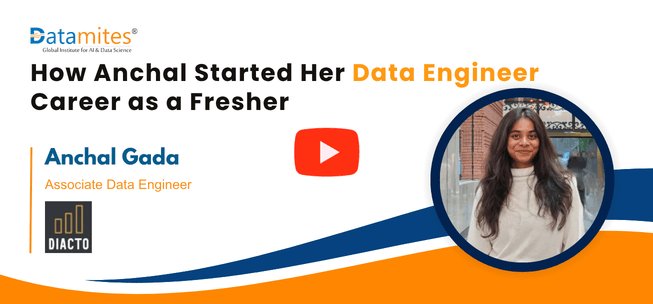
How Anchal Started Her Data Engineer Career as a Fresher
Discover how Anchal started her data engineering career as a fresher, built practical skills, gained industry experience, and secured her first opportunity in the data field.
 Prerana B A
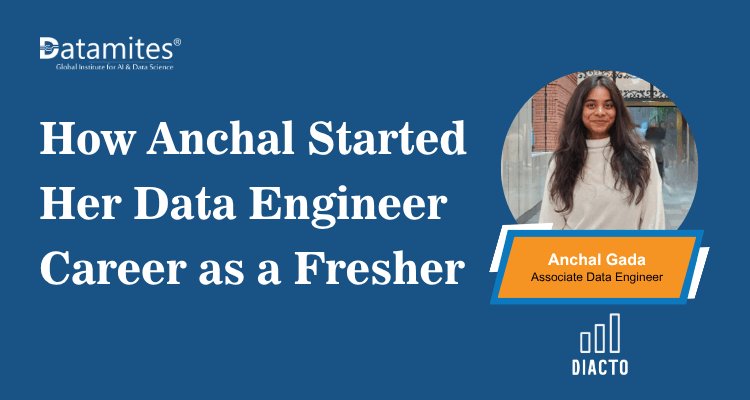
Starting a career in data can be a major step for a fresher. Anchal, a Computer Science graduate, developed an interest in data and wanted to build her career in the field. She joined a Data Science course to strengthen her skills in Python, SQL, statistics, machine learning, and practical projects.
As part of her DataMites Success Story, Anchal shares how practical learning, project experience, and consistent interview preparation helped her begin her career. After completing four capstone projects and one client project and clearing her mock interview, she attended her first client interview and was selected by Diacto Technologies as a Trainee Associate Data Engineer.
Anchal’s Journey to Becoming a Data Engineer as a Fresher
Anchal’s journey to becoming a Data Engineer began with her interest in data and problem-solving. Through learning Python, SQL, machine learning, and practical projects, she built the skills and confidence needed to begin her career as a fresher.
Q1. How did you start your journey in the data field?
I completed my Bachelor’s degree in Computer Science. After graduation, I was quite clear that I wanted to build my career in the data field, so I decided to join DataMites. I was interested in working with data and understanding how it could be used to solve real-world problems, so I wanted to explore the field seriously and develop the skills required for a career in data.
Q2. What made you interested in data science and data engineering?
I was always interested in working with data and understanding how data can be used to solve real-world problems. I was also good at Python, so I decided to explore this field seriously. This interest in data and my existing knowledge of Python encouraged me to join the course and start building my skills in data science.
Q3. Which course did you pursue at DataMites?
I enrolled in the Data Science course at DataMites. During the course, I learned Python, SQL, machine learning concepts, Pandas, and other important topics. I also worked on different projects, which gave me practical exposure and helped me understand how the concepts I learned could be applied.
Q4. How important was practical learning during your training?
Practical learning was very important for me because I believe that just learning concepts is not enough. Initially, I was mainly focused on learning, but later I understood that practising was equally important. Working with datasets, cleaning data, analysing them, writing SQL queries, and regularly applying the concepts helped me improve my technical understanding.
Q5. How did you approach your daily learning and practice?
I did not follow a particular fixed amount of time every day. Instead, I focused on making practice a regular part of my learning. I believe that picking datasets, cleaning them, working on them, and practising SQL regularly is more important than simply spending a fixed number of hours listening to lessons or studying concepts.
Q6. How many projects did you complete during your training?
I completed five projects in total, including four capstone projects and one client project. These projects gave me practical exposure and helped me apply the concepts I learned during the course. Working on projects also helped me understand different technologies and gave me experience that was useful during my interview preparation.
Q7. Could you tell us about your client project?
One of my main projects was the client project, where I worked with different machine learning models. Through this project, I gained a better understanding of machine learning, particularly concepts related to model performance and accuracy. The experience helped me strengthen my knowledge and gave me practical exposure to working with machine learning.
Q8. How did the mock interview help you prepare for the actual interview?
I cleared my mock interview on my second attempt. The mock interview included both a technical part and a coding part, and I found it somewhat similar to the actual client interview. It helped me understand what to expect during an interview and gave me more confidence when preparing for the actual opportunity.
Q9. How did the DataMites team support you after the mock interview?
The DataMites team helped me a lot, especially with resume creation and soft skills. They also conducted sessions through Zoom, which helped me understand how to communicate and present myself better. This support was useful during the time between clearing the mock interview and attending the client interview.
Q10. What resources did you use to prepare for your interviews?
I mainly used the DataMites LMS portal for my preparation. For SQL practice, I used HackerRank. These resources helped me revise the Data Science concepts I had learned and practise the technical skills required for the interview. Regular practice helped me become more comfortable with SQL and Python-related questions.
Q11. How many client interviews did you attend before getting selected?
This was actually my first client interview, and I got selected. The interview process consisted of three rounds, which included an assessment, an AI interview, and a technical interview. Successfully clearing these rounds resulted in my selection as a trainee associate data engineer.
Q12. What kind of questions were asked during the client interview?
The assessment included two coding questions along with multiple-choice questions. The AI interview included questions mainly related to SQL and Python. The technical interview focused more on my projects, and I was also asked to write SQL and Python code. So, both technical knowledge and practical understanding were important throughout the interview process.
Q13. What skills do you think interviewers look for in data-related candidates?
I think practical knowledge and SQL skills are very important for data-related fields. Problem-solving ability is also important. Interviewers also want to see whether candidates can explain their projects properly and whether they genuinely understand the technologies they have used. Being able to explain your project clearly and demonstrate your knowledge can make a difference during a technical interview.
Q14. What advice would you give to learners preparing for a career in data science or data engineering?
I would advise learners to focus strongly on practice. Pick a dataset and work on it from beginning to end, including performing a complete ETL process and developing end-to-end projects. Rather than only listening to a course or attending classes, learners should apply what they learn through practical work. Regular practice with datasets, SQL, Python, and projects can help build stronger technical skills and confidence.
Q15. What was your overall experience at DataMites?
My overall experience at DataMites was very good. The placement team supported me throughout my journey, especially whenever I needed guidance. Their timely responses and support made my learning and placement experience positive.
Refer to these articles :
- Chandana’s Journey from Fresher to Data Engineer
- Subham’s Journey from Fresher to Becoming a Data Engineer
- From Fresher to Data Engineer: Arpitha's Inspiring Journey
Key Takeaways from Anchal’s Journey
Anchal’s journey offers useful insights for freshers aspiring to build a career in data engineering. Her experience highlights the importance of technical skills, practical projects, regular practice, and focused interview preparation.
- Computer Science Graduate: Anchal completed her Bachelor’s degree in Computer Science before entering the data field.
- Interest in Data: Her interest in data and solving real-world problems motivated her to pursue data science.
- Technical Skills: She developed skills in Python, SQL, data analysis, statistics, machine learning, and Pandas.
- Practical Projects: She completed five projects, including four capstone projects and one client project.
- Regular Practice: She emphasised practising with datasets, data cleaning, and SQL rather than focusing only on theoretical learning.
- Interview Preparation: She used the DataMites LMS portal and HackerRank to prepare for interviews.
- Mock Interview: She cleared her mock interview on her second attempt, which helped build her interview confidence.
- Interview Process: Her first client interview included an assessment, AI interview, and technical interview.
- Important Skills: She highlighted practical knowledge, SQL, problem-solving, and strong project understanding as important interview skills.
- Career Achievement: Anchal successfully started her career as a Trainee Associate Data Engineer at Diacto Technologies.
Refer to these articles :
- Your Roadmap to Becoming a Data Science Architect
- The Ultimate Guide to Data Science Models
- Top 10 Data Mining Tools Every Data Scientist Should Know in 2025
Anchal’s journey shows how a fresher can move from a Computer Science background toward data engineering by building technical skills and gaining practical experience. She developed knowledge of Python, SQL, machine learning, and data analysis while working on datasets and projects. Her experience also highlights the importance of understanding projects thoroughly and preparing consistently for technical interviews. She advises aspiring learners to focus on practical, end-to-end learning rather than only studying concepts.
The growing demand for data-driven technologies is creating opportunities for professionals with relevant technical skills. According to Grand View Research, the global data science platform market was valued at USD 96.25 billion in 2023 and is projected to reach USD 470.92 billion by 2030, growing at a 26.0% CAGR. Exploring top IT courses in Bangalore can help learners develop skills relevant to this evolving field.
During her learning journey at DataMites, Anchal used LMS resources, self-learning, mock interviews, and placement support to strengthen her technical and professional skills. Through practical training, project-based learning, and globally recognized IABAC® and NASSCOM FutureSkills® certifications, she developed the skills and confidence needed to approach career opportunities. Her experience demonstrates how regular practice and focused preparation can help freshers build a strong foundation for a career in the data field. Learners exploring a Data Science institute in Bangalore can consider practical training and project-based learning as part of their skill-building journey.
For freshers and aspiring data professionals, DataMites Institute offers structured learning through online programs and 50+ offline centres. It provides data science courses in Pune and learning opportunities across Chennai, Hyderabad, Mumbai, Coimbatore, Ahmedabad, Kolkata, Noida, Indore, Jaipur, Chandigarh, Kochi, Nagpur, and Bhubaneswar. DataMites has also received the Best Skill Development EdTech award for its contribution to career-focused education, while its learning programs include mentorship, projects, internship opportunities, and interview preparation.