How to Stay Competitive in the HR Job Market by Learning AI
Learn how AI skills can help HR professionals stay competitive in the job market by improving recruitment, workforce planning, employee engagement, and data-driven decision-making while preparing for the future of HR.
 Prerana B A
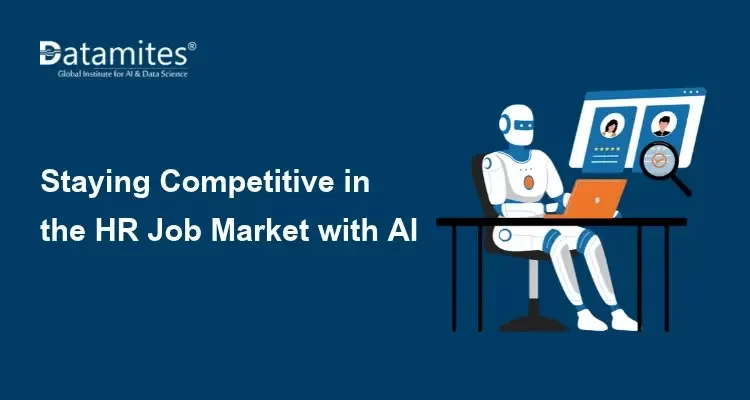
Human Resources is evolving as organizations adopt digital technologies to manage recruitment, employee engagement, performance, and workforce planning. Traditional HR knowledge remains important, but professionals are increasingly expected to understand how technology can improve everyday HR activities.
Developing AI skills for HR professionals can help individuals adapt to these changes, improve productivity, and make better use of workforce information. From creating job descriptions with generative AI to analysing employee data, artificial intelligence is becoming a useful part of modern HR operations.
HR professionals do not need to become programmers or AI engineers. However, understanding AI tools for HR, data analysis and automation can help them strengthen their existing expertise and remain competitive in the changing job market.
Why AI Skills Are Becoming Important in the HR Job Market
AI in HR is changing how organizations manage several important functions. Recruitment teams can use AI-powered systems to organize applications, while HR managers can analyse employee feedback and identify workforce trends more efficiently.
According to SHRM's 2026 State of AI in HR research, only 39% of organizations have implemented AI in their HR functions. Recruitment, HR technology, and learning and development are among the areas seeing adoption. This indicates that AI adoption is growing, while opportunities remain for HR professionals to develop relevant skills.
The World Economic Forum's Future of Jobs Report also estimates that 39% of workers' core skills will change by 2030. AI, big data and technological literacy are among the skills expected to become increasingly important.
These developments make technology awareness valuable across recruitment, employee engagement, performance management, learning and development, and workforce planning.
Essential AI Skills HR Professionals Should Learn
Building the right combination of technical knowledge and HR expertise can help professionals work more effectively. The following AI skills are useful starting points.
Generative AI and Prompt Engineering
Generative AI tools can create and summarize content based on instructions. HR professionals can use them to draft job descriptions, prepare interview questions, summarize HR policies, and write employee communications.
Prompt engineering involves giving clear instructions to AI tools for HR to obtain relevant results. For example, a recruiter can ask an AI assistant to prepare interview questions based on a job description and required competencies.
People Analytics and Data Analysis
People analytics involves using employee data to understand workforce performance, engagement, retention and productivity. Learning Excel, data visualization, and basic statistical concepts can help HR teams identify patterns and make informed decisions.
For example, an HR manager can analyse employee survey results to understand satisfaction levels across departments and identify areas that need attention.
AI-Powered Recruitment Tools
Recruitment technology helps HR teams manage applications, organize candidate information, and support resume screening. Understanding applicant tracking systems (ATS), candidate matching and recruitment automation can improve hiring workflows.
However, AI-generated candidate recommendations should be reviewed by recruiters to ensure that qualified applicants are not overlooked.
HR Automation
HR automation uses technology to reduce repetitive administrative work. AI-powered tools can assist with onboarding documentation, employee queries, leave-related information and routine HR communications.
For instance, an HR team can use an AI-enabled chatbot to answer common questions about company policies while directing complex employee concerns to the appropriate HR representative.
Predictive Analytics
Predictive analytics uses historical data and statistical models to estimate possible future outcomes. HR professionals can use it to examine employee turnover patterns, workforce requirements and potential skill gaps.
For example, analyzing historical attrition data may help HR managers identify departments experiencing higher employee turnover and investigate the reasons.
Responsible AI and Data Privacy
HR professionals regularly work with confidential employee information. Understanding data privacy, algorithmic bias, transparency and responsible AI practices is therefore essential.
AI should support HR decisions rather than independently determine hiring, promotions or performance outcomes. Human review and appropriate data protection practices must remain part of the process.
Refer to these articles:
- How HR Professionals Can Use Generative AI at Work
- How AI Is Improving Early Disease Detection and Diagnosis
- AI Marketing Workflows and Automation
How Learning AI Can Help HR Professionals Stay Competitive
Learning AI can help HR professionals strengthen their existing capabilities and adapt to changing workplace expectations.
Some important benefits include:
- Improved productivity: Automating repetitive tasks gives HR teams more time for employee support and strategic activities.
- Better decision-making: People analytics helps professionals understand workforce patterns and make data-informed decisions.
- Efficient recruitment: AI-supported recruitment tools can simplify application management and candidate communication.
- Stronger workforce planning: Data analysis and predictive techniques help HR teams identify potential workforce challenges.
- Career development: Technology knowledge can support transitions into people analytics, HR technology and workforce planning roles.
Microsoft's Work Trend Index findings for India reported that 93% of surveyed business leaders intended to use AI agents to extend workforce capabilities over the following 12–18 months. This reflects growing organizational interest in AI-supported work and the importance of developing relevant skills.
How Can HR Professionals Start Learning AI?
HR professionals can develop AI knowledge gradually without needing an advanced technical background. A practical learning roadmap includes:
- Understand AI fundamentals: Learn basic concepts such as artificial intelligence, machine learning, generative AI and automation.
- Explore generative AI tools: Practise using AI assistants for job descriptions, interview preparation and employee communication.
- Develop data analysis skills: Learn Excel, basic statistics and data visualization to interpret workforce information.
- Understand people analytics: Explore HR metrics such as employee turnover, retention, engagement and recruitment efficiency.
- Practise with AI tools for HR: Experiment with recruitment platforms, HR chatbots and employee feedback analysis using approved tools.
- Work on practical projects: Create an AI-assisted recruitment workflow or build a dashboard to analyse employee engagement data.
- Consider relevant training: Pursue AI training for HR professionals or certifications that cover practical applications, analytics and responsible AI.
Working on practical HR projects can help learners understand how these technologies fit into actual workplace responsibilities.
Refer to these articles:
- Top AI Trends That Will Shape 2026
- What Are Graph Neural Networks?
- What is Artificial Narrow Intelligence?
Future Career Opportunities for HR Professionals With AI Skills
Combining HR knowledge with AI and analytical capabilities can help professionals explore additional career paths. Some relevant opportunities include:
- People Analytics Specialist: Studies workforce data to identify employee trends and support HR decisions.
- HR Analytics Professional: Uses reporting and data analysis to evaluate HR performance.
- HR Technology Specialist: Supports the implementation and management of digital HR systems.
- AI-enabled Talent Acquisition Specialist: Uses recruitment technology to improve hiring workflows.
- HR Automation Specialist: Identifies opportunities to automate repetitive HR processes.
- Workforce Planning Analyst: Analyses workforce requirements, skill gaps and staffing trends.
- People Analytics Consultant: Helps organizations use workforce information to address HR challenges.
These roles have different qualification and technical requirements. Some focus mainly on HR operations and analytics, while advanced AI engineering positions require programming, mathematics and deeper technical expertise.
The future of AI in HR will involve a combination of human expertise, digital tools, and data-informed decisions. Developing AI skills for HR professionals can help individuals improve their everyday work, understand workforce trends and adapt to evolving organizational requirements.
HR professionals do not need to become AI engineers to benefit from these developments. Learning generative AI, people analytics, automation and responsible AI can strengthen existing HR capabilities and support long-term career growth. Continuous learning and practical experience will be important for staying competitive in the evolving HR job market.
DataMites Institute offers an industry-oriented AI for HR and People Analytics course designed to help HR professionals use artificial intelligence for workforce planning and data-driven decision-making. The program covers key areas such as AI fundamentals, people analytics, talent acquisition, employee engagement, performance management, and workforce planning. Explore the AI for human resource online courses offered by DataMites, along with specialized AI training programs in healthcare, finance, marketing, and product management.
The program offers flexible learning formats, including online classes, classroom training, and project-based internships. Learners can also pursue IABAC-accredited certification and the Certified AI Professional in People Analytics certification. With more than 50 offline centres across India, including Bangalore, Chennai, Hyderabad, Pune, Mumbai, Ahmedabad, Coimbatore, and Delhi, DataMites provides learning opportunities for professionals looking to build their knowledge of AI and people analytics.