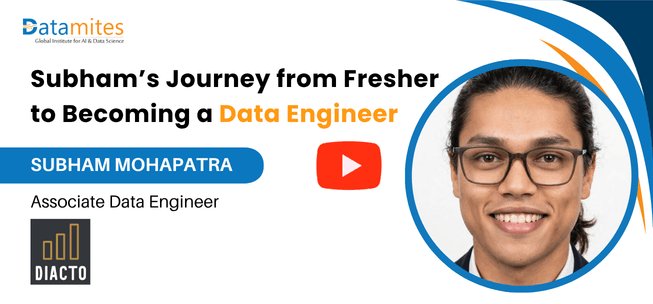
Subham’s Journey from Fresher to Becoming a Data Engineer
Explore Subham’s journey from a fresher to a Data Engineer, highlighting his learning experience, skill development, practical projects, and career growth with DataMites.
 Prerana B A
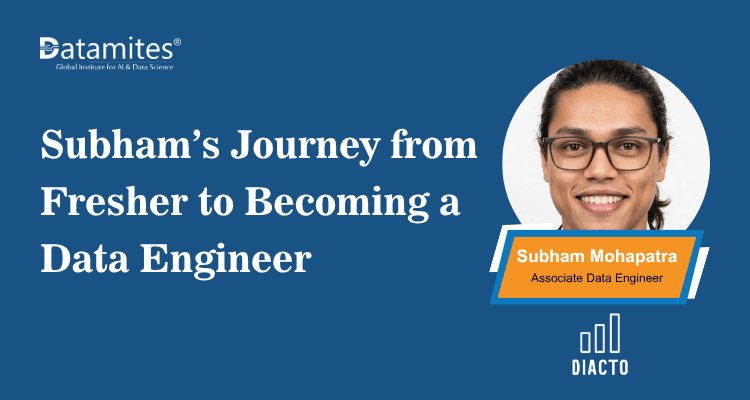
Starting a career in data engineering can be challenging, especially for learners who are trying to understand which technical skills to develop and how to prepare for interviews. For Subham Mohapatra, the goal was to build practical knowledge in data engineering while also getting guidance to enter the industry.
After researching different learning options, Subham joined DataMites to build his data engineering skills and prepare for job opportunities. Through projects, technical learning, mock interviews, and resume guidance, he secured a position as an Associate Data Engineer at Diacto Technologies. In this DataMites Success Story, Subham shares his learning and interview experience.
Subham Mohapatra’s Journey from Fresher to Data Engineer
Subham Mohapatra’s journey shows how focused learning and practical projects can help a fresher build a career in data engineering. His experience highlights the importance of technical skills, mock interviews, resume guidance, and consistent preparation.
Q1. What inspired you to pursue a career in data engineering?
I was initially exploring machine learning and AI, but I found that many opportunities were asking for some experience. So, I started exploring data engineering as another area within the data field. I wanted to develop skills in both areas, but as I learned more about data engineering, I became more interested in it and decided to go deeper into the field.
Q2. When did you start your learning journey with DataMites?
I joined DataMites around November or December. Before joining, I researched different coaching and training institutes because I wanted to find a place where I could learn data engineering and also get placement-related support. After making several inquiries, I decided to join DataMites.
Q3. What were you looking for when choosing a data engineering course?
I was looking for a course where I could gain data engineering knowledge within a reasonable period and also get placement support. I researched different coaching and training institutes before deciding which option would suit my goals.
Q4. Why did you choose DataMites for your data engineering journey?
I made a lot of inquiries before joining DataMites. I wanted to learn data engineering and also have access to placement-related support. After understanding the course and the learning options, I decided to join DataMites.
Q5. What technologies and concepts did you learn during your course?
I started with the basics, including Python and SQL, and then moved into data engineering concepts. I also learned statistics, PySpark, big data, Hadoop, and MongoDB. The topics were covered module by module, starting from the fundamentals and moving toward more advanced concepts.
Q6. What kind of projects did you work on during your learning journey?
I worked on multiple projects. One was a basic SQL project related to data engineering, where I worked with Docker and SQL queries. Another project involved creating an ETL pipeline using medical data. I also wanted to make my projects more advanced, so I explored adding more technologies to make them stronger for my resume.
Q7. How many mock interviews did you attend at DataMites?
I attended two mock interviews. The first one was a learning experience, but I was not able to clear it. I then worked on improving myself and attended another mock interview. The experience helped me understand what to expect during technical interviews.
Q8. What did you learn from your first mock interview?
After the first mock interview, I wanted to understand where I had gone wrong. I contacted the team and received a detailed report explaining the areas where I needed improvement. This helped me understand my weak areas and work on them before my next opportunity.
Q9. How did the placement assistance team help you with your resume?
After completing my project and mock interview preparation, I was asked to share my resume. The team reviewed it and gave me suggestions about what should be added and what should be removed. I also had questions about how to mention my internship experience, and they guided me through it.
Q10. How did you prepare for the client interview?
My main focus was understanding my resume completely. I made sure I could clearly explain everything I had written. I also prepared for scenario-based questions and made sure I understood every technology mentioned in my resume. My end-to-end project was another important part of my preparation.
Q11. What was the interview process like?
After applying, I received an assignment covering Python, machine learning, and data engineering concepts. It included MCQs and questions where I had to explain concepts. After clearing that stage, there was an AI-based assignment where questions were asked based on my resume and data engineering knowledge. After that, I attended a technical interview with the reporting manager.
Q12. How did the guidance from DataMites help you during your placement preparation?
The guidance was helpful, especially through the resume reviews and mock interviews. When I had questions about my resume or internship experience, the team helped me understand how to present them. The detailed feedback after my first mock interview also helped me identify the areas where I needed to improve.
Q13. How would you describe your overall experience with DataMites?
My overall experience was very good. I was able to learn data engineering concepts, work on projects, participate in mock interviews, improve my resume, and receive placement opportunities. The guidance I received during the preparation process was useful for improving my interview readiness.
Q14. What advice would you give to learners who want to build a career in data engineering?
I would say that you need to keep trying. You may face rejection, but you should continue improving your resume, projects, and foundational skills. I would also recommend taking mock interviews as early as possible. If a good opportunity comes and you are not prepared, you may miss it. So, continuous preparation is very important.
Refer to these articles :
- How Rakshitha Successfully Transitioned Into Data Science
- Devadarsan’s Journey from Fresher to Data Scientist
- How Varun Built a Successful Career in Data Science
Key Findings from Subham Mohapatra’s Journey
Subham Mohapatra’s journey shows how practical learning, technical skills, and interview preparation can help freshers build a career in data engineering. His experience highlights the value of continuous improvement and persistence.
- Subham Mohapatra transitioned from exploring Machine Learning and AI to Data Engineering.
- He built skills in Python, SQL, PySpark, Hadoop, MongoDB, statistics, and big data.
- Practical projects helped him strengthen his technical knowledge and resume.
- Mock interviews helped him identify weaknesses and improve his interview preparation.
- Resume reviews provided guidance on presenting projects, technologies, and internship experience.
- His interview process included technical assignments, MCQs, an AI-based assessment, and a technical interview.
- Strong knowledge of his resume, projects, and technologies helped him prepare for the client interview.
- Consistent learning, project improvement, and interview preparation supported his career journey.
- He secured a position as an Associate Data Engineer at Diacto Technologies.
- His key advice to freshers is to keep learning, improve continuously, and not give up after rejection.
Subham Mohapatra’s journey demonstrates how continuous learning, practical projects, and interview preparation can help freshers enter the data engineering field. His experience highlights the importance of strong fundamentals, resume improvement, learning from feedback, and consistent preparation while exploring career opportunities.
Refer to these articles :
- How Generative AI is Changing the Role of Data Scientists
- Cross Entropy in Data Science: Concepts and Applications
- The Ultimate Guide to Data Science Models
Building a career in data engineering requires technical skills, practical experience, and continuous learning. Subham Mohapatra’s journey shows how structured training and hands-on projects supported his career path. According to Grand View Research, the global data science platform market was valued at USD 117.96 billion in 2024 and is projected to reach USD 470.92 billion by 2030, at a 26.0% CAGR. Exploring top IT courses can help learners build relevant skills and prepare for opportunities in the data industry.
Subham's journey from a fresher to an Associate Data Engineer highlights the importance of structured learning, hands-on projects, and continuous upskilling. Through DataMites' industry-focused training, he built expertise in Python, SQL, Machine Learning, Artificial Intelligence, and real-world project implementation. With mock interviews, internships, IABAC® and NASSCOM® FutureSkills certifications, and dedicated placement support, DataMites helps learners become industry-ready. Enrolling in a data science course in Hyderabad at DataMites can help aspiring professionals develop in-demand skills and explore rewarding career opportunities in the growing IT industry.
Whether you’re a fresher or an aspiring data professional like Subham, DataMites Institute offers structured learning opportunities designed to help learners develop practical, industry-relevant skills. With 50+ offline centres and online learning options, DataMites provides data science courses in Delhi along with learning opportunities in Chennai, Hyderabad, Pune, Mumbai, Coimbatore, Ahmedabad, Kolkata, Noida, Indore, Jaipur, Chandigarh, Kochi, Nagpur, and Bhubaneswar. DataMites has also received the Best Skill Development EdTech award, recognising its contribution to skill development and career-focused learning. Through hands-on projects, expert mentorship, internship opportunities, and interview preparation, learners can build relevant knowledge and practical skills for careers in data and technology.