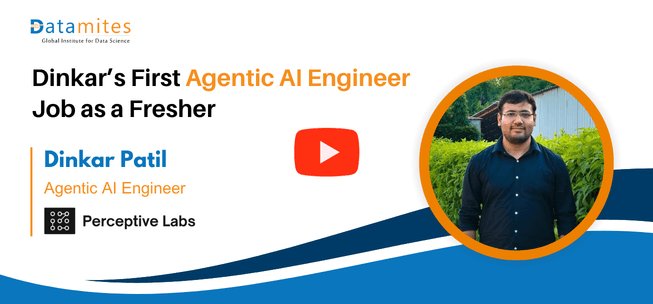
How Dinkar Cracked His First Agentic AI Engineer Job as a Fresher
Dinkar became an Agentic AI Engineer as a fresher by focusing on practical AI skills and hands-on projects. His journey proves that consistent learning and upskilling can lead to strong AI career opportunities even without experience.
 Priyanka BR
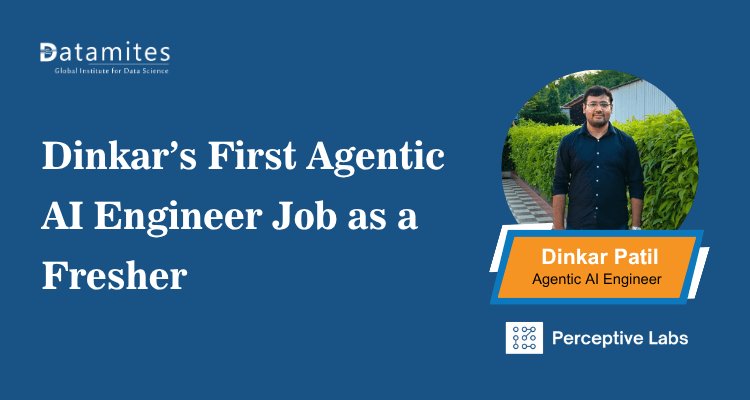
The Data Science and Artificial Intelligence industry is creating exciting career opportunities for learners from every background. Many students and professionals who once prepared for competitive exams or explored completely different career paths are now successfully building careers in AI and Machine Learning. One such inspiring example is Dinkar Patil, who transitioned from UPSC preparation into the field of Data Science and Artificial Intelligence after graduation.
During the conversation, he explained how he managed a four-year career gap, learned Python and Machine Learning from scratch, prepared for interviews, improved his coding skills, and finally secured a placement in an AI startup company. His journey highlights the importance of consistency, practical learning, mock interviews, and staying updated with current AI trends like NLP and Generative AI. Let’s see how his dedication and the right guidance helped him turn ambition into achievement.
How Dinkar Built His Artificial Intelligence Career with DataMites
Dinkar’s journey from UPSC preparation to building a career in Artificial Intelligence highlights the power of determination, continuous learning, and practical training. Despite facing a four-year career gap, he successfully transitioned into the field of AI through structured learning, hands-on project experience, mock interviews, and consistent practice at DataMites
1. Can you introduce yourself and share your background?
My name is Dinkar Patil. I graduated from the College of Engineering Pune. After graduation, I spent around four years preparing for the UPSC civil services examinations. Later, I decided to move into the AI and Data Science field and started learning technologies like Python, SQL, Machine Learning, Deep Learning, and NLP.
2. Why did you decide to move into AI and Data Science after UPSC preparation?
After spending several years preparing for UPSC, I eventually realized I needed to explore another career path. I did not want to stop learning or lose confidence because of setbacks. Data Science and AI were growing rapidly, and I felt this field had strong future opportunities, so I decided to start fresh in this domain.
3. Did you face difficulties because of the four-year career gap?
Yes, definitely. Most companies initially asked questions about my career gap. They wanted to understand why there was such a long break after graduation. To handle this, I supported my profile with certifications, projects, and technical training. I explained honestly about my UPSC preparation journey and showed them the skills I learned in AI.
4. How did you choose your AI and Data Science training institute?
I visited several institutes and attended multiple demo classes before making my decision. After attending the sessions at DataMites, I felt comfortable with the teaching methodology because the trainers explained concepts from the basics in a simple and practical manner. Since I came from a non coding background, this approach helped me learn Python, Machine Learning, and AI concepts confidently, and the placement support eventually helped me secure a role as an Agentic AI Engineer at Perceptive Labs.
5. What technologies did you learn during your AI journey?
I learned Python, SQL, Machine Learning, Deep Learning, and NLP basics. Along with theory, I also focused on practical implementation and project work because interviews usually test practical understanding.
6. Since you came from a non-coding background, was learning Python difficult?
Initially, it was challenging because my background was completely different from coding. However, the trainers explained concepts in very simple steps. We started with basics like running code, understanding notebooks, and writing simple programs. Daily practice helped me become comfortable with Python gradually.
7. How much time did you spend learning every day?
Apart from classes, I used to spend around two to three hours daily practicing concepts. Initially, most of my time went into understanding Python basics and improving my coding skills.
8. How did daily practice help you improve your skills?
Practice played a huge role in my learning process. We received daily assignments and coding questions to solve at home. Regular practice helped me understand concepts better and improved my confidence during interviews.
9. Did you use ChatGPT or online resources while preparing?
Yes, I used ChatGPT regularly for practice questions, doubts, and concept explanations. Nowadays, it helps clear many doubts quickly. I also referred to LinkedIn and Medium articles to stay updated with Machine Learning and AI trends.
10. What kind of interview questions were asked during placements?
Most interview questions were based on Machine Learning fundamentals. Interviewers asked about linear regression, logistic regression, classification problems, evaluation metrics, and handling imbalanced datasets. They mainly wanted to check conceptual clarity and understanding of algorithms.
11. Were coding rounds included in the interview process?
Yes. In one round, we had a case study discussion where we worked as a team on an inventory management system using QR codes. The company focused more on how we approached the problem, communicated with teammates, and explained our logic rather than only writing perfect code.
12. Did the interviewers allow the use of AI tools during the coding round?
Yes, they allowed us to use tools like ChatGPT. Their focus was mainly on problem-solving ability, teamwork, communication, and logical thinking.
13. Which topics do you feel are most important in today’s AI industry?
According to current industry trends, NLP and Generative Artificial Intelligence are extremely important. Many companies are now asking about Large Language Models and Generative AI concepts, so students should at least understand the fundamentals of these technologies.
14. How did mock interviews help you?
Mock interviews helped me understand my mistakes. Initially, I struggled with structuring answers properly. Later, I learned how to explain concepts clearly, include logic behind decisions, and communicate my thought process effectively during interviews.
15. Did you receive support for resume building?
Yes, I created an initial version of my resume and shared it with the placement team. They suggested improvements, helped restructure the resume, and guided me on presenting projects more effectively.
16. How many interviews did you attend before getting selected?
I attended around five to six interviews before getting selected. I believe this is a normal process because every interview teaches something new and improves confidence.
17. What are your career goals for the next five years?
In the next two to three years, I want to focus on learning real industry challenges and improving my technical skills. Later, I want to move into a senior AI Engineer role and eventually take leadership responsibilities where I can lead teams and solve complex business problems.
Refer to these articles:
- Explainable AI: Why Black-Box Models Are Losing Trust
- Traditional AI vs Generative AI: Key Differences, Examples, and Use Cases
- Learn about the Types of Machine Learning Algorithms
Dinkar’s Key Takeaways on Building a Career in AI
His journey highlights how consistency, practical learning, and the right guidance can help learners successfully transition into the field of Artificial Intelligence and Data Science.
- Background: Dinkar completed his graduation and spent four years preparing for UPSC examinations before moving into AI and Data Science.
- Career Transition: After his UPSC preparation journey, he decided to build a career in the growing field of Artificial Intelligence and Machine Learning.
- Training Choice: He joined DataMites after attending demo sessions and understanding the institute’s practical teaching approach.
- Learning Focus: His training included Python, SQL, Machine Learning, Deep Learning, NLP, and Generative AI basics.
- Coding Journey: Coming from a non-coding background, he improved his programming skills through daily practice and assignments.
- Mentorship Support: Trainers explained concepts from the basics, which helped him gradually gain confidence in coding and Artificial Intelligence concepts.
- Daily Practice: He dedicated around two to three hours daily for practice, revision, and improving technical skills.
- Use of AI Tools: He used ChatGPT, LinkedIn, and Medium articles to clear doubts and stay updated with AI trends.
- Interview Preparation: Mock interviews helped him improve answer structuring, communication skills, and technical explanations.
- Placement Support: The placement team supported him with resume building, interview preparation, and continuous job opportunities.
- Challenges Faced: Managing a four-year career gap and shifting into a new domain were difficult, but continuous learning helped him overcome them.
- Career Advice: Dinkar suggests focusing on practical learning, consistency, and staying updated with emerging AI technologies like NLP and LLMs.
Refer to these articles:
- How Khushi Became a Lead ML Engineer in the AI Industry
- From Fresher to ML Engineer: Ajay’s AI Career Journey
- Golla Anand’s Journey from Fresher to Python Developer
Dinkar’s journey shows that building a successful career in Artificial Intelligence is possible with consistency, practical learning, and the right mentorship. After spending four years preparing for UPSC examinations, he decided to transition into the AI field by enrolling in the Artificial Intelligence Course in Pune at DataMites. Through structured training, he learned Python, Machine Learning, NLP, and Generative AI concepts while improving his coding and problem-solving abilities through projects and mock interviews. Continuous practice and mentorship support helped him gain confidence and successfully begin his career in the AI industry.
DataMites Institute offers a structured 9-month Artificial Intelligence program designed to help learners build industry-ready skills through hands-on training, real-time tools, practical projects, and a strong understanding of ethical AI practices. The program provides multiple learning paths, including AI Engineer, AI Specialist, AI for Product Managers, AI Foundation, and Certified NLP Professional, allowing learners to choose a specialization based on their career goals. Supported by globally recognized certifications from IABAC and NASSCOM FutureSkills, the program helps learners gain practical expertise and confidence for real world AI roles.
With the rapid growth of Artificial Intelligence across industries, learners are actively seeking practical and career-focused training to build strong industry skills. DataMites Institute offers offline training programs through its Artificial Intelligence Courses in Ahmedabad, Coimbatore, Bangalore, Pune, Chennai, Mumbai, Hyderabad, and Delhi, providing structured classroom learning, hands-on projects, and real-world AI exposure to help learners become industry-ready professionals.