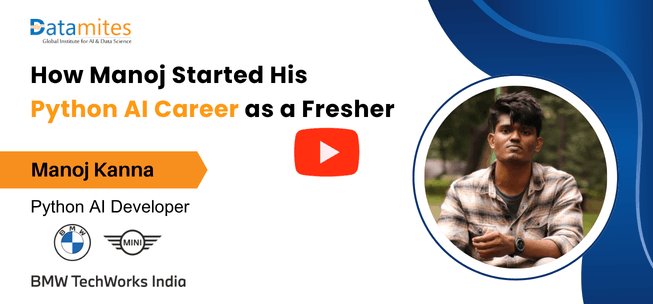
How Manoj Started His Python AI Developer Career as a Fresher
Starting a career in AI as a fresher requires the right Python skills, practical experience, and consistent learning. Manoj's journey highlights how focused preparation helped him secure his first role as a Python AI Developer.
 Priyanka BR
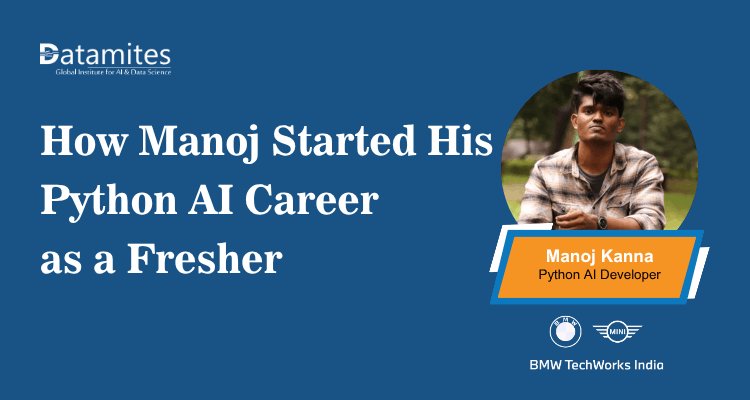
Have you ever wondered how someone from a mechanical engineering background can build a successful career in Artificial Intelligence? Meet Manoj, whose curiosity about AI during his final year of engineering inspired him to make a bold career transition. Instead of following a conventional path, he chose to learn new technologies, develop practical skills, and pursue his passion for Artificial Intelligence.
The journey wasn't easy. Coming from a non technical background, Manoj learned Python, Machine Learning, Deep Learning, and Computer Vision from scratch through consistent practice and real world projects. With structured training, hands-on learning, and placement support from DataMites, he built the skills and confidence needed for a successful AI career.
If you're planning to switch careers into Artificial Intelligence or wondering whether a non technical background can hold you back, Manoj's journey proves that consistency, practical learning, and the right guidance can open the door to exciting opportunities in the AI industry.
How Manoj Built His Artificial Intelligence Career with DataMites
Manoj's journey from a mechanical engineering graduate to an AI professional shows how determination, continuous learning, and the right guidance can lead to a successful career transition. Through DataMites' structured training, hands-on projects, and placement support, he built strong AI skills and launched his career in Artificial Intelligence.
1. Can you introduce yourself and tell us about your recent achievement?
I'm Manoj, and I recently got selected as a Python AI Developer at BMW Tech Works. I completed my graduation last year, and during my final year I started exploring Artificial Intelligence. After completing my learning journey and preparing consistently, I was able to crack the interview and secure this opportunity.
2. What made you interested in Artificial Intelligence?
During my final year, I participated in a hackathon where we built a project called "Enhancing Women Safety Through AI." That was my first exposure to Artificial Intelligence and Data Science. Since I come from a mechanical engineering background, everything was new to me, but it made me curious about how AI actually works and what it can achieve.
3. Why did you decide to switch from Mechanical Engineering to AI?
I had already received a job offer in the mechanical field during my third year, but after working on the AI hackathon and seeing the launch of ChatGPT, I became extremely curious about Artificial Intelligence. I wanted to understand how these technologies worked, and that curiosity motivated me to change my career path completely.
4. Why did you choose DataMites?
Before joining, I spent a lot of time researching different institutes. After comparing various options, I decided to join DataMites because I felt it offered strong foundational training in Python, Machine Learning, and Artificial Intelligence. I even moved from Tamil Nadu to Bangalore so I could attend classroom training.
5. What course did you join?
I enrolled in the Data Science Expert Program. After completing that, I realized I wanted to strengthen my AI knowledge even further, so I also joined the Artificial Intelligence course to learn Deep Learning, Computer Vision, NLP, CNNs, and Transformers.
6. How did DataMites help you build your foundation?
The institute helped me build strong fundamentals in Python, Machine Learning, and Data Science. Since I didn't know much about Python before joining, the trainers started from the basics and gradually covered advanced concepts, making it easier for someone from a non-technical background like me.
7. How many hours did you study every day?
I followed a strict schedule and studied for around six hours every single day. I believed consistency was more important than studying randomly, so I made sure I never broke my routine and continued learning daily.
8. Did you use any learning resources apart from your course?
Yes. Even after completing the classes, I regularly watched YouTube lectures, NPTEL courses, and long technical videos. I also read articles, followed AI updates, and used every reliable learning resource available to improve my understanding.
9. How did you stay updated with the latest AI developments?
I followed AI news daily by reading articles, watching news, and checking updates on Twitter. Since AI evolves rapidly, I made it a priority to stay updated with the latest trends.
10. How did you prepare your internship projects?
After completing my course, I visited the institute daily to work on my projects and cleared my doubts with the mentors. I focused on understanding every line of code instead of simply copying solutions.
11. What kind of projects did you include in your resume?
I made sure my resume included different types of projects, including Machine Learning, Computer Vision, and LLM-based projects. I also added projects that I built outside the course, such as semantic segmentation using U-Net and a medical chatbot based on Retrieval-Augmented Generation (RAG).
12. How was your interview at BMW Tech Works India?
The interview had three rounds. The first round was highly technical and focused on Python, Machine Learning, Computer Vision, and my projects. The second round focused more on understanding the real-world use cases of AI models. The final round was more like a discussion where they evaluated my personality, awareness, and overall thinking.
13. What Python questions were asked during the interview?
They asked me Python fundamentals like lists, tuples, dictionaries, DataFrames, and Series. I was also asked to implement bubble sort, where I focused on explaining the logic rather than just writing the code.
14. What Machine Learning and AI questions were asked?
They asked me about classification and regression metrics, CNN evolution, RCNN, Faster RCNN, Transformer architecture, encoder and decoder blocks, and Computer Vision concepts, along with the purpose and evolution of these models.
15. How important were your projects during the interview?
The projects became one of the biggest discussion topics. I spent almost thirty minutes explaining my Computer Vision project and my RAG-based medical chatbot. Since I understood every line of code and every design decision, I was able to confidently answer all their questions.
16. How did the DataMites placement team help you?
The DataMites placement team guided me throughout the placement process by helping me improve my resume, conducting mock interviews, and providing valuable interview preparation and feedback. Their support gave me the confidence to perform well during the recruitment process.
17. What advice would you give to aspiring AI professionals?
My advice to aspiring AI professionals is to build strong fundamentals in Python, Machine Learning, and Artificial Intelligence. With the growing demand for IT courses and AI careers, focus on practical projects, keep learning consistently, and strengthen your basics to succeed in interviews and the industry.
Refer to these articles:
- Generative AI and Predictive AI: Key Differences Explained
- Guide to Artificial Intelligence Career
- Generative Adversarial Networks (GANs): How are GANs Transforming AI?
Manoj’s Key Takeaways on Building an AI Career
Manoj’s journey shows that consistent learning, practical experience, and strong fundamentals can help anyone successfully transition into the Artificial Intelligence field.
- Background: Manoj completed his Mechanical Engineering degree and developed an interest in AI after participating in an AI hackathon during his final year. This inspired him to pursue a career in Artificial Intelligence through DataMites.
- Skill Development: He strengthened his knowledge in Python, Machine Learning, Deep Learning, Computer Vision, NLP, CNNs, and Transformers to build a solid technical foundation.
- Learning Experience: The structured training at DataMites helped him understand Artificial Intelligence concepts step by step through classroom sessions, recorded lectures, and mentor guidance.
- Practical Approach: He completed several AI and Machine Learning projects, including a U Net segmentation model and a RAG based medical chatbot, while focusing on understanding every part of the implementation.
- Interview Preparation: He revised Python, Machine Learning, Computer Vision, and AI fundamentals daily while also keeping himself updated with the latest AI trends.
- Challenges Faced: Coming from a non technical background, learning programming was challenging at first, but consistent practice and regular revision helped him improve.
- Resume Building: With support from the DataMites Placement Team, he created a project focused resume that highlighted his practical AI and Machine Learning experience.
- Interview Experience: His interviews tested Python fundamentals, Machine Learning, Computer Vision, AI projects, Transformer models, and real world AI applications.
- Career Preparation Strategy: Manoj believes in following a daily study schedule, building projects, revising concepts regularly, and continuously learning beyond the classroom.
- Key Advice: Build strong fundamentals, work on practical projects, stay updated with AI developments, and remain consistent throughout your learning journey.
- Outcome Summary: Manoj’s experience proves that with DataMites' structured training, hands on projects, and continuous effort, learners from any academic background can build a successful career in Artificial Intelligence.
Refer to these articles:
- How Hemanth Entered the World of AI and Software Development
- How Lakshmi Secured Her First Python Developer Job as a Fresher
- How Surya Started His AI Developer Career as a Fresher
If Manoj’s career journey has inspired you to explore opportunities in Artificial Intelligence, the right industry-focused training can help you build a strong foundation. Manoj developed his AI skills with DataMites through structured learning, hands-on projects, continuous practice, and expert mentorship. If you're looking to begin a similar journey, you can explore the Artificial Intelligence Course in Bangalore offered by DataMites, with training centers in Kudlu Gate, Marathahalli, BTM Layout, and Rajajinagar, where learners gain practical experience and industry-relevant AI skills.
DataMites Institute provides a comprehensive 9-month Artificial Intelligence program designed to combine theoretical knowledge with extensive practical experience. Through live projects, industry-oriented assignments, and hands-on learning, participants develop the skills required for careers such as AI Engineer, Artificial Intelligence Specialist, and NLP Professional. The program also includes globally recognized certifications from IABAC and NASSCOM FutureSkills, equipping learners with the knowledge, credibility, and practical expertise needed to excel in the rapidly evolving AI industry.
With more than 30 training centers across India, DataMites makes quality Artificial Intelligence education accessible to learners nationwide. Aspiring AI professionals can enroll in Artificial Intelligence Courses in Chennai, Hyderabad, Bangalore, Mumbai, Coimbatore, Ahmedabad, Nagpur, and Delhi, where they gain practical exposure through live projects, hands-on learning, and guidance from experienced mentors to build job-ready AI skills.