AI Trends That Will Transform Marketing and Advertising
Discover the top AI trends transforming marketing and advertising in 2026. Learn how AI-driven personalization, predictive analytics, automation, and generative AI are helping businesses improve customer engagement, campaign performance, and ROI.
 Kriti Maurya
Businesses today are moving beyond traditional marketing strategies and embracing intelligent technologies to understand customers, automate campaigns, and improve decision-making. The rise of data-driven marketing has significantly increased the adoption of AI tools across industries, making AI one of the most influential forces in digital transformation.
The growing implementation of AI marketing trends is changing how brands interact with consumers, create campaigns, and measure performance. From personalized customer experiences to predictive analytics, AI technologies are helping businesses deliver more targeted and impactful advertising strategies.
The increasing adoption of AI-driven insights is fueling market growth. As reported by MarketsandMarkets, the global AI analytics market is forecast to rise from USD 13.5 billion in 2023 to USD 38.8 billion by 2028, reflecting a CAGR of 23.3%.
Here will explore the latest AI trends in marketing, the importance of AI for advertisers and brands, and the challenges businesses may face while adopting AI-driven strategies.
The Growing Demand of AI in Marketing and Advertising
The growing adoption of AI marketing trends is transforming the global marketing and advertising industry. Businesses are increasingly using AI-powered tools to automate campaigns, improve audience targeting, and enhance customer engagement. According to recent marketing reports, companies using predictive analytics in marketing experience higher conversion rates and improved ROI through data-driven decision-making.
The rise of predictive marketing and personalized advertising allows brands to deliver customized customer experiences based on browsing behavior, purchase history, and consumer preferences. Additionally, the growing impact of AI on advertising helps businesses optimize ad placements, automate bidding strategies, and improve campaign performance across digital platforms.
As digital competition increases, AI trends in marketing and AI trends in advertising are becoming essential for brands seeking scalable growth, customer retention, and long-term marketing success.
Read the below articles:
- How AI is Transforming Cybersecurity in 2026
- How AI Engineer Programs Develop Practical Skills for Career Advancement
- What is Artificial Narrow Intelligence
Top AI Marketing Trends in 2026
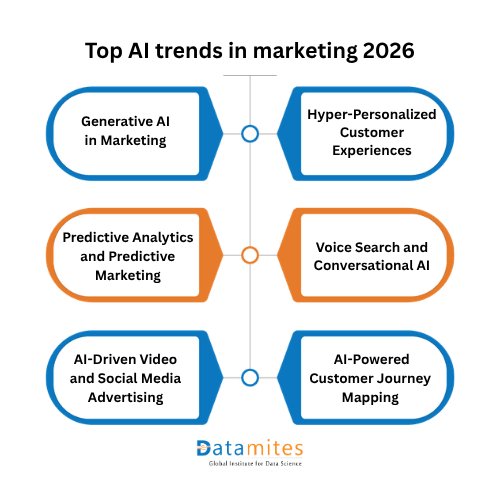
As businesses continue to embrace digital transformation, several emerging AI marketing trends are expected to reshape the future of branding, customer engagement, and advertising in 2026.
According to recent industry reports, AI adoption in marketing is projected to grow rapidly as brands prioritize data-driven decision-making and customer-centric strategies.
1. Generative AI in Marketing
One of the most significant AI trends in marketing is the rise of generative AI in marketing. Businesses are using AI tools to create blog content, ad copy, product descriptions, social media creatives, and personalized email campaigns at scale. This trend helps marketing teams improve productivity while maintaining consistent brand communication. Industry insights show that brands using generative AI can significantly reduce content creation time and improve campaign efficiency.
The HubSpot’s report found that 52% of marketers use generative AI for content creation, 50.7% use AI for email marketing, and 68% report positive ROI from AI-driven blog and long-form content strategies.
2. Hyper-Personalized Customer Experiences
AI-powered personalization is transforming customer engagement strategies. Through customer data analysis, brands can deliver personalized advertising based on user interests, browsing behavior, and purchase history. Streaming platforms, e-commerce companies, and online retailers are increasingly using AI recommendation engines to improve customer retention and conversion rates. Personalized experiences are becoming essential for businesses aiming to enhance customer satisfaction and loyalty.
3. Predictive Analytics and Predictive Marketing
The growing adoption of predictive analytics in marketing is helping businesses forecast AI for customer behavior and future market trends. AI-driven predictive models analyze historical data to identify high-converting audiences and optimize advertising campaigns. The rise of predictive marketing also enables brands to improve lead generation, customer retention, and budget allocation strategies. Reports suggest that predictive analytics can significantly improve marketing ROI by enabling more accurate targeting.
4. Voice Search and Conversational AI
Voice assistants and AI-powered chatbots are becoming critical components of modern marketing strategies. Businesses are optimizing content for voice search to improve online visibility and accessibility. Conversational AI tools provide real-time customer support, automate interactions, and enhance user experiences across websites and social media platforms.
5. AI-Driven Video and Social Media Advertising
Video content continues to dominate digital platforms, and AI is enhancing video marketing through audience analysis and automated optimization. Simultaneously, the growth of AI trends in advertising is transforming social media campaigns. AI algorithms help businesses optimize audience targeting, automate bidding, and improve engagement across platforms like Instagram, Facebook, LinkedIn, and YouTube.
6. AI-Powered Customer Journey Mapping
AI technologies are helping marketers analyze customer interactions across multiple touchpoints. This enables businesses to understand consumer behavior, identify engagement gaps, and create seamless omnichannel experiences. Advanced customer journey mapping is becoming a key strategy for improving brand engagement and long-term customer relationships.
Why AI Matters for Advertisers and Brands in 2026
Artificial Intelligence is transforming modern marketing by helping brands improve efficiency, customer engagement, and campaign performance. The growing adoption of ai trends in marketing enables businesses to automate email campaigns, customer segmentation, and ad optimization. AI-powered tools also support predictive analytics in marketing, helping companies analyze customer behavior and make faster, data-driven decisions for better marketing outcomes.
HubSpot research also revealed that AI is becoming central to modern marketing, with 67% of marketers believing AI will significantly transform marketing jobs and workflows by 2030.
The increasing impact of AI on advertising is improving audience targeting and boosting conversion rates through personalized advertising. Businesses can use generative AI in marketing to create customized content, optimize campaigns, and improve customer experiences across digital platforms. These advanced ai marketing trends allow advertisers and brands to increase ROI, strengthen customer relationships, and scale marketing operations effectively.
Challenges of Using AI in Marketing and Advertising
Despite its numerous benefits, AI adoption in marketing and advertising also presents several challenges that businesses must address carefully.
Data Privacy and Security Concerns
One of the biggest challenges associated with AI-driven marketing is data privacy. AI systems rely heavily on customer data to deliver personalized experiences and targeted advertisements. Businesses must ensure compliance with data protection regulations and maintain transparency in data collection practices.
Consumers are becoming increasingly concerned about how companies use their personal information. Failure to protect customer data can damage brand reputation and lead to legal consequences.
Lack of Human Creativity
Although AI can automate content creation and campaign optimization, it cannot fully replace human creativity and emotional intelligence. Marketing strategies still require human input to create authentic brand storytelling and emotional connections with audiences.
Overreliance on AI-generated content may lead to repetitive messaging and reduced originality. Businesses should combine AI capabilities with human creativity for balanced marketing strategies.
High Implementation Costs
Implementing AI technologies can be expensive, especially for small and medium-sized businesses. AI tools for marketing often require investments in software, infrastructure, training, and skilled professionals.
Organizations must also continuously update AI systems to keep up with evolving technologies and market trends. This can increase long-term operational costs.
Ethical Concerns and Bias
AI algorithms can sometimes produce biased outcomes if trained on incomplete or biased datasets. In marketing and advertising, this may result in unfair targeting practices or discriminatory advertising.
Businesses must regularly monitor AI systems to ensure ethical and unbiased decision-making. Transparent AI practices are essential for maintaining customer trust and brand credibility.
Skill Gap and Workforce Challenges
The increasing adoption of AI technologies has created a growing demand for professionals with expertise in AI, machine learning, data analytics, and digital marketing. Many organizations face challenges in finding skilled professionals capable of managing AI-powered marketing systems.
Companies must invest in employee training and upskilling programs to bridge the skill gap and maximize the benefits of AI technologiesfor AI marketing career.
Read the below articles:
- The 2026 Guide to Implementing AI in HR Analytics
- Popular AI Tools in Healthcare for 2026
- Who is an AI Product Manager Key Roles and Responsibility
Modern AI marketing trends, including generative AI in marketing and predictive analytics in marketing, help businesses improve customer engagement and campaign performance. AI trends in advertising enable brands to deliver personalized advertising experiences and optimize marketing strategies effectively. However, businesses must overcome challenges like data privacy, ethical concerns, and implementation costs. Companies that combine AI innovation with human creativity will achieve long-term success in the evolving digital marketing landscape.
DataMites Institute offers an industry-focused AI marketing course designed for professionals seeking expertise in AI-driven business strategy, marketing analytics, and decision-making. This industry-focused program features specialized tracks such as AI Product Management, AI for HR & People Analytics, AI for Finance, AI for Product Managers, AI for Healthcare, and Generative AI for Business Leaders.
Accredited by IABAC, the program includes flexible online and classroom learning, internship training, and specialized AI tracks. With centers in Bangalore, Hyderabad, Pune, Chennai, Ahmedabad, Mumbai, and Coimbatore, DataMites delivers career-oriented AI education across India.