From Fresher to Software Developer: Atharv's AI/ML Career Journey
Explore Atharv Patil's inspiring journey from a Computer Science fresher to a Software Developer in AI and Machine Learning. Discover how practical AI/ML training, real-world projects, and continuous skill development helped him build a successful career in the rapidly growing field of Artificial Intelligence.
 Priyanka BR
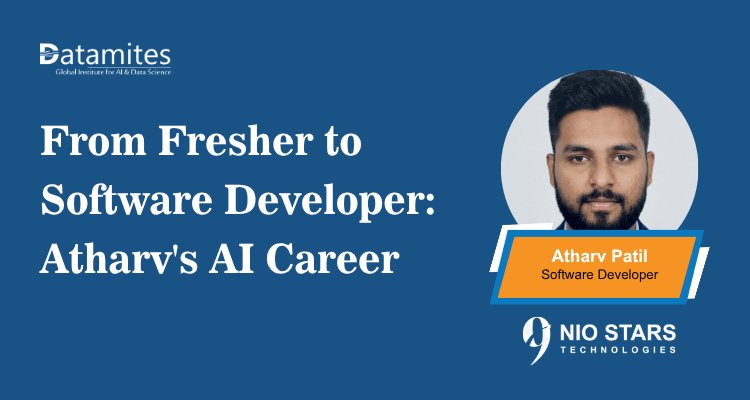
Have you ever wondered how a Computer Science graduate can build a successful career in Artificial Intelligence and Machine Learning? Meet Atharv Patil, who transformed his technical background and interest in AI into a professional journey by developing the right skills, gaining practical experience, and staying committed to continuous learning.
His journey involved exploring new AI concepts, strengthening his foundation, and moving beyond theory to understand real-world applications. From learning Machine Learning and Deep Learning concepts to building practical projects with technologies such as Computer Vision, RAG, and LangChain, Atharv focused on gaining hands-on experience that prepared him for industry challenges.
The turning point in his career was the structured, practical learning experience at DataMites, where he received the right guidance, worked on real-world projects, and developed the confidence to enter the AI/ML field. Atharv’s journey shows that with consistent effort, practical implementation, and the right mentorship, aspiring AI professionals can turn their career goals into reality.
How Atharv Started His AI/ML Career with DataMites
Atharv Patil’s journey from a Computer Science graduate to a Junior Software Developer (AI/ML) shows how practical learning and the right guidance helped him build a successful career in Artificial Intelligence and Machine Learning.
Q1. Can you introduce yourself and tell us about your current role?
My name is Atharv Patil, and I am working as a Junior Software Developer (AI/ML) at Nio Stars Technologies LLP. I specialize in Artificial Intelligence and Machine Learning. I completed my AI training through DataMites, which helped me build the skills and practical knowledge required to start my career in Artificial Intelligence.
Q2. What is your educational background?
I completed my Diploma in Computer Science, followed by a B.Tech in Computer Science. Although I already had programming knowledge, Artificial Intelligence was a completely new field for me. That's why I decided to pursue specialized AI training to build industry-relevant skills.
Q3. What are your day-to-day responsibilities as a Junior Software Developer?
Currently, I am learning how the company's internal systems work. My primary responsibility is understanding the organization's data flow and how AI solutions can eventually be integrated into existing processes.
Since I recently joined, my focus is on gaining domain knowledge before contributing to AI implementation projects.
Q4. Which AI topics did you focus on while preparing for interviews?
My primary focus was on Computer Vision, Deep Learning, YOLO Models, and practical AI applications.
These technologies were gaining significant attention in the Artificial Intelligence industry, so I concentrated on building projects that demonstrated practical implementation rather than only studying theoretical concepts.
Q5. Did you attend mock interviews before getting placed?
Due to my internships, I couldn't participate in many mock interviews. After completing my internship with Rubixe, I joined another US-based internship, which limited my availability. However, I stayed connected with the Placement Assistance Team and received guidance throughout my preparation journey.
Q6. Which AI projects did you include in your resume?
My resume included projects based on:
- Retrieval-Augmented Generation (RAG)
- LangChain
- Computer Vision
- YOLO-based Object Detection
These projects helped demonstrate practical AI implementation skills instead of just theoretical understanding.
Q7. Which programming language is more important for AI interviews: Python or SQL?
Both Python and SQL are important skills for an AI career, but if your goal is Artificial Intelligence or Machine Learning, Python deserves more focus because it forms the foundation of AI development. SQL is also valuable for managing and querying data, but having strong Python knowledge is essential for building AI solutions and working with ML frameworks.
Q8. How many interview rounds did you go through?
The hiring process consisted of two rounds: an HR Technical Interview and a CEO Interview. The HR round focused mainly on technical concepts, while the CEO round evaluated my projects, practical understanding, and problem-solving approach.
Q9. What technical questions were asked during the interview?
The interviewer asked questions on Python, SQL, Deep Learning, Convolutional Neural Networks (CNN), LangChain, MLflow, and AI fundamentals. The discussion lasted around 30 minutes and covered both theoretical concepts and practical implementation skills related to Artificial Intelligence and Machine Learning.
Q10. Which skills are most useful in your current AI role?
Although I am currently learning the company’s internal systems, I can already identify opportunities where technologies like RAG can improve workflows. Understanding business problems before selecting AI solutions is equally important as having knowledge of the latest Artificial Intelligence tools and technologies.
Q11. What advice would you give to freshers preparing for AI careers?
My advice is to focus on practical projects because theory helps clear interviews, but hands-on experience improves selection chances. Industry-focused IT Courses in Pune can help learners build strong technical skills. Working on projects also builds the confidence to explain AI solutions effectively during interviews.
Q12. How did the AI course help you build a strong foundation?
Before joining the AI course, I was unsure about where to begin, but the structured curriculum provided me with a clear roadmap covering the essential concepts required for an AI career. After building a strong foundation, I explored advanced topics independently and improved my practical skills through additional projects.
Q13. How did you prepare your GitHub profile and resume?
I uploaded my AI projects to GitHub to showcase my practical skills. I also used AI tools like ChatGPT to improve my resume, organize project details, and highlight my technical skills according to job requirements.
Q14. What is the biggest takeaway from your AI career journey?
The biggest lesson is that practical experience matters more than memorizing concepts. Building projects, understanding real-world problems, and continuously improving AI skills can help freshers confidently prepare for interviews and build successful AI careers.
Refer to these articles:
- Reinforcement Learning: Basics and Applications
- What is the Difference Between AI Engineer and AI Expert Course?
- What is an AI Agent? Guide to Intelligent Agents in AI
Atharv’s Key Takeaways on Building an AI/ML Career
Atharv’s journey highlights how practical learning, project-based experience, and continuous skill development can help freshers build a successful career in the Artificial Intelligence and Machine Learning field.
- Background: Atharv Patil completed his Computer Science education and decided to specialize in Artificial Intelligence and Machine Learning through DataMites training to build industry-relevant skills.
- Skill Development: He focused on strengthening important AI concepts such as Python, Deep Learning, Computer Vision, RAG, LangChain, and Machine Learning models, which helped him develop a strong technical foundation.
- Learning Experience: The structured AI training provided him with a clear roadmap and helped him understand complex concepts through guided learning, practical sessions, and hands-on implementation.
- Practical Approach: He worked on multiple AI projects based on RAG, LangChain, and YOLO models, which helped him understand real-world applications and confidently explain his solutions during interviews.
- Interview Preparation: Atharv focused on project implementation and technical concepts instead of only theory. His interview preparation covered Python, SQL, Deep Learning, CNN, MLflow, LangChain, and AI fundamentals.
- Challenges Faced: Since he was managing internships alongside preparation, he could not attend many mock interviews. However, he stayed connected with the Placement Assistance Team for guidance and continued improving his skills.
- Resume Building: He showcased his practical AI projects through GitHub and used Artificial Intelligence tools like ChatGPT to improve his resume structure, organize project details, and highlight relevant technical skills.
- Interview Experience: His selection process included an HR technical round and a CEO round. The HR discussion focused on technical concepts, while the CEO round evaluated his projects, problem-solving approach, and ability to apply AI solutions.
- Career Preparation Strategy: Atharv believes that freshers should focus on building practical projects because recruiters value candidates who can demonstrate real-world implementation of AI concepts.
- Key Advice: He recommends focusing on Python fundamentals, creating hands-on projects, understanding business problems, and continuously learning new AI technologies to succeed in the industry.
- Outcome Summary: Atharv’s journey shows that combining structured AI training, practical projects, and consistent learning can help aspiring professionals secure opportunities and grow as AI/ML engineers.
Refer to these articles:
- How Lakshmi Secured Her First Python Developer Job as a Fresher
- How Surya Started His AI Developer Career as a Fresher
- From Fresher to Python Developer: Amit’s Inspiring Career Journey
If Atharv’s career journey has inspired you to explore opportunities in Artificial Intelligence and Machine Learning, starting with the right industry-focused training can make a significant difference. Atharv built his AI skills with DataMites through structured learning, practical projects, and expert guidance. Learners who want to begin a similar AI career path can explore the Artificial Intelligence Course in Pune offered by DataMites, with training centers in Baner and Kharadi that provide hands-on learning and industry-relevant AI skills.
DataMites Institute offers a 9-month Artificial Intelligence program focused on hands-on training, real-world projects, and practical skill development. The course prepares learners for roles such as AI Engineer, AI Specialist, and NLP Professional while providing globally recognized certifications from IABAC and NASSCOM FutureSkills. It helps learners build the expertise and confidence needed for careers in Artificial Intelligence and emerging technologies.
With 30+ training locations across India, DataMites provides industry-focused Artificial Intelligence education for aspiring learners. Students can explore Artificial Intelligence Courses in Hyderabad, Bangalore, Chennai, Mumbai, Coimbatore, Ahmedabad, Nagpur, and Delhi with practical projects, hands-on training, and expert mentorship to build strong AI skills for career growth.