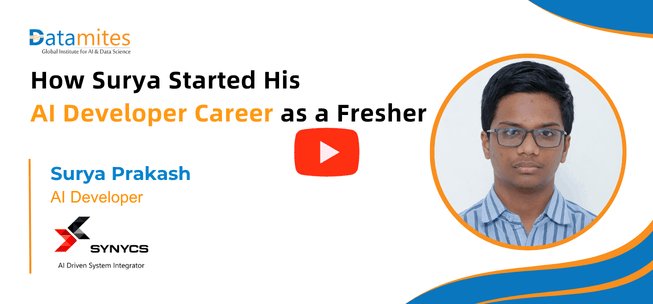
How Surya Started His AI Developer Career as a Fresher
Surya’s journey explains how a fresher from a non-IT background became an AI Developer through consistent learning, practical projects, and strong mentorship. It highlights how the right training and dedication can build a successful career in Artificial Intelligence.
 Priyanka BR
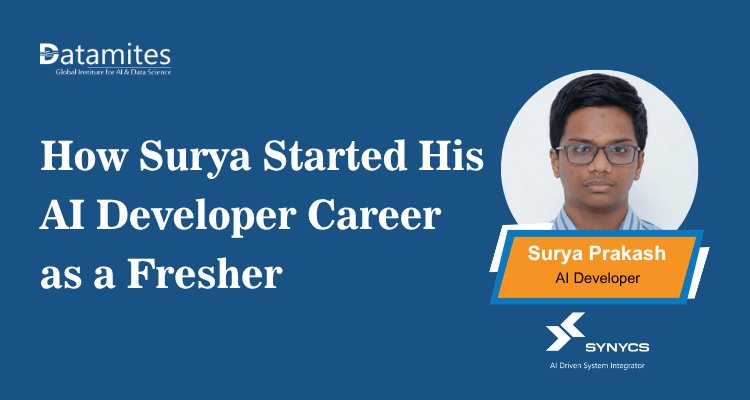
Have you ever wondered how someone from a Civil Engineering background can switch into an AI Developer role in today’s competitive tech world? Meet Surya, who turned his interest in data, problem-solving, and Artificial Intelligence into a growing career through the right guidance and training at DataMites, along with consistent effort.
His journey was not easy. From learning Python and machine learning basics to working on real projects, mock interviews, and an intensive boot camp, Surya proved that discipline and practice can overcome any limitations of background. The turning point was structured, hands-on learning at DataMites, which helped him build job-ready skills.
If you are dreaming of becoming an AI Developer as a fresher or from a non-technical background, Surya’s journey shows how it is possible. Let’s see how his effort, practice, and training at DataMites helped him turn ambition into success.
Surya’s Journey from Civil Engineering to AI Developer: Complete Q&A
This Q&A session highlights Surya's journey from a Civil Engineering background to becoming an AI Developer. He shares his learning experience, project work, internship exposure, mock interview preparation, boot camp experience, and the strategies that helped him successfully transition into the field of Artificial Intelligence.
Q1. Can you introduce yourself and share your recent achievements?
My name is Surya Prakash, and I recently got selected as an AI Developer at Synycs Group. Coming from a Civil Engineering background, I transitioned into AI and Data Science through consistent learning, hands-on project experience, and interview preparation.
Q2. What was your background before entering the AI field?
Before moving into AI, I was doing a Data Analytics internship. I did not have any full-time work experience at that time. The internship gave me some exposure to data-related work, but I wanted to build stronger technical skills and pursue a long-term career in Artificial Intelligence and Data Science.
Q3. What motivated you to move from Civil Engineering to Data Science and AI?
I have always enjoyed problem-solving and working with data. Data Science and AI matched my interests, and while I had learned some concepts on my own, I needed a structured learning path to build deeper knowledge and prepare for industry opportunities.
Q4. How did the hybrid learning mode help you?
The hybrid learning format gave me the flexibility to balance my personal commitments while studying at my own pace through a combination of online and offline learning.
Q5. How was your experience learning Python and Machine Learning?
The learning experience was smooth because the classes were practical and well-structured. Along with lectures, I received exercises and assignments that helped me gain hands-on experience, especially in Python.
Q6. What helped you learn technical concepts effectively?
Practice played the biggest role. After every class, I worked on exercises, solved problems, and revised concepts regularly. The tests conducted after each module also helped me evaluate my understanding and identify areas where I needed improvement.
Q7. Did you use any external learning resources?
Most of my learning came from the materials provided during training. The lecture recordings, practice files, assignments, and project resources were extensive and covered everything required for learning and project implementation.
Q8. What projects did you complete during your training?
I worked on three major projects. The first project focused on Data Analytics and helped me apply the concepts I had learned. The second project was based on SQL and involved solving multiple database-related problems. The third project was a live project where I worked as part of a team on a more complex problem that required advanced analysis and implementation.
Q9. How did the live project differ from the other projects?
The live project was more challenging as it involved real-world problem-solving, teamwork, and collaboration. It gave me valuable exposure to how projects are executed in an industry environment.
Q10. Did the projects help during your interviews?
Yes, the projects strengthened my resume and helped me answer interview questions confidently about the Artificial Intelligence tools, algorithms, and work I had done.
Q11. How important were mock interviews in your preparation?
Mock interviews were very helpful in my preparation. The feedback from my first attempt helped me improve, and after a month of focused preparation, I successfully cleared the second mock interview.
Q12. How did resume preparation support your job search?
Resume preparation was very helpful. I received valuable feedback on improving my resume and presenting my skills more effectively, which strengthened my professional profile.
Q13. How helpful were the soft skills sessions?
The soft skills sessions helped me improve my communication, interview preparation, resume building, and HR interview skills, making me more confident during interviews.
Q14. What was the interview process for your AI Developer role?
The selection process involved multiple stages, beginning with an introductory HR discussion. I then moved into a boot camp, driven by the growing demand for IT course in the industry, and finally went through a technical interview focused on my projects, tools, implementation approach, and technical decision-making.
Q15. What was your experience during the AI boot camp?
The boot camp was challenging because we had just five days to build a project from scratch. It involved coding, debugging, learning new tools, and presenting the project clearly during the final evaluation.
Q16. What skills were evaluated during the boot camp?
The evaluation assessed both technical and communication skills. We had to present our project, explain our approach, discuss the tools used, and confidently answer questions.
Q17. What advice would you give to freshers entering Data Science and AI?
My biggest advice is to stay consistent. Attend all classes, take notes, revise regularly, and practice as much as possible. Do not rely only on watching lectures. Solve problems, complete exercises, and actively test your understanding. The more hands-on practice you do, the more confident you will become.
Refer to these articles:
- Supervised vs. Unsupervised Learning: What’s the Difference?
- The Future of Coding: Can AI Replace Software Engineers?
- AI Sovereignty: The New Mandate for Data Governance in the Cloud Era
Surya’s Key Takeaways on Starting a Career in Artificial Intelligence
Surya’s journey from Civil Engineering to AI Developer shows how consistent effort, structured learning, and hands-on practice can help build a strong career in Artificial Intelligence.
- Background: I come from a Civil Engineering background and started my journey with an interest in data and analytics.
- Career Transition: I decided to move into AI because I was more interested in problem-solving and working with data.
- Structured Learning: Joining DataMites helped me get a clear learning path in AI and Machine Learning.
- Core Skills: I focused on building strong fundamentals in Python, Machine Learning, SQL, and data analysis.
- Practical Learning: Exercises and assignments after every class helped me understand concepts better.
- Project Experience: I worked on multiple projects including analytics, SQL-based tasks, and a live project.
- Live Project Learning: The live project helped me understand real-world problem-solving and teamwork.
- Mock Interviews: Mock interviews helped me identify mistakes and improve through feedback and practice.
- Soft Skills: Communication and interview preparation sessions helped me perform better in HR and technical rounds.
- Boot Camp Experience: The 5-day boot camp helped me build and present a complete AI project under pressure.
- Resume Improvement: Feedback sessions helped me present my skills and projects more effectively.
- Key Learning: Consistency, practice, and adaptability were the most important factors in my AI journey.
Refer to these articles:
- From Fresher to AI Engineer: Sagar’s AI Career Journey
- Karthikeyan’s Journey from B.Com Fresher to AI Engineer
- Golla Anand’s Journey from Fresher to Python Developer
Surya’s journey shows that building a successful career in Artificial Intelligence is possible with consistency, practical learning, and the right guidance. Coming from a Civil Engineering background, he decided to transition into the AI field by enrolling in the Artificial Intelligence Course in Hyderabad at DataMites. Through structured training, he learned Python, Machine Learning, SQL, and core AI concepts while improving his problem-solving skills through hands-on projects and mock interviews. Continuous practice, boot camp experience, and mentorship support helped him build confidence and successfully begin his career in the AI industry.
DataMites Institute offers a structured 9-month Artificial Intelligence program focused on building job-ready skills through hands-on training, real-world projects, and practical tools. It includes multiple paths like AI Engineer, AI Specialist, AI for Product Managers, AI Foundation, and Certified NLP Professional, allowing learners to choose based on their goals. With IABAC and NASSCOM FutureSkills certifications, the program helps learners gain practical knowledge, industry exposure, and confidence for real-world AI roles.
With the rapid expansion of Artificial Intelligence across various industries, learners are increasingly looking for practical and career-oriented training to develop strong job-ready skills. DataMites Institute delivers offline training programs through its Artificial Intelligence Courses in Chennai, Ahmedabad, Coimbatore, Bangalore, Pune, Mumbai, Hyderabad, and Delhi, offering structured classroom sessions, hands-on project experience, and real-world AI exposure to prepare learners for successful industry careers.