The Role of AI in Investment and Portfolio Analysis
Explore the role of AI in investment and portfolio analysis, including risk assessment, asset allocation, market trend prediction, and portfolio optimization. Discover how artificial intelligence helps investors make data-driven decisions, improve efficiency, and manage investment risks.
 Kriti Maurya
Artificial intelligence (AI) is transforming investment research and portfolio management by helping financial professionals analyze large datasets, identify potential risks, automate repetitive tasks, and evaluate investment scenarios. From machine learning and predictive analytics to natural language processing and generative AI, these technologies are expanding the analytical capabilities available to asset managers, financial analysts, wealth managers, and institutional investors.
However, AI does not eliminate investment uncertainty. Financial markets are influenced by economic shocks, investor behavior, geopolitical developments, and unexpected events that historical data may not capture. AI-generated forecasts can also be affected by data quality problems, model bias, and changing market conditions.
The most effective approach is therefore to combine AI-driven insights with established financial methods, validated models, human judgment, and appropriate risk controls.
How Does AI Work in Investment Analysis?
AI in investment analysis combines machine learning, statistical modeling, data processing, and language technologies to identify patterns in financial information and support investment decisions.
The process generally involves five stages.
1. Data collection
AI systems can process several categories of financial data, including:
- Historical stock prices, trading volumes, and market indices.
- Company financial statements, earnings reports, and valuation metrics.
- Interest rates, inflation figures, employment data, and other economic indicators.
- Financial news, earnings-call transcripts, and corporate announcements.
- Portfolio holdings, asset classifications, and risk exposures.
The usefulness of an AI model depends partly on whether these datasets are accurate, relevant, sufficiently representative, and appropriately updated.
2. Data cleaning and preparation
Financial datasets frequently contain missing values, inconsistent identifiers, duplicate records, and delayed prices. Before modeling begins, these problems must be identified and addressed.
For example, an incorrectly recorded share price could distort a return calculation, while inconsistent company identifiers could cause a model to associate financial information with the wrong security.
Data preparation should also account for survivorship bias, look-ahead bias, and other errors that can make historical investment strategies appear more successful than they would have been in practice.
3. Pattern recognition
Machine learning models can examine relationships between financial variables that may be difficult to identify through manual analysis alone.
A model might investigate how earnings growth, valuation ratios, interest rates, and sector performance have historically related to equity returns. It may also identify unusual changes in trading activity or unexpected portfolio exposures.
These relationships are useful research signals, not proof of a reliable investment opportunity. A pattern that existed in historical data may weaken or disappear when market conditions change.
4. Predictive analytics
Predictive models use historical and current information to estimate possible outcomes, such as volatility, credit deterioration, earnings trends, or asset-price movements.
Different techniques serve different purposes. Regression models can estimate relationships between variables, while tree-based models and neural networks can identify more complex patterns. Time-series models can help analyze observations recorded over time.
Model selection should depend on the financial problem, data availability, interpretability requirements, and the consequences of an incorrect prediction.
5. Decision support and human review
AI systems can present forecasts, risk indicators, summaries, and potential scenarios to investment professionals.
The final decision should consider the investor's objectives, time horizon, liquidity requirements, risk tolerance, transaction costs, tax implications, and applicable regulations.
For example, an AI system might flag a portfolio with unusually high exposure to interest-rate-sensitive securities. A portfolio manager can then examine the underlying positions and decide whether the exposure is consistent with the investment strategy.
Refer to the articles below:
- Top AI Product Manager Skills in 2026
- AI in Marketing Funnel Analysis for Effective Decision-Making
- Popular AI Tools in Healthcare for 2026
Key Applications of AI in Investment and Portfolio Analysis
AI supports several activities throughout the investment lifecycle, from research and security selection to portfolio construction and ongoing risk monitoring.
1. Predictive analytics for market trends
Predictive analytics in investment research uses historical data and statistical methods to estimate possible future outcomes with top AI trends in finance.
AI models may analyze:
- Historical returns and trading volumes.
- Earnings growth and valuation changes.
- Macroeconomic indicators.
- Market volatility and correlations.
- Financial news and company announcements.
These analyses can help investment teams develop scenarios, prioritize research, and identify changes that require further investigation.
However, forecasting financial markets is particularly challenging because asset prices reflect changing expectations, competition, policy decisions, and unexpected events. Predictive accuracy should therefore be measured using appropriate out-of-sample tests rather than historical fit alone.
2.AI-powered portfolio optimization
Portfolio optimization involves selecting asset weights that align with an investor's return objectives, risk tolerance, and practical constraints.
AI-assisted portfolio analysis can help compare allocation strategies, investigate nonlinear relationships, and identify potential concentration risks. These capabilities can complement established portfolio optimization methods.
For example, a portfolio manager may compare alternative allocations across equities, government bonds, corporate bonds, and other permitted investments. Each allocation can be assessed against expected return assumptions, volatility estimates, liquidity needs, and concentration limits.
One established framework is mean-variance optimization, which evaluates expected portfolio returns against estimated variance. However, its outputs can be sensitive to errors in expected returns and covariance estimates. AI does not automatically resolve these weaknesses.
3. AI-driven risk management
AI can support the monitoring of market risk, credit risk, liquidity risk, and portfolio concentration.
For example, a model may identify:
- Excessive exposure to a particular company, industry, or economic factor.
- Unexpected increases in portfolio volatility.
- Changes in correlations between assets.
- Deteriorating financial indicators among borrowers.
- Unusual transactions or inconsistencies in portfolio records.
AI-generated alerts should be investigated rather than treated as definitive evidence of a problem. Risk systems must also be evaluated for false positives and false negatives, since missed risks can be more consequential than unnecessary alerts.
4. Sentiment analysis and financial news processing
Natural language processing (NLP) enables AI systems to analyze unstructured text, including earnings-call transcripts, financial news, corporate announcements, and research reports.
Sentiment models can classify language as positive, negative, or neutral and identify topics such as revenue growth, management guidance, litigation, or regulatory developments.
However, financial sentiment is context-dependent. A negative statement may reflect an already anticipated event, while positive commentary may have little effect if investors expected better results. Sentiment analysis should therefore complement, rather than replace, fundamental and quantitative research.
5. Algorithmic trading
Algorithmic trading systems execute transactions according to programmed rules or model-generated signals.
AI can support signal generation, anomaly detection, and the analysis of market conditions. Depending on the strategy, automated systems may evaluate order-book information, trading volumes, price movements, and transaction costs.
Automation introduces additional risks, including execution errors, model failures, unexpected market behavior, and excessive trading. Appropriate safeguards include position limits, pre-trade checks, transaction monitoring, independent testing, and procedures for suspending a malfunctioning system.
6. Financial research and reporting
Generative AI can assist investment teams with document summarization, information extraction, report drafting, and research organization.
For example, an analyst may use an AI assistant to compare the latest earnings disclosures of several companies and prepare a summary of changes in revenue, margins, debt, and management guidance.
The extracted information should be checked against the original filings. Generative AI may omit qualifications, confuse reporting periods, or produce unsupported statements.
AI vs. Traditional Investment and Portfolio Analysis
Traditional investment analysis relies on financial statements, valuation techniques, statistical models, economic indicators, and professional judgment. AI extends these methods by helping professionals process information at scale and examine relationships across large datasets.
| Comparison factor | Traditional analysis | AI-assisted analysis |
| Data processing | Often involves manual review and established software | Can automate extraction and analysis across large datasets |
| Pattern recognition | Uses financial models and analyst interpretation | Can identify complex or nonlinear relationships |
| Forecasting | Relies on valuation, statistics, and professional judgment | Can incorporate machine learning and additional data sources |
| Risk monitoring | Often uses scheduled reviews and established risk models | Can support more frequent monitoring and anomaly detection |
| Explainability | Established models may have transparent assumptions | Some complex models are difficult to interpret |
| Adaptability | Changes may require manual model adjustments | Models can be retrained, subject to validation and governance |
| Limitations | Time requirements and potential human bias | Data problems, overfitting, model drift, and automation risks |
AI should not be viewed as a universal replacement for traditional investment analysis.
Fundamental research helps assess business quality and valuation. Established financial models provide structured methods for estimating risk and return. AI can enhance these activities by improving information processing and identifying signals that merit further investigation.
A combined approach is generally more defensible than relying on AI predictions alone.
The Future of AI in Investment and Portfolio Management
The future of AI in investment management will depend not only on model sophistication but also on data infrastructure, operational integration, transparency, and governance.
1. AI-assisted investment research
AI tools for finance can help analysts search financial documents, extract metrics, compare disclosures, and identify changes in company performance.
Integrated research systems may reduce the time required to locate information and allow analysts to focus more on interpretation and investment implications.
The key requirements will be source traceability, accurate data extraction, and the ability to distinguish verified facts from AI-generated interpretations.
2. Integrated portfolio and risk analytics
Investment teams often need to assess risk across asset classes, investment strategies, and AI-Driven Strategies for Finance.
Integrated analytical platforms can consolidate portfolio holdings, monitor exposures, and evaluate hypothetical economic shocks. AI may help detect unusual relationships or prioritize the risks that deserve closer examination.
The effectiveness of these systems depends on data consistency, model quality, realistic assumptions, and the relevance of their outputs to actual decisions.
3. Explainable and governed AI
Explainability is important because investment decisions can materially affect clients and financial institutions.
Where possible, investment teams should understand the key factors influencing a model's output, the limitations of its predictions, and the conditions under which its performance may deteriorate.
Responsible AI governance can include:
- Model documentation and independent validation.
- Monitoring for changes in performance and input data.
- Access controls and data-protection safeguards.
- Human approval for consequential decisions.
- Escalation procedures for unexpected results.
- Periodic reviews of whether a model remains fit for purpose.
Not every complex model can be explained fully. Where interpretability is limited, institutions should assess whether the model's benefits justify the additional oversight requirements.
4. Personalized wealth management
AI may help wealth management teams prepare portfolio reviews, organize client information, identify allocation mismatches, and explain financial concepts.
Personalized recommendations still require consideration of an individual's financial circumstances, objectives, investment horizon, risk tolerance, liquidity needs, and relevant legal obligations.
AI-generated recommendations should not bypass suitability assessments or professional responsibilities.
5. Data quality and anomaly detection
AI can also support investment operations by identifying unusual records and prioritizing data-quality exceptions.
In an article titled AI and the Future of Intelligent Investing, State Street described a data-validation example involving a rules-based process that reportedly flagged more than 31,000 exceptions over six months, of which 250 were true exceptions. The company reported that a neural-network model identified approximately 4,000 exceptions while detecting all the true exceptions in that dataset.
This example illustrates the potential to reduce unnecessary investigations while retaining meaningful alerts.
The reported results are specific to State Street's use case. They should not be treated as a general performance benchmark without examining the dataset, evaluation method, definitions of true exceptions, and independent validation.
6. Regulatory compliance and responsible AI in India
Financial institutions in India must consider the regulatory requirements applicable to their services, activities, and role of AI in Finance.
Relevant considerations may include securities-market regulation, data protection, information security, recordkeeping, model validation, and investor protection.
The Securities and Exchange Board of India (SEBI) has issued requirements concerning the use of artificial intelligence and machine learning by regulated entities. Applicable obligations depend on the relevant regulations, circulars, amendments, and circumstances.
Organizations should consult current official SEBI publications and obtain appropriate legal or compliance guidance before implementing AI in regulated investment activities.
Refer to the articles below:
- Why Choose a Career as AI Product Manager
- Best AI Platform for Finance Data Analysis
- The 2026 Guide to Implementing AI in HR Analytics
Real-World Examples of AI in Investment Management
Financial institutions provide useful examples of how AI and advanced analytics can be incorporated into research, portfolio workflows, risk management, and operational processes.
The following examples illustrate reported capabilities. They do not independently establish that AI produces superior investment returns.
1. JPMorganChase: AI-assisted investment workflows
JPMorganChase's annual report describes SpectrumIQ, a proprietary suite of AI capabilities integrated into its Spectrum platform to connect research, data, and risk information.
The company describes AI-assisted capabilities that support investment workflows, including research automation and access to analytical insights. Its reporting also discusses AI-assisted tools for advisers and wealth management activities.
The example illustrates how AI can be integrated into existing financial workflows rather than deployed only as a separate analytical application.
Key lessons:
- AI can help professionals retrieve and organize information more efficiently.
- Connecting research and risk information can support a more integrated analytical process.
- Investment professionals remain responsible for interpreting results and making appropriate decisions.
- Model accuracy, source verification, and governance are essential.
- Source to verify: JPMorganChase's official 2025 annual report. Confirm the exact product descriptions and claims against the published document before release.
2. BlackRock: Portfolio risk analytics through Aladdin
BlackRock's Aladdin platform provides investment management and risk analytics capabilities for institutions and investment professionals.
These capabilities can help users assess portfolio exposures, evaluate market scenarios, and understand how changes in financial variables may affect investments.
Advanced portfolio analytics can be particularly useful when a portfolio contains multiple asset classes, complex instruments, or overlapping exposures.
The important distinction is that portfolio analytics provide estimates based on data, assumptions, and models. They cannot eliminate uncertainty or guarantee that all risks will be identified.
Key lesson: AI and advanced analytics are most useful when they improve visibility into portfolio exposures and support disciplined risk-management decisions.
Source to verify: BlackRock's official Aladdin risk-management documentation. Avoid attributing a specific AI capability to the platform unless the source explicitly supports that claim.
3. State Street: AI-assisted data validation
State Street's reported data-validation example demonstrates an operational application of AI in financial services.
Traditional rules-based checks can generate large numbers of alerts, some of which may not represent genuine problems. Investigating every alert can consume significant staff time.
In the example described by State Street, a neural-network model reduced the number of flagged exceptions while identifying all true exceptions in the reported dataset.
This suggests that machine learning can help financial operations teams prioritize investigations and reduce unnecessary manual work.
However, fewer alerts do not necessarily mean better performance. A credible evaluation must also measure missed exceptions, test results against independently labeled examples, and monitor performance after deployment.
Key lesson: AI can improve operational efficiency when it is evaluated against clear, independently verified performance criteria.
How to Use AI to Evaluate Portfolio Risk
AI-assisted portfolio risk analysis combines portfolio data, established financial measures, scenario modeling, and anomaly detection to help investors understand potential vulnerabilities.
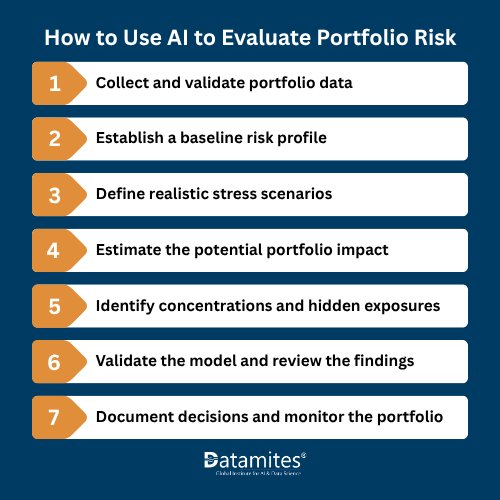
Consider a hypothetical portfolio containing equities and fixed-income investments. The portfolio manager wants to estimate how an equity-market decline and an increase in interest rates could affect the portfolio.
Step 1: Collect and validate portfolio data
Gather current holdings, market values, asset classifications, security prices, bond durations, and relevant risk measures.
Check for missing prices, duplicate positions, inconsistent identifiers, stale data, and incorrect classifications.
The analysis should use an appropriate valuation date and document the assumptions applied to missing or uncertain data.
Step 2: Establish a baseline risk profile
Calculate the portfolio's asset weights, sector concentrations, estimated volatility, and relevant risk exposures.
Several established risk measures are useful:
- Portfolio volatility: Measures the variability of portfolio returns. It is commonly estimated from historical returns and is sensitive to the selected observation period.
- Value at Risk (VaR): Estimates a loss threshold over a specified horizon and confidence level under a defined methodology. VaR does not describe how severe losses may become beyond that threshold.
- Conditional Value at Risk (CVaR): Estimates the average loss in the tail beyond a specified VaR threshold under the chosen methodology. It helps examine severe outcomes that VaR alone does not describe.
- Maximum drawdown: Measures the largest peak-to-trough decline over a specified period. It helps illustrate the magnitude of a historical loss but does not predict the next drawdown.
No single measure captures every portfolio risk. A combination of metrics and scenario analysis provides a more complete view.
Step 3: Define realistic stress scenarios
Suppose the portfolio manager wants to evaluate the following hypothetical conditions:
- Equity markets decline by 15%.
- Market interest rates rise by one percentage point.
- Credit spreads widen, affecting corporate bond valuations.
- These are illustrative stress assumptions, not forecasts.
AI can help organize relevant historical observations, identify sensitive holdings, and compare scenarios. The actual portfolio impact must be calculated using the holdings and appropriate valuation methods.
Step 4: Estimate the potential portfolio impact
For a simplified portfolio, scenario analysis can begin with a weighted combination of assumed asset returns.
The approximate portfolio return is:
Portfolio return = Sum of (Asset weight × Asset return)
For example, consider a hypothetical portfolio with 60% equities and 40% bonds.
Assume equities decline by 15% and bonds decline by 5% under a simplified scenario.
The illustrative portfolio return would be:
- Equity contribution: 60% × (−15%) = −9%.
- Bond contribution: 40% × (−5%) = −2%.
- Combined portfolio return: −9% + (−2%) = −11%.
This example assumes fixed portfolio weights at the start of the scenario and ignores rebalancing, fees, taxes, cash flows, and other effects. The assumed bond decline is illustrative; it is not a universal consequence of a one-percentage-point interest-rate increase.
In a real portfolio, the bond impact would depend on duration, convexity, credit spreads, coupon characteristics, and the instruments held. Equity and bond returns may also be affected by the same economic shock in different ways.
The calculation is therefore a simple stress illustration, not a prediction of actual investment performance.
Step 5: Identify concentrations and hidden exposures
AI-assisted tools can help investigate whether the portfolio is overly dependent on a small number of companies, sectors, economic factors, or sources of liquidity.
They can also flag changes in correlations or unexpected relationships between holdings.
These signals should be reviewed against the underlying positions. A model-generated alert is a reason to investigate, not proof that the portfolio is incorrectly positioned.
Step 6: Validate the model and review the findings
Before relying on AI-generated risk insights, investment teams should evaluate the model using appropriate historical and out-of-sample data.
Useful checks include:
- Comparing estimates with realized outcomes.
- Testing different market regimes and stress scenarios.
- Examining false positives and missed risks.
- Assessing sensitivity to assumptions and data quality problems.
- Monitoring changes in model performance over time.
A qualified investment professional should then determine whether any portfolio adjustment is appropriate.
Step 7: Document decisions and monitor the portfolio
Risk analysis should be repeatable and auditable.
Document the portfolio data used, the valuation date, scenario assumptions, model version, limitations, and the reasons for any subsequent decisions.
Ongoing monitoring can help identify changes in portfolio composition or market conditions that require the analysis to be updated.
Best Practices for Implementing AI in Investment Management
Organizations seeking to use AI in investment analysis should establish a structured implementation process.
1. Start with a clearly defined use case
Determine whether the objective is to improve research efficiency, detect data errors, monitor portfolio exposures, or evaluate risk scenarios.
A narrowly defined objective makes it easier to select appropriate models and measure their usefulness.
2. Use reliable and appropriately licensed data
Verify data accuracy, completeness, timeliness, and permitted use. Establish controls for confidential information and third-party data sources.
3. Establish measurable evaluation criteria
Measure performance using metrics relevant to the application. A risk-detection model may require precision, recall, and missed-event analysis, while a forecasting model may need out-of-sample error measurements and comparisons against simple benchmarks.
4. Maintain human oversight
Assign responsibility for reviewing consequential outputs, investigating unusual results, and approving actions that affect client portfolios.
5. Monitor models after deployment
Market conditions, input data, and investor behavior can change. Monitor for model drift, performance deterioration, and emerging failure modes.
6. Document limitations and governance
Maintain records of assumptions, model versions, testing results, approvals, and incidents. Ensure that the level of oversight reflects the risks associated with the system's intended use.
Limitations and Risks of AI in Investment Analysis
AI offers analytical advantages, but several limitations must be addressed.
- Poor data quality: Inaccurate or incomplete inputs can lead to misleading results.
- Overfitting: Models may perform well on historical data but fail on unseen observations.
- Changing market conditions: Relationships that previously existed between financial variables may weaken or reverse.
- Limited explainability: Complex models can make it difficult to understand why a particular output was generated.
- Operational and cybersecurity risks: Automated systems may introduce vulnerabilities through unauthorized access, software failures, or inappropriate handling of sensitive information.
- False confidence: Precise-looking forecasts can create an unjustified impression of certainty.
- Regulatory and ethical concerns: Financial institutions must consider applicable legal obligations, client interests, data protection, and accountability.
These risks do not make AI unsuitable for investment analysis. They demonstrate why model validation, transparent assumptions, and human oversight are necessary parts of implementation.
AI is expanding the capabilities available for investment research, portfolio optimization, financial reporting, and risk management. Machine learning can identify patterns in large datasets, natural language processing can organize unstructured financial information, and AI-assisted analytics can help professionals investigate portfolio vulnerabilities.
Refer to the articles below:
- AI Copilots vs AI Agents: How Are They Different
- How AI is Transforming Customer Analytics
- Top AI Trends That Will Shape 2026
However, the quality of an AI-driven investment process depends on more than the sophistication of its algorithms. Reliable data, appropriate financial models, realistic assumptions, independent validation, and human oversight remain essential.
For investment professionals, the most practical approach is to use AI as a decision-support capability that complements established financial analysis. When implemented responsibly, it can improve research efficiency and risk visibility while preserving accountability for investment decisions.
DataMites offers a comprehensive AI for Finance Course designed to help finance professionals leverage artificial intelligence for data-driven insights and informed decision-making. The program covers fundamental AI concepts, financial analytics, and practical applications such as risk assessment, fraud detection, investment analysis, and financial forecasting.
DataMites provides specialized programs in AI for Product Managers, AI for HR Analytics, AI in Healthcare, Business Leadership, and AI in Marketing. Learners can select flexible online or classroom training formats and gain practical exposure through case study-based internships. With certifications from IABAC, DataMites focuses on industry-relevant learning and practical skill development, offering training opportunities across major Indian cities, including Bangalore, Hyderabad, Pune, Chennai, Ahmedabad, Mumbai, Coimbatore, Delhi, Nagpur, and Kochi.