AI in HR Analytics vs Traditional HR Analytics: What’s the Difference?
Explore the key differences between AI in HR analytics and traditional HR analytics, including data analysis, workforce planning, employee performance, predictive insights, and how AI helps HR teams make smarter, data-driven decisions.
 Prerana B A
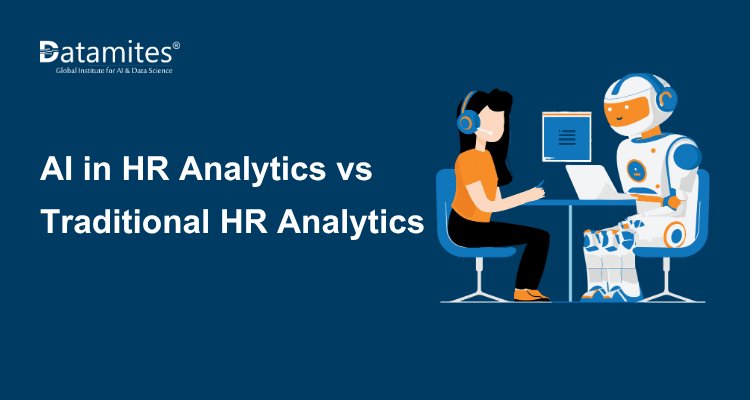
Human resources is becoming increasingly data-driven, with organizations using workforce data to improve recruitment, employee retention, and workforce planning. AI in HR analytics uses artificial intelligence to identify patterns, predict potential workforce outcomes, and support decision-making, while traditional HR analytics focuses on historical reports, established metrics, and statistical analysis. Understanding these differences helps HR leaders choose the right tools and make more informed, data-driven workforce decisions.
What Is Traditional HR Analytics?
Traditional HR analytics involves collecting and analyzing workforce data to measure HR performance and identify employee trends. It typically uses spreadsheets, dashboards, HR information systems (HRIS), and statistical methods.
It mainly focuses on descriptive analytics to understand what happened and diagnostic analytics to investigate why.
Common applications include:
- Employee turnover: Tracking resignation rates.
- Absenteeism: Monitoring attendance patterns.
- Recruitment: Measuring time-to-hire and hiring costs.
- Performance reporting: Evaluating employee performance.
- Workforce costs: Tracking salaries and headcount.
For example, an HR manager may use a dashboard to identify rising turnover in a department and investigate its possible causes.
Traditional HR analytics is familiar, cost-effective to implement, and useful for consistent reporting. However, it may struggle to identify complex patterns or predict future workforce challenges without additional analytical methods.
What Is AI in HR Analytics?
AI in HR analytics uses artificial intelligence to analyze workforce data, identify patterns, automate tasks, and predict potential outcomes. It uses technologies such as machine learning and natural language processing to generate insights and support HR decision-making.
AI-powered HR analytics supports four types of analysis:
- Descriptive: What has happened?
- Diagnostic: Why did it happen?
- Predictive: What could happen next?
- Prescriptive: What actions could improve outcomes?
For example, AI can analyze workforce data to identify potential employee turnover risks, forecast staffing needs, detect skills gaps, and analyze employee feedback.
However, AI does not guarantee accurate predictions. Its effectiveness depends on data quality, suitable models, and appropriate human oversight.
Refer to these articles:
- AI Product Innovation: Strategy, Process & Business Impact
- Ethical Challenges of AI in Healthcare
- The Role of AI in Financial Reporting and Financial Analysis
AI in HR Analytics vs Traditional HR Analytics: Key Differences
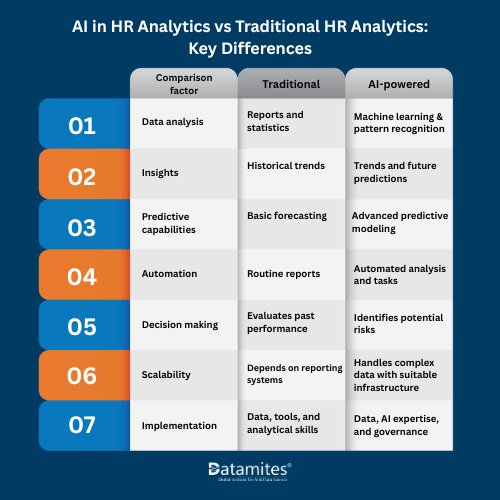
Understanding the difference between AI in HR analytics and traditional HR analytics helps organizations choose the right approach to workforce data analysis and decision-making. While traditional HR analytics focuses primarily on historical reporting and performance measurement, AI-powered HR analytics extends these capabilities through advanced pattern recognition, predictive modeling, and intelligent automation.
1. Data Analysis Approach
Traditional HR analytics uses spreadsheets, dashboards, and statistical methods to track employee turnover, absenteeism, and recruitment metrics. AI-powered HR analytics uses machine learning and pattern recognition to identify workforce trends and potential risks.
2. Type of Insights and Decision-Making
Traditional analytics explains what happened and helps investigate why. AI-powered analytics can also identify patterns and estimate potential future outcomes, supporting more proactive HR decisions.
3. Predictive Analytics in HR
Traditional analytics focuses mainly on historical trends, although it can also support forecasting. AI-powered HR analytics can help predict attrition risks, hiring needs, and skills gaps. These predictions depend on data quality and model accuracy.
4. Automation and Operational Efficiency
Traditional tools automate routine reports and workforce tracking. AI can extend automation to employee feedback analysis, pattern detection, and data summarization, helping HR teams focus on strategic priorities.
5. Workforce Planning and Decision-Making
Traditional analytics helps evaluate staffing levels and workforce performance. AI-powered analytics can forecast workforce demand and identify potential skills shortages, helping HR teams plan recruitment, reskilling, and internal mobility.
6. Scalability and Data Complexity
Traditional analytics works well for routine reporting and manageable datasets. AI-powered tools can analyze more complex workforce data, provided the organization has reliable data, suitable infrastructure, and effective governance.
7. Implementation Costs and Technical Requirements
Traditional HR analytics generally requires reporting tools, reliable data, and analytical skills. AI adoption may require additional investment in technology, specialist expertise, data security, and ongoing monitoring. Privacy, transparency, and algorithmic fairness must also be considered.
Ultimately, AI in HR analytics complements rather than replaces traditional HR analytics. Combining reliable reporting with predictive insights can help organizations make more informed workforce decisions.
Benefits of AI-Powered HR Analytics
AI-powered HR analytics can extend existing people analytics capabilities and help HR teams respond more effectively to workforce challenges. Its value depends on how well the technology aligns with organizational objectives.
- Faster Data Analysis: Automates repetitive tasks and analyzes employee feedback, saving time and improving efficiency.
- Improved Workforce Planning: Forecasts staffing needs, skills gaps, and potential attrition to support better planning.
- Better Employee Retention: Identifies turnover patterns and helps HR teams investigate workload, career growth, and management issues.
- Smarter Recruitment Decisions: Analyzes hiring metrics, identifies recruitment bottlenecks, and forecasts staffing requirements.
- Proactive Decision-Making: Helps HR teams identify potential workforce risks early and make informed, data-driven decisions.
The CIPD people analytics factsheet offers guidance on using workforce data to address organizational challenges. Although AI can expand analytical capabilities, organizations should measure actual outcomes rather than assume that adopting the technology will automatically improve performance.
Limitations and Challenges of AI vs Traditional HR Analytics
Despite its potential benefits, AI-powered HR analytics introduces challenges that organizations must address before relying on automated insights.
- Data quality and availability: Incomplete employee records, inconsistent job titles, and disconnected HR systems can reduce the reliability of analytical results. Establishing consistent data definitions and governance is an important starting point.
- Employee privacy and data security: Workforce data may contain sensitive information. Organizations should limit access appropriately, protect data against unauthorized use, and comply with applicable privacy and employment laws.
- Algorithmic Bias and Fairness: AI-powered HR tools can introduce risks if their training data or decision-making processes disadvantage certain groups. The U.S. Equal Employment Opportunity Commission (EEOC) highlights that employment selection procedures, including technology-assisted assessments, must be evaluated for potential discriminatory effects. Organizations should regularly assess AI systems for fairness and maintain appropriate human oversight.
- Implementation costs and technical complexity: AI adoption may require additional software, system integration, technical expertise, employee training, and ongoing model monitoring. These requirements should be weighed against the business value of the proposed use case.
- Transparency and explainability: HR professionals should understand the limitations of analytical recommendations, particularly when the results could affect an employee's career or employment opportunities.
- Human oversight: AI-generated predictions are estimates, not guaranteed outcomes. HR leaders must retain accountability for consequential decisions and ensure that employees have appropriate avenues to raise concerns or challenge errors.
The NIST AI Risk Management Framework provides guidance on identifying and managing AI-related risks. Responsible AI adoption in HR requires appropriate validation, ongoing monitoring, transparent governance, and meaningful human oversight to help ensure fair and reliable workforce decisions.
Which HR Analytics Approach Is Right for Your Business?
Choosing between traditional HR analytics and AI-powered HR analytics depends on your business goals, budget, data maturity, and workforce requirements. Consider the following factors before selecting the right approach.
Traditional HR Analytics Is Best When:
- You need regular HR reports and performance dashboards.
- Your primary focus is recruitment metrics, employee turnover, and compliance monitoring.
- Your workforce data is limited or still being organized.
- You want to establish a reliable HR reporting process before adopting advanced technology.
AI-Powered HR Analytics Is Best When:
- You want to forecast workforce demand and future skills gaps.
- You need deeper insights into employee retention and turnover patterns.
- You want to analyze large volumes of workforce data and employee feedback.
- Your organization has reliable data and the resources to implement and monitor AI responsibly.
Can You Combine Both Approaches?
Yes. Combining traditional HR analytics with AI-powered HR tools can help organizations balance reliable reporting with predictive insights. For example, HR teams can use dashboards to monitor employee attrition and predictive analytics to identify potential workforce risks and evaluate retention strategies.
The right approach: Start by identifying your key HR challenges, assessing your data readiness, and setting measurable business objectives. Whether you choose traditional analytics, AI, or both, your HR analytics strategy should support better workforce planning and informed decision-making.
Refer to these articles:
- Guide to Artificial Intelligence Career
- AI Sovereignty: The New Mandate for Data Governance in the Cloud Era
- How Knowledge-Augmented Generation (KAG) Is Solving AI Hallucinations
The Future of AI in HR Analytics
The future of AI in HR analytics will focus on predictive workforce planning, skills intelligence, and AI-powered insights. Organizations can use these capabilities to identify skills gaps, improve employee retention, and make better workforce decisions.
However, responsible AI adoption, data privacy, transparency, and human oversight will remain essential. The goal is to combine technology with human judgment to build a more efficient, data-driven, and employee-focused HR strategy.
AI in HR analytics enhances traditional methods by offering predictive insights, advanced pattern recognition, and smarter workforce planning. While traditional HR analytics remains valuable for reporting and performance tracking, AI-powered analytics supports more proactive decision-making.
The best approach depends on your business goals, data maturity, and resources. By combining reliable reporting with AI-driven insights, organizations can make informed decisions and build a more effective, future-ready HR strategy.
DataMites Institute offers an industry-focused AI for HR and People Analytics course designed to help HR professionals apply artificial intelligence to workforce planning and data-driven decision-making. Among its AI HR training courses, the program covers AI fundamentals, people analytics, talent acquisition, employee engagement, performance management, and workforce planning. DataMites also offers specialized AI training programs in fields such as healthcare, finance, marketing, and product management.
Learners can choose from flexible learning options, including online classes, classroom training, and project-based internships. Certification options include IABAC-accredited certification and the Certified AI Professional in People Analytics certification. With 50+ offline centres across India, including Bangalore, Chennai, Hyderabad, Pune, Mumbai, Ahmedabad, Coimbatore, and Delhi, DataMites offers accessible learning opportunities for professionals seeking to develop their AI and people analytics skills.