UG or PG: Which Is Better for Artificial Intelligence in Delhi?
Compare UG and PG options for artificial intelligence in Delhi, including eligibility, curriculum, career opportunities, and salary prospects to choose the right degree.
 Prerana B A
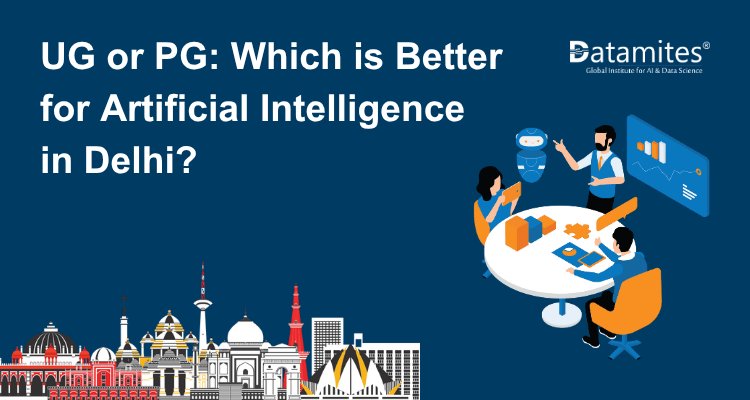
Choosing the right educational path is an important step toward building a career in artificial intelligence. In Delhi-NCR, where technology adoption and business innovation are creating new opportunities, students often face a key question: should they pursue an undergraduate (UG) or postgraduate (PG) degree in AI? Understanding the differences in eligibility, curriculum, and career prospects can help learners choose a path that aligns with their qualifications and professional goals.
What Makes Delhi a Leading City for Artificial Intelligence Careers?
Delhi-NCR is an attractive destination for aspiring AI professionals because of its growing technology ecosystem, diverse industries, and expanding startup environment. Companies in IT services, healthcare, finance, e-commerce, and consulting are increasingly exploring AI to improve efficiency, automate routine tasks, and support better decision-making. These developments create opportunities for those pursuing an artificial intelligence career in Delhi, making technical skills and practical experience valuable for entering this evolving field.
According to ABI Research, the global AI software market was valued at US$122 billion in 2024 and is projected to reach US$467 billion by 2030, growing at a compound annual growth rate (CAGR) of 25%. This growth highlights the expanding role of AI across industries. Students in Delhi-NCR can prepare for emerging career opportunities by developing programming, machine learning, and data analysis skills through academic programs, internships, and practical projects.
Refer to these articles:
- Generative Adversarial Networks (GANs): How are GANs Transforming AI?
- Learn about the Types of Machine Learning Algorithms
- What is a Confusion Matrix in Machine Learning?
UG vs PG in Artificial Intelligence: Eligibility, Curriculum, and Key Differences
An undergraduate degree is generally suitable for students beginning their higher education after Class 12, while a postgraduate degree is designed for graduates who want to develop advanced knowledge or specialize in AI.
1. Eligibility and Admission Requirements
Admission requirements for artificial intelligence programs depend on the degree level and the institution. Students should check the eligibility criteria, subject requirements, and entrance examination details before applying.
UG programs: Students who have completed Class 12, preferably with mathematics and other relevant science subjects, can explore B.Tech, B.Sc., or related AI programs. Specific eligibility requirements vary by institution.
PG programs: Applicants generally need a relevant bachelor's degree in engineering, computer science, mathematics, statistics, or another accepted discipline. Some institutions require entrance examinations or additional prerequisites.
2. Curriculum and Learning Approach
UG programmes establish a broad technical foundation before introducing advanced AI concepts. PG programs focus more deeply on specialized subjects and research-oriented applications.
| Factor | Undergraduate (UG) | Postgraduate (PG) |
| Duration | Usually 3 years | Usually 2 years |
| Learning focus | Programming, mathematics, algorithms, and AI fundamentals | Advanced machine learning, deep learning, research, and specialization |
| Practical exposure | Academic projects and internships | Advanced projects, research, and industry applications |
| Best suited for | School graduates starting their technical education | Graduates seeking advanced expertise |
Both pathways benefit from hands-on experience with Python, machine learning, data processing, and real-world projects. When exploring artificial intelligence in Delhi, students should compare course content, faculty expertise, laboratory facilities, and internship opportunities rather than choosing a program based on its title alone.
Artificial Intelligence Career in Delhi: Opportunities After UG and PG
Delhi and the wider NCR offer AI career opportunities in IT, finance, healthcare, consulting, and startups. Artificial intelligence roles include machine learning, data analysis, and intelligent application development, with qualifications varying by job responsibilities.
Career Opportunities After UG
Graduates can begin with entry-level technical positions and build expertise through practical experience.
- Junior AI developer: Supports the development and testing of AI-powered applications.
- Machine learning associate: Helps prepare datasets, evaluate models, and perform basic experiments.
- Data analyst: Uses programming, statistics, and visualization to interpret business information.
- Python developer: Builds software components and automation tools that may support AI solutions.
Career Opportunities After PG
Postgraduates with strong technical and project experience may qualify for more specialized positions.
- Machine learning engineer: Develops, trains, and deploys machine learning models.
- AI engineer: Creates intelligent applications using suitable algorithms and AI frameworks.
- NLP engineer: Works on language-based applications, including chatbots and text analysis.
- AI research associate: Supports experiments, model evaluation, and research projects.
A postgraduate degree does not guarantee a higher salary or senior role. According to Glassdoor, machine learning engineers in Delhi earn around ₹6 lakh–₹15.8 lakh annually, with an average base salary of ₹10 lakh. Salaries depend on skills, experience, and employer. Building a strong project portfolio can help learners pursue an artificial intelligence career in Delhi.
UG or PG in Artificial Intelligence: Choosing the Right Path for Your Career Goals
Choosing between UG and PG education depends on your current qualifications, career interests, and long-term plans. Understanding your priorities can help you select a suitable learning path.
When to Choose a UG Program in AI
An undergraduate program is a suitable choice for students who have completed Class 12 and want to build a strong foundation in computer science and AI. It provides time to develop programming skills, understand mathematical concepts, complete projects, and gain internship experience before entering the job market.
When to Choose a PG Program in AI
A postgraduate program is worth considering if you already hold a bachelor's degree and want to develop advanced knowledge of AI, machine learning, or related research areas. Before applying, check the eligibility criteria and ensure the curriculum matches your intended career direction.
Refer to these articles:
- Top IT Courses in Delhi
- How much is the Artificial Intelligence Course Fee in Delhi?
- AI Engineer vs ML Engineer in Delhi: Identify Your Best Career Path
Key Factors to Consider When Choosing an AI Degree
Beyond choosing the right qualification, students should evaluate the quality and practical value of a program before making a decision.
- Course curriculum: Look for relevant subjects such as Python, statistics, machine learning, deep learning, and AI applications.
- Practical experience: Prioritize programs that include hands-on projects, internships, laboratory work, and real-world problem-solving.
- Fees and duration: Compare tuition fees, course length, learning resources, and additional expenses.
- Institution quality: Review faculty expertise, recognized accreditation where applicable, industry connections, and placement support.
- Industry requirements: Research the skills employers seek for AI roles across Delhi and the National Capital Region (NCR).
Students should also consider their preferred learning style, available time, and career objectives. Comparing these factors can help them choose a program that offers relevant knowledge and practical skills.
Learners who want to strengthen their technical skills alongside their academic studies can consider an artificial intelligence training institute in Delhi to gain practical experience with AI tools, industry-relevant projects, and emerging technologies. Such training can complement a UG or PG degree by helping students develop hands-on skills and prepare for career opportunities in artificial intelligence.
Choosing between UG and PG education in artificial intelligence depends on your academic background and career goals. While a UG degree builds a strong foundation in AI and computer science, a PG degree helps graduates develop advanced technical knowledge and specialized skills. Along with formal education, hands-on projects, internships, and practical training can help students prepare for evolving AI career opportunities in Delhi-NCR.
For learners seeking supplementary hands-on experience, DataMites Institute offers a 9-month artificial intelligence program covering statistics, machine learning, and data analytics through practical projects and hands-on exercises. The program includes IABAC® and NASSCOM® FutureSkills certifications and prepares learners for roles such as AI Engineer, AI Specialist, and NLP Professional. With 50+ training centers across India, DataMites was recognized by BW Businessworld and BW Education as the Best Skill Development EdTech Institute in India 2026. Expert mentorship and practical training help learners develop industry-relevant skills.