AI Marketing Workflows and Automation
Explore AI marketing workflows and automation to streamline campaigns, personalize customer experiences, automate lead nurturing, and improve marketing efficiency. Discover practical applications, essential tools, and strategies to optimize digital marketing performance using artificial intelligence.
 Kriti Maurya
Modern marketing teams manage information from multiple sources, including websites, customer relationship management (CRM) platforms, social media, advertising channels, and email campaigns. Managing these activities manually can create operational challenges, particularly as customer interactions increase.
AI-powered marketing automation connects these activities through intelligent workflows. Instead of relying exclusively on predefined rules, AI-enabled systems can analyze customer information, recognize behavioral patterns, recommend relevant content, and support campaign optimization.
For example, when someone downloads a course brochure, a traditional automation system might send a standard confirmation email. An AI-enhanced workflow can use the available course interest and engagement information to recommend relevant learning resources, prioritize follow-up, and help the admissions team identify promising inquiries.
However, successful automation requires more than adopting AI software. Businesses must establish clear objectives, maintain reliable customer data, select appropriate tools, monitor automated decisions, and retain human oversight.
The Salesforce State of Marketing Report examines how marketers are leveraging generative and predictive AI, strengthening data strategies, and delivering personalized customer experiences. The report also highlights key challenges businesses face when implementing AI technologies and activating real-time customer data to improve marketing effectiveness.
This article explains how AI marketing workflows operate, their business benefits, practical applications, popular tools, implementation strategies, measurable KPIs, and challenges organizations should consider before adopting AI-powered marketing automation.
What Are AI Marketing Workflows and Automation?
AI marketing workflows and automation combine artificial intelligence technologies with automated marketing processes to improve how businesses manage customer interactions and campaigns.
Traditional marketing automation executes actions according to predefined conditions. For instance, an email platform can automatically send a welcome message when someone subscribes to a newsletter.
AI-powered marketing workflows extend these capabilities by analyzing available information, identifying patterns, generating recommendations, and supporting more adaptive marketing decisions.
The distinction is important:
- Traditional automation: Executes predefined actions when specific conditions are met.
- AI-powered automation: Uses AI capabilities to analyze information, generate predictions or recommendations, and assist with decisions within an automated process.
For example, an online education company can use marketing automation to capture student inquiries and send course information. AI can additionally help categorize inquiries according to course interests, identify engagement patterns, recommend relevant resources, and prioritize follow-up.
How Does an AI Marketing Workflow Work?
A typical AI marketing workflow involves six connected stages:
- Data collection: Collect relevant customer information through website forms, CRM systems, email interactions, and other authorized sources.
- Data organization: Connect customer information and organize it into a usable format.
- AI analysis: Apply appropriate AI capabilities to identify behavioral patterns, recommend content, or estimate customer engagement.
- Workflow execution: Trigger emails, notifications, audience updates, or other predefined marketing actions.
- Human review: Review important recommendations, generated content, and customer-facing decisions.
- Performance measurement: Evaluate campaign results and improve the workflow using actual outcomes.
The process creates a connection between customer insights and marketing execution.
Refer to the articles below:
- Advantages and Disadvantages of Artificial Intelligence
- What’s the Difference Between Gen AI, Agentic AI and AI Agents
- What Is AI? Know Everything About Artificial Intelligence
Key Benefits of AI Marketing Automation
AI-powered marketing automation can improve operational efficiency and customer engagement when implemented with reliable data and clearly defined objectives.
1. Improved Marketing Efficiency
Marketing teams frequently spend time on repetitive activities such as email scheduling, lead assignment, campaign reporting, and audience updates.
Marketing workflow automation helps reduce this workload by executing routine tasks automatically.
For example, a business can configure a workflow that sends a confirmation email whenever a visitor downloads a whitepaper. The system can also record the inquiry in a CRM platform and notify the appropriate team.
AI can further assist by recommending follow-up content based on available engagement information.
- Business value: Less time spent on repetitive execution and more time available for campaign strategy, creative work, and customer relationships.
2. Personalized Customer Experiences
Customers interact with businesses through multiple digital channels and may have different interests, preferences, and purchasing requirements.
AI tools can analyze available customer information to help marketers personalize:
- Email content and subject lines.
- Product and service recommendations.
- Website content suggestions.
- Advertising audiences.
- Follow-up communication.
- Customer engagement messages.
For example, an online retailer can recommend products based on a customer's previous purchases and browsing activity.
Personalization should remain relevant, transparent, and consistent with customer consent and applicable privacy requirements.
- Business value: More relevant communication and potentially stronger customer engagement.
3. AI-Powered Customer Segmentation
Traditional segmentation often relies on predefined characteristics such as location, purchase history, or customer demographics.
AI-powered customer segmentation can identify more complex behavioral patterns using available customer data.
An e-commerce business, for example, might identify audience groups such as:
- Frequent customers.
- First-time visitors.
- Customers who abandon shopping carts.
- Customers interested in specific product categories.
- Customers showing declining engagement.
These insights can help marketing teams develop targeted campaigns rather than sending identical messages to every customer.
- Business value: Better audience understanding and more relevant campaign targeting.
4. Better Campaign Optimization
AI-assisted analytics can help marketers evaluate campaign performance and identify areas that require attention.
Relevant measurements include email engagement, website conversion rates, advertising performance, customer acquisition costs, and lead quality.
AI recommendations can support decisions involving audience selection, campaign messaging, and advertising budget allocation.
For example, a marketing team can analyze which campaign segments generate qualified inquiries rather than evaluating success solely through website traffic.
However, AI recommendations should be validated against actual campaign results before significant budget or targeting decisions are made.
- Business value: More informed campaign decisions and improved use of marketing resources.
5. Predictive Marketing Insights
Predictive analytics in marketing uses historical and current data to estimate possible future outcomes.
Marketing teams can use predictive models to help:
- Estimate customer purchase likelihood.
- Identify potential customer churn.
- Prioritize leads for follow-up.
- Forecast campaign demand.
- Recognize declining customer engagement.
For example, a subscription-based business may analyze engagement patterns to identify customers who could be at risk of becoming inactive.
These predictions are estimates, not guarantees. Their usefulness depends on data quality, model performance, and regular validation.
- Business value: Better planning and earlier identification of potential marketing opportunities.
How to Build an AI-Powered Marketing Workflow
Businesses should implement AI marketing workflows systematically rather than automating every marketing activity at once.
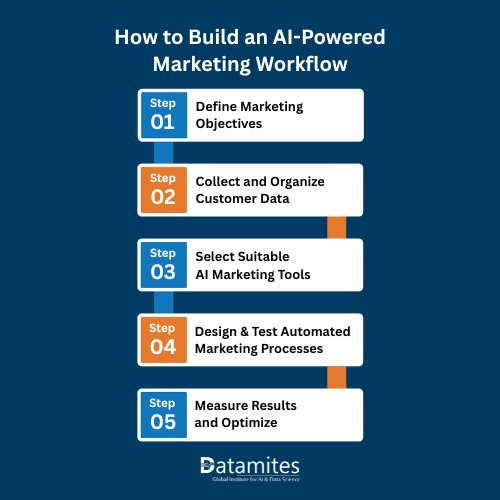
The following five-step framework provides a practical starting point.
Step 1: Define Marketing Objectives
Begin by identifying the specific business problem the workflow should address.
Possible objectives include:
- Increasing qualified leads.
- Improving email click-through rates.
- Reducing customer acquisition costs.
- Improving conversion rates.
- Reducing manual campaign management.
- Increasing customer retention.
- Set measurable key performance indicators (KPIs) before selecting tools.
For example, a marketing team may want to reduce the time required to assign new inquiries or improve the percentage of qualified leads receiving timely follow-up.
A clear objective makes it easier to evaluate whether the automation delivers meaningful business value.
Step 2: Collect and Organize Customer Data
AI-powered marketing automation depends on reliable information.
Relevant data may come from:
- Website analytics.
- CRM platforms.
- Email marketing systems.
- Customer support interactions.
- E-commerce transactions.
- Advertising platforms.
- Website registration forms.
Businesses should ensure that customer information is accurate, relevant, appropriately collected, and processed according to applicable privacy requirements.
Data should also be reviewed for duplicates, missing values, outdated records, and inconsistent formats.
Poor-quality information can lead to inaccurate segmentation, irrelevant recommendations, and ineffective marketing decisions.
Step 3: Select Suitable AI Marketing Tools
Choose marketing automation tools according to business objectives, technical requirements, available resources, and integration capabilities.
A small business may need an email automation platform and a basic CRM integration. A larger organization may require a more comprehensive marketing environment with customer data management, analytics, and multi-channel campaign capabilities.
Evaluate tools based on:
- AI functionality.
- Workflow customization.
- CRM integration.
- Analytics and reporting.
- Data security and access controls.
- Ease of implementation.
- Pricing and scalability.
- Human review and approval capabilities.
Avoid purchasing multiple overlapping tools without a clear operational requirement.
Step 4: Design and Test Automated Marketing Processes
Identify the events that should trigger automated actions.
Examples include:
- A visitor subscribing to a newsletter.
- A prospect downloading an e-book.
- A customer requesting a product demonstration.
- A shopper abandoning a cart.
- A subscriber becoming inactive.
For each workflow, define:
- Trigger: What event starts the workflow?
- Condition: What criteria determine the next action?
- Action: What should the system do?
- Escalation: When should a human representative become involved?
- Measurement: How will success be evaluated?
For example, when a visitor downloads a course brochure, the system can record the inquiry, send a confirmation email, recommend relevant course information, and notify the admissions team when the prospect meets predefined qualification criteria.
Before launch, test the workflow with sample records and verify that triggers, conditions, integrations, and messages work correctly.
Step 5: Measure Results and Optimize
After deployment, evaluate the workflow using measurable business outcomes.
Important KPIs include:
- Lead conversion rate.
- Cost per lead.
- Email click-through rate.
- Marketing-qualified leads.
- Customer acquisition cost.
- Customer retention rate.
- Revenue generated by campaigns.
- Time required to process an inquiry.
- Compare results with the baseline established before automation.
Test different messages, audience criteria, follow-up intervals, and workflow conditions. Expand successful processes only after reviewing their effectiveness and potential risks.
Starting with one workflow makes it easier to identify problems and understand the actual value of automation.
Practical Applications of AI Marketing Workflows
AI marketing workflows can support multiple activities across the customer journey.
1. Automated Email Marketing and Lead Nurturing
Email marketing is an important channel for customer communication and lead nurturing.
An AI-enhanced email workflow can:
- Capture subscriber information.
- Organize audiences according to relevant interests.
- Recommend appropriate content.
- Trigger follow-up communication.
- Identify inactive subscribers.
- Analyze engagement patterns.
Practical example:
An online learning company receives an inquiry from someone interested in a data science course.
The workflow records the inquiry in its CRM, sends relevant course information, recommends introductory learning resources, and notifies the admissions team when the prospect requests a consultation.
The admissions representative can then provide personalized assistance instead of manually identifying and organizing every inquiry.
2. AI-Powered Content Planning and Optimization
AI tools can assist marketing professionals with content research, planning, and optimization.
Common applications include:
- Keyword research.
- Topic clustering.
- Content outline generation.
- Search intent analysis.
- Content gap identification.
- Editorial calendar planning.
- Content performance analysis.
For example, a digital marketing team can identify related topics around marketing automation and organize them into a content calendar.
AI can also assist with summarizing research and generating initial content ideas.
However, AI-generated content should undergo editorial review to verify accuracy, originality, usefulness, search intent, and brand consistency.
3. Customer Segmentation and Predictive Analytics
AI-powered segmentation helps organizations understand different customer groups using behavioral and transactional information.
An online retailer can analyze purchase history, browsing activity, and product interests to identify customers who frequently engage with specific categories.
Predictive analytics can help estimate which groups may respond to particular offers or show signs of declining engagement.
Marketing teams can use these insights to design more relevant campaigns.
4. Advertising Campaign Optimization
AI-driven marketing campaigns can use automated bidding, audience signals, and performance analysis to support advertising decisions.
For example, Google Ads provides AI-assisted campaign capabilities that can help advertisers manage targeting and campaign delivery.
A professional training institute can analyze campaign information to identify which advertisements generate qualified course inquiries rather than simply maximizing clicks.
Marketing professionals should monitor:
- Advertising expenditure.
- Lead quality.
- Conversion tracking.
- Audience relevance.
- Campaign performance.
- Cost per acquisition.
Automated optimization should operate within clearly defined business goals and budget controls.
5. AI Chatbots and Customer Engagement
AI chatbots can help businesses respond to common questions and guide website visitors through digital experiences.
Applications include:
- Answering frequently asked questions.
- Explaining products and services.
- Guiding visitors through website content.
- Collecting inquiry information.
- Directing complex requests to human representatives.
For example, an educational website can use a chatbot to explain course eligibility, program duration, and enrollment procedures before connecting interested visitors with an admissions representative.
Businesses should provide a clear route to human assistance, particularly when a conversation involves complex requirements or sensitive information.
Refer to the articles below:
- Top AI Product Manager Skills in 2026
- The Role of AI in Investment and Portfolio Analysis
- The 2026 Guide to Implementing AI in HR Analytics
Popular AI Marketing Automation Tools
Selecting the right marketing automation tools depends on the size of the organization, campaign complexity, existing technology, AI Trends for marketing and available budget.
The following platforms support different aspects of marketing operations.
1. HubSpot
HubSpot provides CRM, marketing automation, email marketing, and customer engagement capabilities.
Businesses can use its platform to organize leads, create automated workflows, manage customer information, and analyze marketing performance.
Suitable for: Businesses looking for connected CRM and marketing operations.
2. Salesforce Marketing Cloud
Salesforce Marketing Cloud supports customer engagement and marketing campaign management across multiple channels.
Its capabilities can help organizations manage customer journeys, coordinate communication, and personalize marketing interactions.
Suitable for: Organizations with more complex customer engagement and marketing requirements.
3. Mailchimp
Mailchimp provides email marketing, audience management, campaign automation, and reporting capabilities.
It can help businesses organize subscriber communication and create automated email campaigns.
Suitable for: Small businesses and teams focusing on email marketing.
4. Zapier
Zapier connects supported applications and automates tasks between different software platforms.
For example, a business can connect a website inquiry form with its CRM system and configure automated notifications for new submissions.
Suitable for: Teams that need to connect applications and automate repetitive cross-platform tasks.
5. Google Analytics 4
Google Analytics 4 helps businesses understand how users interact with websites and applications.
Marketing teams can use its reporting and event measurement capabilities to evaluate traffic sources, user engagement, and conversion-related activity.
Suitable for: Businesses that need to measure website and application performance.
How to Choose the Right Marketing Automation Tool
| Business requirement | Tool to evaluate |
| CRM and marketing workflows | HubSpot |
| Enterprise customer journeys | Salesforce Marketing Cloud |
| Email campaign automation | Mailchimp |
| Application integrations | Zapier |
| Website performance analysis | Google Analytics 4 |
These platforms are not direct substitutes for one another. Many organizations use multiple tools together, provided their integrations and data practices are properly managed.
Before selecting a platform, review its current features, pricing, integration support, privacy controls, and suitability for your business.
Measuring the ROI of AI Marketing Automation
Marketing automation should be evaluated according to business outcomes rather than the number of tasks automated.
A workflow may save time but still fail to deliver value if it generates irrelevant inquiries or reduces customer engagement.
A useful approach is to compare performance before and after implementation.
Important Marketing Automation KPIs
| KPI | What it measures |
| Conversion rate | Percentage of visitors or leads completing a desired action |
| Cost per lead | Marketing expenditure divided by leads generated |
| Customer acquisition cost | Cost associated with acquiring a customer |
| Email click-through rate | Percentage of delivered emails generating clicks |
| Lead qualification rate | Percentage of leads meeting defined qualification criteria |
| Customer retention rate | Percentage of customers retained over a defined period |
| Response time | Time between an inquiry and the first relevant response |
| Marketing ROI | Financial return relative to marketing investment |
How to Calculate Marketing ROI
A simplified marketing ROI formula is:
Marketing ROI = [(Revenue Attributed to Marketing − Marketing Investment) ÷ Marketing Investment] × 100
For example, assume a business attributes ₹5,00,000 in revenue to a campaign and spends ₹1,00,000 on that campaign.
The illustrative calculation is:
Marketing ROI = [(₹5,00,000 − ₹1,00,000) ÷ ₹1,00,000] × 100
Marketing ROI = 400%
This is an example for understanding the formula, not a benchmark or a guaranteed result from AI automation.
For a more accurate assessment, businesses should account for attribution limitations, sales costs, technology subscriptions, integration expenses, and the time required to implement and maintain workflows.
Best Practices for Implementing AI Marketing Automation
Successful implementation requires strategic planning, responsible data management, and continuous evaluation to Get Into AI Marketing.
1. Establish Clear Business Objectives
Every workflow should address a specific marketing requirement.
Avoid automating activities simply because the technology makes them possible.
Prioritize processes that reduce repetitive work, improve response times, or support more relevant customer communication.
2. Maintain High-Quality Customer Data
Ensure customer information is accurate, relevant, and regularly updated.
Establish appropriate data access controls and remove unnecessary or outdated records.
Review the information used for segmentation and predictive models to identify potential errors or bias.
3. Protect Customer Privacy
Follow applicable data protection and privacy requirements.
Obtain consent where required, explain how customer information is used, and avoid collecting unnecessary personal information.
Apply suitable security controls when connecting CRM platforms, analytics systems, and marketing applications.
4. Maintain Human Oversight
AI recommendations should not automatically replace important human decisions.
Marketing professionals should review generated content, validate recommendations, and monitor customer-facing automated interactions.
Provide human escalation options for complex inquiries and complaints.
5. Test Workflows Before Deployment
Test triggers, conditions, integrations, and message delivery before launching workflows.
Verify that customers receive appropriate messages and that duplicate or conflicting communications are avoided.
6. Monitor and Optimize Regularly
Review workflow performance consistently.
Identify ineffective messages, inaccurate segmentation, integration issues, and unexpected automated actions.
Update workflows when customer behavior, platform capabilities, or business objectives change.
Common Challenges in AI Marketing Automation
Although AI-powered marketing automation offers several advantages, businesses should understand its limitationsand Challenges in Implementing AI in Marketing.
1. Data Quality Problems
Inaccurate or incomplete customer information can affect personalization, segmentation, and predictive analysis.
How to address it: Establish data validation procedures, remove duplicates, and regularly review CRM records.
2. Integration Difficulties
Connecting multiple marketing platforms can require technical expertise and careful configuration.
How to address it: Select compatible AI tools for marketing, test integrations, and document how information moves between systems.
3. Implementation Costs
Advanced automation platforms may require subscription fees, training, implementation resources, and ongoing maintenance.
How to address it: Start with a workflow that has a clear business purpose and evaluate its value before expanding.
4. Over-Automation
Excessive automated communication can frustrate customers and reduce engagement.
How to address it: Use appropriate communication frequency, preference controls, and clear unsubscribe options.
5. AI-Generated Inaccuracies
AI-generated content and recommendations can contain errors, unsupported assumptions, or inappropriate messaging.
How to address it: Introduce human review, verify factual claims, and monitor customer-facing outputs.
6. Privacy and Compliance Risks
Improper data collection, excessive tracking, or unauthorized information sharing can create legal and reputational risks.
How to address it: Apply appropriate consent, access, retention, and security practices according to applicable requirements.
Future of AI Marketing Workflows and Automation
Artificial intelligence is expected to play an increasingly important role in digital marketing operations.
Several developments are shaping the future of AI-powered marketing automation and AI in Marketing Funnel Analysis.
1. Predictive Customer Analytics
Predictive models can help businesses estimate AI for Customer Behavior Analysis, identify possible churn risks, and prioritize marketing opportunities.
2. Generative AI for Marketing Content
Generative AI can assist with campaign ideas, content drafts, email variations, product descriptions, and creative planning.
Human review remains essential for accuracy, originality, brand consistency, and relevance.
3. Conversational Marketing
AI assistants are creating additional ways for customers to interact with businesses.
These systems can help answer questions, guide website visitors, and support lead collection while providing options for human assistance.
4. Advanced Personalization
AI can help marketers use customer interaction information to recommend more relevant products, services, and content.
Organizations should balance personalization with transparency and privacy.
5. Connected Marketing Ecosystems
Integration between CRM platforms, analytics systems, advertising tools, and communication channels can create more coordinated customer experiences.
From personalized email marketing and automated lead nurturing to predictive analytics and AI for Customer Segmentation, these technologies can support multiple stages of the customer journey.
However, successful implementation requires more than selecting an AI platform. Businesses need clearly defined objectives, reliable customer data, suitable marketing automation tools, appropriate privacy safeguards, and continuous performance measurement.
Refer to the article below:
Human expertise remains essential for developing marketing strategies, reviewing AI recommendations, protecting customer relationships, and ensuring that automation supports genuine business objectives.
DataMites Institute offers industry-oriented AI marketing courses designed to help professionals develop expertise in AI-driven marketing strategies, marketing technologies, and data-driven business applications. In addition to marketing analytics, the institute provides specialized programs in AI for Finance, AI Product Management, and Generative AI for Business Leaders. Through online and on-demand classroom training, combined with practical case studies, learners gain relevant skills to understand AI applications in marketing and make informed business decisions.
The IABAC-accredited Certified AI Professional in Marketing Analytics course is designed to strengthen learners' practical knowledge and professional capabilities in AI-powered marketing. With training centers across India, including Pune, Bangalore, Hyderabad, Mumbai, Coimbatore, Chennai, Delhi, and Ahmedabad, DataMites Institute offers accessible learning opportunities for aspiring and experienced marketing professionals seeking to advance their AI and marketing analytics skills.