What Is Feasibility Analysis and How Is It Used in Data-Driven Decision-Making
Explore what feasibility analysis is and how it supports data-driven decision-making. Discover its key types, process, benefits, and real-world applications to evaluate project viability, assess risks, optimize resources, and make informed business decisions using reliable data and analytical insights.
 Kriti Maurya
Businesses often face decisions involving significant investments, new products, technology adoption, and operational changes. Before committing resources, decision-makers need to understand whether a proposed initiative is practical, financially sustainable, and aligned with business objectives.
Feasibility analysis is a structured method for evaluating whether a proposed project is achievable and worth pursuing. It examines market demand, financial requirements, technical capabilities, operational readiness, and legal obligations to help organizations identify opportunities and risks before making major commitments.
When combined with data-driven decision-making, feasibility analysis becomes more than a preliminary assessment. It provides a framework for comparing alternatives, testing assumptions, estimating potential returns, and determining whether a project should proceed, be modified, or be rejected.
This guide explains the main types of feasibility analysis, the data and analytical methods involved, a practical financial example, and the steps businesses can use to evaluate projects more confidently.
What Is Feasibility Analysis?
Feasibility analysis is the systematic assessment of a proposed business initiative to determine whether it can be implemented successfully under realistic conditions.
The assessment considers whether an organization has the necessary resources, technology, funding, market opportunity, and operational capabilities to achieve its objectives. It also evaluates uncertainties that could affect implementation or long-term performance.
For example, a company considering an AI-powered customer support service might assess whether its existing data is suitable for the application, whether the expected savings justify development costs, and whether its employees can integrate the system into existing workflows.
The findings help decision-makers determine whether the proposal is viable, what changes might improve its prospects, and which risks need to be addressed before implementation.
Feasibility Analysis vs. a Business Plan
A feasibility study and a business plan serve different but complementary purposes.
- Feasibility analysis: Determines whether a specific proposal is practical and sufficiently attractive to pursue.
- Business plan: Explains how the business or approved initiative will operate, compete, allocate resources, and pursue its objectives.
A feasibility study often informs the business plan by identifying realistic assumptions, financial requirements, and implementation constraints.
Refer to the articles below:
- What Is Categorical Analysis and How Do Data Analysts Use It
- Top 5 Emerging Trends in Data Analytics
- Top Industries Hiring Data Analysts
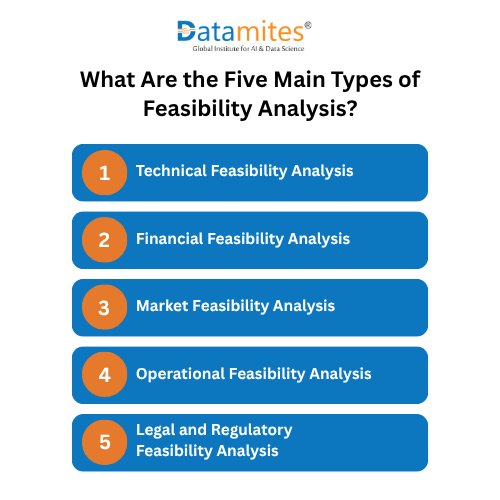
What Are the Five Main Types of Feasibility Analysis?
A comprehensive feasibility study examines a proposal from several perspectives. The appropriate depth of each assessment depends on the project's size, complexity, and potential consequences.
1. Technical Feasibility Analysis
Technical feasibility determines whether the required technology, infrastructure, equipment, and expertise are available to implement and maintain a project.
Businesses typically evaluate:
- Existing hardware, software, and infrastructure.
- Data availability, quality, and compatibility.
- Integration with current systems.
- Technical skills and staffing requirements.
- Security, scalability, reliability, and maintenance needs.
For example, a retailer introducing AI-based demand forecasting must determine whether its Sales Analytics on Business Decisions data are sufficiently complete, whether its systems can support the model, and whether employees can use its predictions effectively.
A technically possible solution is not automatically a technically feasible business investment. The organization must also consider implementation complexity, operating requirements, and long-term maintenance.
2. Financial Feasibility Analysis
Financial feasibility examines whether the expected financial benefits justify the investment and ongoing costs.
Key considerations include:
- Initial investment and implementation expenses.
- Recurring operating and maintenance costs.
- Expected revenue and cash flow.
- Funding requirements and working capital.
- Break-even point and return on investment.
- Payback period and, where appropriate, net present value.
A financial assessment should distinguish between revenue, profit, cash flow, and return on investment. These measures answer different questions and should not be treated as interchangeable.
For example, a subscription service may generate revenue but still produce negative cash flow if customer acquisition, technology, fulfillment, and support costs are too high.
3. Market Feasibility Analysis
Market feasibility evaluates whether a sufficient customer base exists for a product or service and whether the business can compete effectively.
The analysis may include:
- Target customer characteristics and purchasing behavior.
- Customer interviews, surveys, and purchase history.
- Market size and demand estimates.
- Competitor offerings, pricing, and positioning.
- Customer acquisition costs and retention expectations.
- Market trends and potential changes in demand.
The U.S. Small Business Administration identifies market research and competitive analysis as important tools for understanding customers and evaluating business opportunities. Its guidance is available through the SBA business planning.
Historical sales data can help identify patterns, but it should be supplemented with current customer research when entering a new market or launching an unfamiliar product.
4. Operational Feasibility Analysis
Operational feasibility assesses whether an organization can implement and sustain a proposed initiative using its people, processes, and resources.
Important questions include:
- Are sufficient employees and data analyst skills available?
- Will existing workflows need to change?
- Can suppliers and distribution channels support the initiative?
- What training and support will be required?
- Can the organization maintain service quality during implementation?
- Will the project create additional operational bottlenecks?
For example, a business may have sufficient funding and suitable technology to launch an online store but lack the warehouse capacity, order management processes, or customer service resources needed to handle increased demand.
Operational feasibility helps identify these constraints before they disrupt business performance.
5. Legal and Regulatory Feasibility Analysis
Legal feasibility determines whether a proposal can comply with applicable laws, regulations, contractual obligations, and industry requirements.
Depending on the project, the assessment may cover:
- Business licenses and permits.
- Data protection and privacy requirements.
- Intellectual property rights.
- Employment and contractual obligations.
- Industry-specific regulations.
- Recordkeeping and reporting requirements.
A company introducing an AI-based customer service platform, for instance, may need to review how customer information is collected, processed, retained, and shared.
Because legal obligations vary by jurisdiction and industry, organizations should obtain qualified legal advice when a project presents significant compliance risks.
How Is Feasibility Analysis Used in Data-Driven Decision-Making?
Data-driven decision-making involves using relevant evidence, analysis, and measurable outcomes to guide business choices. Feasibility analysis provides a structured way to apply these principles before committing resources.
A practical process consists of six steps.
Step 1: Define the Business Objective
Start by identifying the problem the project is intended to solve and the outcomes it should deliver.
For example, a retailer might want to reduce inventory waste, improve customer retention, or create a recurring revenue stream.
Define measurable success criteria, such as reducing stockouts by a specified percentage, reaching a target contribution margin, or recovering the initial investment within an acceptable period.
Without clear objectives, the study may collect large amounts of information without answering the central business question.
Step 2: Collect Relevant Data
Gather the information required to evaluate the proposal.
Potential data sources include:
- Internal sales, cost, and customer records.
- Customer interviews, surveys, and purchase behavior.
- Competitor research and industry reports.
- Supplier quotations and staffing estimates.
- Technology assessments and operational records.
- Relevant legal and regulatory documentation.
- Document where the data came from, when it was collected, and whether it has limitations.
Check for missing values, inconsistent records, sampling bias, and outdated information. Poor-quality data can produce misleading forecasts even when the analytical methods are technically sound.
Step 3: Estimate Costs, Benefits, and Risks
Translate the collected information into estimates of implementation requirements and expected outcomes.
Financial models can estimate startup costs, monthly expenses, revenue, contribution margins, cash flow, and investment returns.
Risk assessments should consider both the likelihood of an adverse event and its potential impact. Relevant risks might include lower-than-expected demand, cost overruns, implementation delays, or regulatory changes.
Separate known costs from estimates, and make important assumptions explicit.
Step 4: Compare Alternatives
A project should not automatically be approved simply because it appears viable. Decision-makers should compare it with realistic alternatives.
For example, a company considering an AI system could compare building a solution internally, purchasing an existing platform, outsourcing the work, or retaining its current process.
Useful analytical methods include:
- Spreadsheet-based financial modeling.
- Statistical analysis and forecasting.
- Scenario and sensitivity analysis.
- Cost-benefit analysis.
- Weighted decision matrices.
- Pilot testing and controlled experiments.
Each method answers a different question. A weighted decision matrix can help compare qualitative and quantitative factors, while sensitivity analysis shows how the recommendation changes when key assumptions change.
Step 5: Evaluate the Evidence
Compare the results with the original objectives, financial thresholds, resource constraints, and acceptable risk levels.
Ask whether the conclusions remain reasonable under less favorable assumptions. Consider what would happen if demand were lower, costs were higher, or implementation took longer than expected.
Where uncertainty is material, collect additional data or conduct a small pilot rather than relying on a single forecast.
Step 6: Make and Document the Decision
The feasibility study should conclude with a clear recommendation:
- Proceed: The project meets the defined requirements, starts with Data Preparation for Data Analysis.
- Proceed with conditions: The project is viable if specified risks are addressed.
- Revise: The proposal needs changes to its pricing, scope, technology, or operating model.
- Pilot first: Additional real-world evidence is needed before full implementation.
- Postpone or reject: The current proposal does not meet the required criteria.
Document the evidence, assumptions, limitations, approval criteria, and reasons behind the decision. This makes the recommendation easier to review and update as new information becomes available.
Refer to the articles below:
- How much is the Data Analytics course fee in India
- Mastering Data Analytics in India
- Data Analyst Career Scope in India
Practice Example: Evaluating an Online Subscription Service
Consider a hypothetical retail company planning to introduce a subscription service. Before launching it, management wants to determine whether the expected revenue can cover operating costs and justify the initial investment.
The following figures are illustrative assumptions, not actual results from a company.
Illustrative financial feasibility assessment
| Metric | Assumption |
| Initial investment | ₹10,00,000 |
| Monthly fixed operating costs | ₹1,00,000 |
| Monthly subscription price | ₹500 |
| Variable cost per subscriber per month | ₹150 |
| Expected active subscribers | 300 |
The company estimates monthly revenue by multiplying the subscription price by the number of active subscribers.
Monthly revenue
300 × ₹500 = ₹1,50,000
Monthly variable costs
300 × ₹150 = ₹45,000
Monthly operating surplus before other costs
₹1,50,000 − ₹45,000 − ₹1,00,000 = ₹5,000
Under these assumptions, the service generates a monthly operating surplus of ₹5,000 before taxes, financing costs, depreciation, and any additional expenses not included in the model.
However, this small surplus is not sufficient by itself to establish that the project is an attractive investment.
Calculate the break-even subscriber count
The contribution per subscriber is the subscription price minus variable cost:
₹500 − ₹150 = ₹350
The estimated monthly break-even subscriber count is:
₹1,00,000 ÷ ₹350 = 285.71
The company therefore needs approximately 286 active subscribers to cover the assumed monthly fixed and variable operating costs.
This calculation excludes the recovery of the initial investment. Reaching operating break-even does not mean that the company has recovered its startup expenditure.
Examine alternative scenarios
| Scenario | Active subscribers | Monthly operating result |
| Lower demand | 200 | −₹30,000 |
| Expected demand | 300 | ₹5,000 |
| Higher demand | 400 | ₹40,000 |
These results use the same subscription price, variable cost, and fixed operating cost in each scenario.
The comparison shows that relatively small changes in customer demand can substantially affect the project's operating performance.
At 300 subscribers, the business has only a limited operating cushion. Management might therefore test customer willingness to pay, estimate customer acquisition costs, verify fulfillment expenses, and run a pilot before committing the full investment.
What does the analysis tell the business?
The initial results suggest that the subscription service could cover its assumed monthly operating costs at around 286 active subscribers. They do not establish that the project will generate an acceptable return on the initial ₹10 lakh investment.
Before approving the launch, management should evaluate customer acquisition costs, churn, working capital, customer retention, additional overheads, and the time required to reach the break-even subscriber count.
A useful next step would be a limited pilot with predefined success criteria. Actual conversion rates, retention, and cost data could then replace uncertain assumptions in the financial model.
This example illustrates an important principle: feasibility analysis should identify the conditions under which a project succeeds, not merely produce a positive forecast.
What Are the Benefits of Feasibility Analysis?
When performed carefully, feasibility analysis helps organizations make better-informed decisions in several ways.
Reduced uncertainty
The process identifies assumptions, constraints, and potential obstacles before significant resources are committed. It cannot eliminate uncertainty, but it can make that uncertainty more visible and manageable.
Better resource allocation
Businesses can compare projects according to their financial potential, strategic relevance, resource requirements, and risk exposure. This helps decision-makers prioritize initiatives rather than approving proposals solely because they appear attractive.
Improved risk management
Assessing technical, market, financial, operational, and legal feasibility helps organizations identify different categories of risk and plan appropriate responses.
More realistic financial planning
Cost estimates, break-even calculations, cash flow projections, and sensitivity analysis help businesses understand how a project's financial performance could change under different conditions.
Greater accountability
Documenting assumptions and decision criteria creates a record that stakeholders can review. Actual results can later be compared with the original forecasts to improve future estimates.
What Are the Challenges and Limitations of Feasibility Analysis?
Feasibility analysis supports decision-making, but its conclusions depend on the quality of its inputs and the appropriateness of its methods.
Incomplete or unreliable data
Missing customer information, inaccurate cost estimates, and biased surveys can distort the findings. Businesses should verify important inputs and disclose material data limitations.
Uncertain forecasts
Customer behavior analysis, competitor responses, supplier costs, and economic conditions can change. Historical trends should not be treated as guarantees of future performance.
Overconfidence in financial models
A model can appear precise while relying on uncertain assumptions. Decision-makers should examine a range of scenarios and avoid interpreting estimated outcomes as guaranteed results.
Difficult-to-quantify factors
Employee readiness, customer trust, brand reputation, organizational culture, and strategic flexibility may not be adequately captured by a simple financial model. These factors should be evaluated explicitly alongside numerical measures.
Time and resource requirements
Comprehensive studies can be expensive and time-consuming. The depth of analysis should be proportionate to the project's scale, complexity, reversibility, and potential downside.
Risk of rejecting innovative opportunities
New products and emerging technologies may lack reliable historical data. An unfavorable initial forecast should not automatically end consideration of an idea. A controlled experiment or smaller pilot may provide better evidence at a manageable cost.
The best response to these limitations is to document assumptions, validate critical inputs, test uncertain variables, and revisit the analysis when conditions change.
Best Practices for Conducting a Reliable Feasibility Study
Organizations can strengthen the usefulness of their assessments by following a few practical principles.
- Establish measurable decision criteria. Define the financial, operational, technical, and market requirements before evaluating the proposal.
- Use multiple sources of evidence. Combine internal data with customer research, supplier information, and relevant external sources.
- Validate key assumptions. Confirm important cost estimates, customer demand, and technical requirements wherever possible.
- Model uncertainty. Use sensitivity analysis and realistic scenarios instead of relying exclusively on a single forecast.
- Include relevant stakeholders. Involve finance, operations, technical teams, legal advisers, and people who understand the target customers.
- Document limitations. Distinguish verified information from estimates and explain uncertainties that could materially affect the recommendation.
- Set review milestones. Compare actual results with forecasts during implementation and update the assessment when new evidence emerges.
These practices help turn feasibility analysis into a repeatable decision-making process rather than a document prepared only to obtain project approval.
How Data Analytics Skills Improve Feasibility Analysis
Data analytics can strengthen feasibility studies by helping professionals collect, organize, analyze, and interpret business information.
Spreadsheet modeling supports cost estimates and break-even calculations. Statistical methods help identify patterns and evaluate relationships in historical data. Forecasting can estimate demand under specified assumptions, while data analysis tools help stakeholders understand trends and compare scenarios.
More advanced techniques, including predictive modeling and simulation, may be useful for projects involving substantial uncertainty or complex operating conditions. Their usefulness depends on data quality, model validation, and whether the outputs address a genuine decision-making need.
Feasibility analysis helps businesses evaluate opportunities systematically before committing significant resources. By assessing market demand, financial sustainability, technical capabilities, operational readiness, and legal requirements, organizations can identify risks and make more informed decisions.
When combined with data analytics, it enables decision-makers to test assumptions, compare alternatives, evaluate financial scenarios, and establish measurable criteria for success. Reliable data, transparent assumptions, and ongoing validation are essential to producing useful conclusions.
Refer to the articles below:
- What Is a Snowflake Database and How Does It Work for Data Analytics
- What Is Data Anonymization and Why Is It Important for Data Privacy
- Data Analytics in Business – How does it benefit Business Operations
Professionals interested in applying these methods can develop relevant skills in spreadsheet modeling, statistical analysis, forecasting, and data visualization. Data analytics training programs, including those offered by DataMites, may provide opportunities to build these capabilities through structured learning and practical exercises. Prospective learners should review course content, credentials, project work, and current program details before choosing a course.
Ultimately, feasibility analysis cannot guarantee project success. It helps organizations understand the conditions required for success, evaluate uncertainty, and determine whether to proceed, revise, test, or reject a proposal based on the available evidence.
DataMites Institute provides career-oriented training programs in Data Science, Artificial Intelligence, Machine Learning, and Data Analytics, designed to help learners develop practical, industry-relevant skills. Those looking to strengthen their analytical capabilities can explore the Data Analyst Course in Mumbai, which focuses on building data analysis knowledge through practical learning. The institute emphasizes hands-on projects, internship opportunities, and placement assistance to support learners in their career development. With certifications from IABAC and NASSCOM FutureSkills, DataMites offers flexible online and classroom training formats to accommodate different learning preferences. Along with its DataMites Delhi presence, the institute serves learners across major Indian cities, including Bangalore, Pune, Chennai, Mumbai, Kolkata, Coimbatore, and Chandigarh.