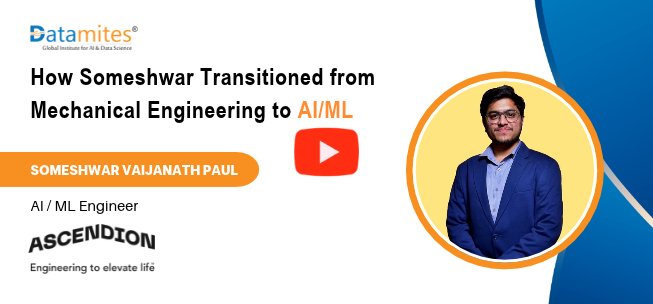
How Someshwar Transitioned from Mechanical Engineering to AI/ML
Discover how Someshwar transitioned from mechanical engineering to an AI/ML career through DataMites training, practical learning, and continuous skill development.
 Prathap Kumar
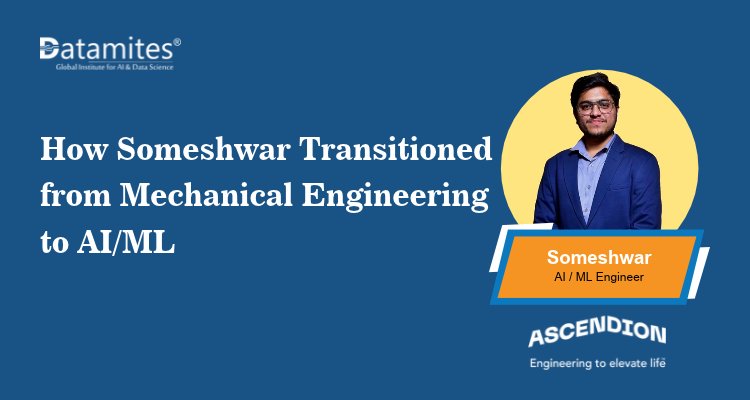
Artificial Intelligence and Machine Learning (AI/ML) are creating career opportunities for graduates from different educational backgrounds. Someshwar’s journey shows how someone without an IT background can build a career in this growing field through the right training and practical skills.
A mechanical engineering graduate, Someshwar joined DataMites without prior coding knowledge. He learnt Python, data science, computer vision, and NLP during his training. Within a month of completing the course, he secured a job at CamCom Technologies as a computer vision engineer. After three years of experience, he moved to Accenture, where he currently works as an AI/ML Engineer specialising in Agentic AI. His journey is a DataMites success story that inspires aspiring AI/ML professionals.
Someshwar’s Career Journey: From Mechanical Engineering to AI/ML Engineer
Starting an AI/ML career without a computer science background can be challenging. Someshwar shares how he moved from mechanical engineering into AI through practical learning, technical training, and his first industry opportunity.
Q1. How did you transition from a DataMites student to an AI/ML engineer?
I started my journey in 2022 when I joined DataMites on 22 November. Coming from a non-IT background with a B.Tech in Mechanical Engineering and no coding experience, I decided during my final year to pursue a career in artificial intelligence and machine learning.
At DataMites, I learned Python, data science, NumPy, Pandas, computer vision, and NLP. Within a month of completing my training, I secured a job at CamCom Technologies as a Computer Vision Engineer, where I worked for three years. Currently, I am working at Accenture as an AI/ML engineer, focusing on agentic AI.
Q2. How was your learning experience with DataMites trainers?
Classes were conducted four days a week, with each session lasting around two hours. The trainers explained Python concepts, including data structures, and their practical applications. I also practised regularly after every class to improve my understanding.
The trainers were very supportive and patiently cleared my doubts, even when I asked about the same concepts multiple times. Their guidance played an important role in my learning journey.
Q3. How has the AI/ML industry evolved since you started your career?
The AI industry has evolved rapidly since I started learning in 2022, when attention mechanisms were gaining popularity. Today, Large Language Models (LLMs) such as ChatGPT and Claude have become part of everyday life, supporting coding, daily tasks, and problem-solving across industries.
Companies are increasingly investing in AI technologies, and I believe the field has significant potential to grow further in the coming years.
Q4. What skills do beginners need to build a career in AI/ML?
As the AI industry evolves, professionals must continuously upgrade their skills to meet current industry requirements. Along with understanding fundamentals such as neural networks, candidates should focus on practical technologies like agentic AI, Retrieval-Augmented Generation (RAG), and LLM applications.
Companies increasingly look for professionals who can use LLMs, build orchestration workflows, and automate tasks. My suggestion is to strengthen your basics while learning the latest AI technologies and their practical applications.
Q5. What should candidates expect in AI/ML technical interviews?
The AI/ML interview process generally includes L1 and L2 technical rounds, though some companies may conduct three to seven rounds.
The initial rounds usually focus on:
- Coding skills: Basic coding and Data Structures and Algorithms (DSA).
- Programming fundamentals: Knowledge of languages such as Python or Java.
- System design: Selecting suitable technologies, designing architectures, and solving problems.
As AI tools can now generate code, companies increasingly focus on candidates' ability to choose the right technologies and design effective systems. Therefore, analytical thinking and problem-solving skills are equally important.
Q6. Why are practical projects important for an AI/ML career?
Projects are essential for demonstrating your technical knowledge and standing out from other candidates. They show how well you can apply technologies to real-world problems, develop practical solutions, and deploy applications for users. Without projects, it becomes difficult to showcase your skills to potential employers.
Q7. Which tools and technologies do you use in your Agentic AI role?
I currently work with tools and frameworks such as CrewAI, LangGraph, LangChain, LangFuse, and LlamaIndex. These technologies help build LLM orchestration workflows, develop RAG systems, and automate tasks.
I am also working on an Agentic AI platform for enterprises. Users can enter a simple prompt, and the platform understands their requirements, selects the necessary tools and knowledge bases, and manages the workflow automatically. This helps businesses automate complex tasks with minimal effort.
Q8. What advice would you give aspiring AI/ML professionals?
I would suggest focusing on two important areas. First, build practical projects to demonstrate your technical knowledge and ability to solve real-world problems. Second, strengthen your system design and software architecture skills, as companies increasingly value candidates who can design effective solutions.
Along with learning the fundamentals, keep upgrading your skills to stay relevant in the evolving AI industry.
Refer to these articles:
- How Thennarasu Started His AI Developer Career as a Fresher
- How Angel Started Her AI/ML Engineer Career as a Fresher
- How Did Jayanth Transition into an AI & ML Engineer Career?
Key Findings from Someshwar’s AI/ML Career Journey
Someshwar’s journey shows how proper training, practical experience, and continuous learning can help non-IT graduates build careers in AI/ML. His experience highlights the importance of choosing quality training programmes, exploring top AI courses, working on real-world projects, and staying updated with emerging technologies. Key takeaways include:
- Non-IT graduates can enter AI/ML: Someshwar transitioned from mechanical engineering to AI/ML without prior coding knowledge.
- Structured learning builds strong foundations: DataMites training helped him learn Python, data science, computer vision, and NLP.
- Practical training supports career growth: Regular practice and trainer guidance helped him strengthen his technical skills.
- Career opportunities can come quickly: He secured a computer vision engineer role at CamCom Technologies within a month of completing his training.
- Continuous learning is essential: AI professionals need to keep up with emerging technologies such as LLMs, Agentic AI, and RAG.
- Technical interviews test problem-solving: coding, programming fundamentals, DSA, system design, and analytical thinking are important.
- Projects demonstrate practical knowledge: Real-world projects help candidates showcase their ability to develop and deploy solutions.
- Knowledge of modern AI tools is valuable: Technologies such as CrewAI, LangGraph, LangChain, LangFuse, and LlamaIndex support agentic AI development.
- System design and architecture matter: Companies increasingly value professionals who can design effective software solutions.
- A non-linear career path is possible: Someshwar’s journey from mechanical engineering to an AI/ML engineer role at Accenture highlights the opportunities available through consistent learning and practical experience.
Someshwar’s journey shows how practical learning, dedication, and continuous skill development can help aspiring professionals, including non-IT graduates, build successful careers in AI/ML and adapt to evolving industry demands.
Refer to these articles:
- AI Sovereignty: The New Mandate for Data Governance in the Cloud Era
- How GenAI Is Influencing Data Analyst Productivity and Accuracy
- How AI is Transforming Customer Analytics in 2026
Someshwar’s journey from mechanical engineering to becoming an AI/ML engineer demonstrates that a non-IT background need not limit career opportunities in artificial intelligence. His transition from learning Python and data science through an artificial intelligence training institute in Surat at DataMites to working as a computer vision engineer at CamCom Technologies and later as an AI/ML engineer at Accenture highlights the importance of structured training, practical experience, and continuous learning.
The growing demand for AI professionals further highlights the opportunities in this field. According to Precedence Research, the global AI market is estimated to reach USD 900 billion in 2026 and is projected to grow to USD 4,216.29 billion by 2035, at a CAGR of 18.73%. As AI adoption expands across industries, developing hands-on project experience, strengthening system design skills, and learning emerging technologies such as LLMs and Agentic AI can help aspiring professionals prepare for future career opportunities.
DataMites offers an 8-month Artificial Intelligence programme covering statistics, machine learning, and data analytics through hands-on training and practical projects. It also provides specialised programmes such as Certified Agentic AI Professional (CAAIP), Certified AI Architect, and AI for Business Leaders, focusing on advanced AI applications. With 50+ training centres across India, learners can explore best artificial intelligence courses in Ahmedabad, Hyderabad, Chennai, Pune, Bangalore, Mumbai, Coimbatore, Delhi, Nagpur, and Kolkata, with practical learning and expert mentorship to develop industry-relevant skills.