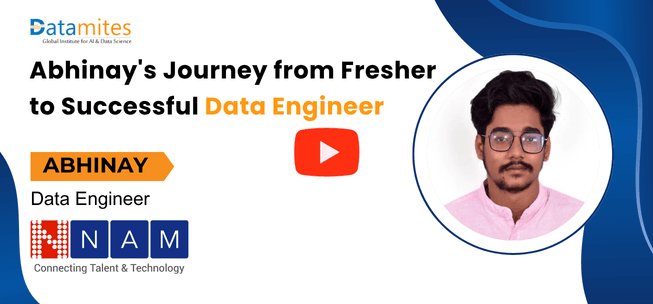
Abhinay's Journey from Fresher to Successful Data Engineer
Learn how Abhinay transformed from a fresher into a successful Data Engineer with practical training, technical skills, and real-world project experience.
 Prerana B A
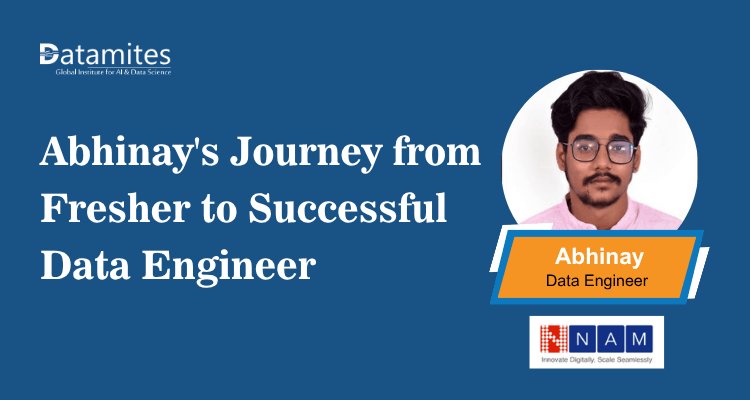
Abhinay's journey from an Artificial Intelligence and Machine Learning graduate to a Data Engineer at NAM Info demonstrates how strong fundamentals, practical learning, and consistent effort can pave the way for a successful career in the data industry. By strengthening his skills in Python, SQL, Statistics, and Machine Learning through hands-on capstone and client projects, he developed the confidence and technical expertise needed to excel in interviews and secure his first job.
Throughout his learning journey, Abhinay focused on applying theoretical concepts to real-world datasets, experimenting with different machine learning models, and improving his problem-solving abilities. His insights on building a strong foundation, mastering Python and SQL, practicing consistently, and embracing continuous learning offer valuable guidance for aspiring Data Scientists and Data Engineers. This DataMites success story is an inspiring example of how practical experience, perseverance, and the right learning approach can help fresh graduates launch a successful career in the ever-growing field of Data Engineering.
Abhinay Shares His Journey to Becoming a Data Engineer with Datamites
Explore how Abhinay built his Data Engineering career with hands-on projects, technical skills, and determination.
1. Can you introduce yourself?
My name is Abhinay. I completed my Bachelor's degree in Artificial Intelligence and Machine Learning from Cambridge Institute of Technology in 2025. After graduation, I joined the Certified Data Scientist (CDS) program to strengthen my practical skills in data science.
2. Why did you choose Data Science after graduation?
I decided to build my career in data science during my final year. After researching different institutes and comparing course offerings, I chose a program that focused on practical learning, projects, and industry-relevant skills.
3. Did you have any programming experience before joining the course?
Yes. Since I studied Artificial Intelligence and Machine Learning, I already had basic knowledge of Python and SQL. However, most of my learning was theoretical. The course helped me apply those concepts through practical exercises.
4. Which programming language do you prefer and why?
I prefer Python because it is easy to understand and widely used in data science. It offers powerful libraries for data analysis, machine learning, and automation.
5. How important is Statistics in Data Science?
Statistics is the foundation of data science. It helps in understanding data, building reliable machine learning models, and evaluating their performance accurately.
6. Which part of the Data Science course did you enjoy the most?
Machine Learning was my favorite part because I could implement algorithms practically, identify mistakes, improve models, and understand how different algorithms perform on real datasets.
7. How did the capstone projects help you?
The capstone projects gave me hands-on experience in cleaning data, handling missing values, feature engineering, model building, and evaluating machine learning models using different algorithms.
8. How did you choose the best machine learning model?
I tested multiple algorithms on the same dataset and compared their evaluation metrics such as accuracy, precision, and recall before selecting the best-performing model.
9. Why is understanding the dataset important?
Understanding the dataset helps identify important features, data quality issues, and the right approach for model building. It also improves overall model performance.
10. How did your projects help during interviews?
Many interview questions were based on real project experiences. Since I had already solved practical problems, I could confidently explain how I handled errors, selected models, and improved performance.
11. What was the interview process like?
The interview consisted of an online MCQ round, two technical rounds, and one HR round. The technical interviews mainly focused on SQL, machine learning, and project discussions.
12. Which interview round was the most challenging?
The first technical round was the most challenging because it included multiple SQL query-writing questions along with discussions about my capstone projects.
13. Which technical skills were tested during the interview?
The interview mainly tested SQL, Python, Machine Learning concepts, project implementation, and problem-solving skills.
14. How did SQL help you crack the interview?
Strong SQL knowledge helped me solve multiple query-writing problems confidently. Practicing SQL regularly made it easier to answer technical questions.
15. What advice would you give to beginners?
Beginners should first build a strong foundation in one programming language, preferably Python, and learn SQL thoroughly before moving to advanced topics.
16. Is it possible to learn Data Science without mastering multiple programming languages?
Yes. Learning one programming language well, along with SQL, is enough to build a strong foundation for a career in data science.
17. How did you improve your coding skills?
I regularly practiced Python and SQL problems on coding platforms and worked on real-world projects to improve my practical understanding.
18. What is your message for aspiring Data Science professionals?
Be patient and focus on learning the fundamentals. Data science cannot be mastered overnight. Consistent practice, project work, and continuous learning will help you build a successful career.
Refer to these articles :
- How Rakshitha Successfully Transitioned Into Data Science
- Devadarsan’s Journey from Fresher to Data Scientist
- How Varun Built a Successful Career in Data Science
Key Takeaways from Abhinay's Journey
Abhinay's journey highlights the importance of strong fundamentals, hands-on learning, and consistent practice in building a successful career in Data Engineering. Here are the key takeaways from his experience.
- Abhinay successfully transitioned from an AI & Machine Learning graduate to a Data Engineer by combining academic knowledge with practical learning.
- He enrolled in the Certified Data Scientist (CDS) program to gain hands-on experience in Python, SQL, Statistics, and Machine Learning.
- Building a strong foundation in Python and SQL played a crucial role in his career preparation.
- Practical implementation of concepts helped him bridge the gap between theoretical learning and industry expectations.
- Statistics proved essential for understanding data, building machine learning models, and evaluating their performance.
- Machine Learning was the most engaging part of his learning journey, allowing him to experiment with multiple algorithms and improve model accuracy.
- Completing four capstone projects and one client project enhanced his skills in data cleaning, preprocessing, feature engineering, model building, and evaluation.
- Working with incomplete real-world datasets improved his problem-solving abilities and prepared him for practical industry challenges.
- Consistent practice through coding exercises and real-world projects significantly strengthened his technical confidence.
- Abhinay advises freshers to focus on mastering one programming language, such as Python, along with SQL before learning advanced technologies.
- He believes continuous learning is essential and has already started exploring AI Agents and APIs after securing his placement.
Refer to these articles :
- How to Learn Data Science
- Data Science Applications
- Data Science Project Lifecycle: From Data Collection to Deployment
Abhinay's journey proves that consistent learning, practical experience, and a strong foundation can help fresh graduates successfully enter the technology industry. By focusing on hands-on projects, strengthening Python and SQL skills, and continuously improving through practice, he transformed academic knowledge into real-world expertise and secured his first role as a Data Engineer. His story serves as an excellent example for aspiring professionals who wish to build a successful career in Data Science and Data Engineering.
If you're planning to build a career in Data Engineering or Data Science, Abhinay's journey demonstrates how practical learning, project experience, and consistent upskilling can help fresh graduates enter the data industry with confidence. The demand for data professionals continues to grow as organizations accelerate AI adoption and digital transformation. According to the U.S. Bureau of Labor Statistics, employment of Data Scientists is projected to grow by 33.5% between 2024 and 2034, making it one of the fastest-growing technology careers. As a result, Data Science, Data Engineering, Artificial Intelligence, Machine Learning, and Python have emerged as some of the top IT courses, equipping learners with the in-demand skills required for today's rapidly evolving technology landscape.
Abhinay's successful transition from an Artificial Intelligence and Machine Learning graduate to a Data Engineer at NAM Info was made possible through the Certified Data Scientist (CDS) program at DataMites. By working on real-world projects, he strengthened his skills in Python, SQL, Statistics, and Machine Learning. Learners exploring Data Science courses in Kolkata can benefit from DataMites' hands-on training, expert mentorship, internship opportunities, and globally recognized IABAC® and NASSCOM FutureSkills® certifications to build successful careers in the data industry.
Whether you're a fresher, student, or aspiring data professional like Abhinay, DataMites makes quality Data Science education accessible through flexible online and offline learning. Along with Data Science courses in Bhubaneswar, DataMites offers industry-focused programs across major cities in India. Through structured learning, hands-on projects, expert mentorship, internship opportunities, placement assistance, and globally recognized IABAC® and NASSCOM FutureSkills® certifications, learners gain the practical skills needed for successful careers. Abhinay's DataMites success story proves that with the right guidance, continuous learning, and practical experience, building a rewarding career in Data Engineering is within reach.