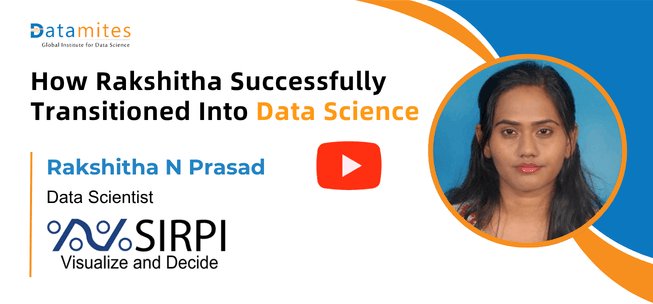
How Rakshitha Successfully Transitioned Into Data Science
Learn how Rakshitha transitioned into data science through structured learning, hands-on projects, mentorship, and career-focused training.
 Prerana B A
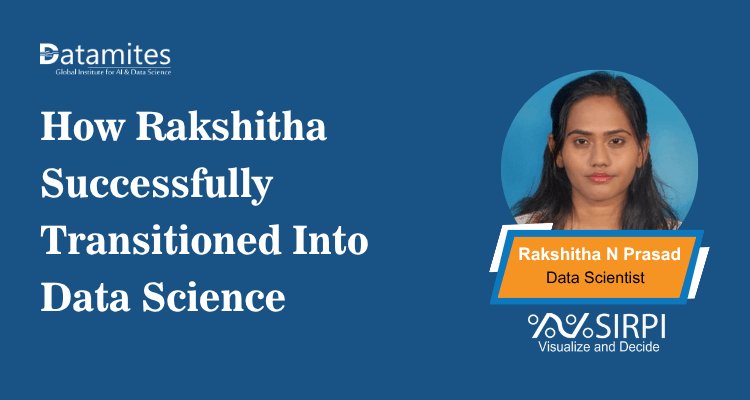
Starting a career in data science can feel challenging, but Rakshitha's journey shows that with structured learning, hands-on practice, and perseverance, it is possible to achieve your career goals. From discovering her interest in data science during her engineering project to building practical skills through real-world projects and interview preparation, she successfully secured a position as a Data Scientist at Sirpi Data Science Pvt. Ltd.
Join us for Rakshitha's Success Story Session as she shares her inspiring career journey, learning experience, placement process, and valuable insights for aspiring data science professionals.
Rakshitha shares her honest, detailed journey from choosing online learning over classroom sessions, to what her mock interviews and real client interviews were actually like, to the one skill she says matters just as much as technical knowledge. Her story is a valuable roadmap for anyone considering a career transition into data science through DataMites success story
Rakshita's Journey from Engineering Student to Data Scientist
Rakshita's journey from an engineering student to a Data Scientist highlights how curiosity, continuous learning, and consistent effort can lead to a successful career in data science.
Q1. Could you please introduce yourself and share your academic background?
I completed my Computer Science and Engineering degree. During my college days, I became interested in Data Science while selecting a domain for my final-year project. Since AI and Machine Learning were rapidly growing, I chose a Data Science project, which sparked my interest in pursuing this career.
Q2. What inspired you to choose Data Science as your career?
My interest started during my final-year project. I realized how AI, Machine Learning, and automation are transforming industries. That motivated me to explore Data Science further. To strengthen my knowledge and practical skills, I enrolled in the Data Science course at DataMites.
Q3. Why did you choose online training instead of classroom training?
I opted for online training because I am not from Bangalore. The online sessions were convenient and allowed me to learn comfortably from home without relocating.
Q4. How was your learning experience during the course?
Although I had basic knowledge of Python because of my Computer Science background, I had very limited understanding of Statistics, Machine Learning, and AI. The course helped me understand the complete Data Science workflow from building models to testing and evaluating them. It covered Python, Statistics, AI concepts, and various industry tools in a structured manner.
Q5. Did you study only from the course materials or use additional learning resources?
The study materials provided were sufficient to build strong fundamentals. However, I also explored the internet to learn about new algorithms and techniques. Self-learning helped me gain additional insights beyond the course.
Q6. How did you manage your studies along with your job?
I was already working while pursuing the course, so managing both was challenging. I dedicated around 4 to 5 hours every week to revise concepts and practice coding consistently.
Q7. Can you tell us about the internship you completed?
I completed an internship in partnership with Rubixe where I worked on an LSTM-based project related to ticket prioritization and prediction in software companies. It was a live project that gave me real-world exposure. Along with that, I also completed several capstone projects that strengthened my practical understanding.
Q10. Did your projects help you during interviews?
Absolutely. Almost every interviewer asked about my projects. Since I had worked on them personally, I could confidently explain my approach, the challenges, and the results. The projects became one of my biggest strengths during interviews.
Q11. How many mock interviews did you attend?
I attended around two to three mock interviews. They were conducted very professionally and simulated real interview environments.
Q12. What was your mock interview experience like?
The mock interviews were quite challenging. The interviewers evaluated technical knowledge, communication skills, confidence, and problem-solving ability. After every mock interview, they provided detailed feedback on areas where I needed improvement.
Q13. What kind of questions were asked during the mock interviews?
They asked coding questions, SQL queries, and Machine Learning concepts. I had to write code in Notepad during the interview. Surprisingly, many questions were very similar to those asked in actual company interviews, which made the preparation extremely useful.
Q14. How did you prepare for your interviews?
The interview preparation handbook provided during the course was extremely helpful. It contained short notes on algorithms, Python, SQL, and Machine Learning concepts. I revised it before every interview. The interview preparation materials covered most of the important topics, so I rarely needed external resources.
Q15. Can you share your experience of the Data Scientist interview that you recently cleared?
It was an online interview that lasted around one hour. The interview covered Python, SQL, Statistics, Machine Learning algorithms, communication skills, and coding questions. Most questions tested my fundamentals rather than advanced coding skills.
Q16. What type of technical questions were asked during the interview?
One example involved manipulating a DataFrame by reversing a set of values. There were also questions on arrays, debugging code, SQL queries, and Machine Learning basics. The interviewers mainly wanted to assess my understanding of core concepts rather than lengthy programming.
Q17. What advice would you give to Data Science aspirants preparing for interviews?
Focus on building strong fundamentals. Attend interview preparation sessions, revise the study materials regularly, and practice coding consistently. Companies value candidates who have a solid understanding of core concepts. Self-effort is equally important alongside the training.
Q18. Which technical skills are essential for cracking Data Science interviews?
The most important skills include:
- Python programming
- SQL
- Statistics
- Machine Learning fundamentals
- Basic algorithms like Linear Regression and Logistic Regression
- Understanding when and where to apply different algorithms
A clear understanding of these basics is sufficient for many entry-level interviews.
Q19. Apart from technical knowledge, what other skills are important?
Confidence and communication skills are equally important. Earlier, I struggled with confidence, and despite answering technical questions correctly, I wasn't selected. Once I improved my communication and confidence, my interview performance improved significantly.
Q20. How was the placement support you received?
The placement support was excellent. This is actually my second job opportunity through the placement team. They carefully shortlisted relevant Data Science job openings, shared job requirements, and guided me throughout the interview process. They also collected interview feedback whenever I wasn't selected, which helped me improve. With this continuous support and guidance, I got placed as a Data Scientist at Sirpi Data Science Pvt Ltd.
Q21. What is your final message for students planning to build a career in Data Science?
Stay consistent, strengthen your fundamentals, practice coding regularly, work on real projects, and never stop learning. Along with technical knowledge, improve your confidence and communication skills. If you put in consistent effort and make good use of the available guidance and placement support, getting a Data Science job becomes much more achievable.
Refer to these articles :
- Ashutosh Punia on Building a Career in Data Engineering
- From Curiosity to Career: Shashank’s Path into Data Engineering
- Charting a Path in Data Engineering with Asutosh
Key Takeaways from Rakshitha's Success Story
Rakshita's journey demonstrates that a combination of structured learning, practical experience, and consistent effort can help aspiring professionals build a successful career in Data Science.
- Develop Strong Fundamentals: A solid understanding of Python, SQL, Statistics, and Machine Learning basics forms the foundation for success in Data Science.
- Start with Real-World Projects: Working on academic, capstone, and live projects helps bridge the gap between theory and practical application.
- Follow a Structured Learning Path: Learning concepts step by step makes it easier to understand complex topics and build confidence.
- Practice Consistently: Even dedicating a few hours each week to coding, revision, and problem-solving can lead to steady improvement.
- Go Beyond Course Materials: While structured learning is important, exploring additional resources and staying curious helps deepen your knowledge.
- Take Mock Interviews Seriously: Simulated interviews help identify technical and communication gaps while preparing you for real interview scenarios.
- Focus on Core Concepts: Most employers evaluate your understanding of fundamentals rather than expecting highly complex coding solutions.
- Build Confidence Alongside Technical Skills: Clear communication and self-confidence can significantly improve interview performance and overall professional growth.
- Learn from Feedback: Constructive feedback after interviews helps identify areas for improvement and increases your chances of success in future opportunities.
- Balance Learning with Practical Experience: Managing work, learning, and project execution develops discipline and prepares you for industry challenges.
- Stay Persistent Throughout the Job Search: Success may require multiple interview attempts, but continuous learning and perseverance ultimately lead to better opportunities.
- Keep Learning as Technology Evolves: Data Science is constantly evolving, so staying updated with new tools, frameworks, and industry trends is essential for long-term career growth.
Rakshittita's story is a strong example of how DataMites' combination of structured curriculum, practical internships, and dedicated placement support helps learners including those without a prior data science background transition into confident, successful data science professionals.
Refer to these articles :
- Data Science vs Decision Science: What’s the Real Difference?
- How to Become a Research Scientist in 2026
- The Best Data Science Learning Paths for Working Professionals in Dehradun
Starting a career in data science requires strong fundamentals, practical projects, and continuous learning. Rakshita’s journey shows how structured training and hands-on experience can help aspiring professionals succeed. According to GlobeNewswire, the global Data Science and Machine Learning Platforms Market is expected to grow from USD 94.2 billion in 2022 to USD 466.3 billion by 2032, driven by AI, automation, and data-driven decision-making. Enrolling in top IT courses such as data science, artificial intelligence, machine learning, and data analytics can help professionals develop the skills needed to explore growing career opportunities in this evolving field.
Rakshita’s journey from an engineering student to a Data Scientist highlights the value of structured learning, hands-on projects, and continuous practice. Through DataMites’ industry-focused training, she developed skills in Python, Statistics, Machine Learning, and real-world project implementation. With internships, mock interviews, certifications like IABAC and NASSCOM FutureSkills, and career support, DataMites helps learners become industry-ready. Enrolling in a Data Science course in Kolkata, Pune, Mumbai, Bangalore, Chennai, Hyderabad, or Delhi can open opportunities in the growing IT industry.
Rakshitha’s journey highlights how structured mentorship, hands-on project experience, and continuous interview preparation can help learners successfully enter and grow in the data science field. DataMites Institute offers an industry-focused Data Science course with IABAC® and NASSCOM® Certifications, designed to build essential technical and practical skills. The 8-month program includes 700 learning hours, with 120 hours of live online training, capstone projects, client projects, internship opportunities, and placement assistance to help learners gain real-world experience and prepare for successful data science careers.