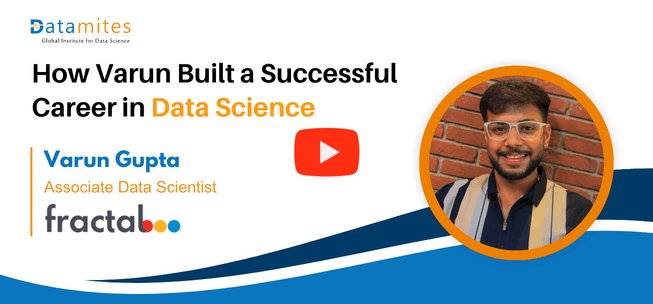
How Varun Built a Successful Career in Data Science
Explore Varun's inspiring Data Science career journey, from learning essential skills to securing opportunities in the fast-growing data industry.
 Prerana B A
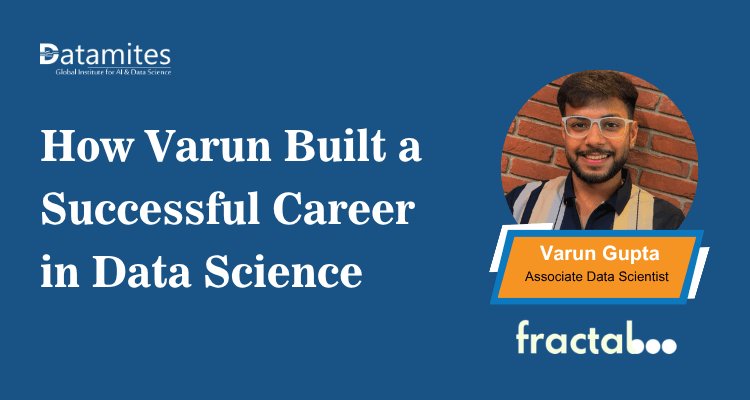
Career transitions into data science rarely follow a straight line, and Varun Gupta's journey is a great example of that. Starting out as a social media manager during his BCA degree, Varun went on to become an Associate Data Scientist at Fractal Analytics, working on Generative AI and MLOps projects for global healthcare clients. Along the way, he built his foundation in data science through DataMites, picked up hands-on experience with tools like Databricks, and transitioned into prompt engineering and Gen AI development.
In this DataMites success story, Varun shares his complete career path from his early interest in Python to landing his first ML Ops role, and finally becoming an Associate Data Scientist at Fractal Analytics. This Q&A covers practical advice for freshers, insights into what interviewers actually look for, and a behind-the-scenes look at how Gen AI is being applied in real healthcare use cases. If you're exploring a career in Data Science, Machine Learning, or Gen AI, this conversation offers a grounded, real-world perspective on what the journey actually looks like.
How Varun Gupta Built a Career in Data Science
Varun Gupta's journey into Data Science is a great example of how curiosity, continuous learning, and practical experience can shape a successful career.
Q1. Please introduce yourself and tell us about your career journey.
I'm Varun Gupta, currently working as an Associate Data Scientist at Fractal Analytics. I work on Generative AI and MLOps projects. I'm also a Fractal Certified GenAI Associate, a Cloud Certified Architect, and a DataMites alumnus. I'm currently pursuing my Master's in Data Science.
I completed my BCA from Chitkara University. Alongside my studies, I worked as a Social Media Manager for my university for over two years. During my final year, I joined DataMites, where I built a strong foundation in Statistics, Python, Machine Learning, and MLOps. My first industry role was at Digital Vision Pharma, where I worked on MLOps using Databricks. After working there for about a year, I joined Fractal Analytics, where I now work on Generative AI projects.
Q2. What was your background before entering Data Science?
I completed my Bachelor of Computer Applications (BCA) from Chitkara University. During college, I worked as a Social Media Manager for my university's official pages for over two years. At the same time, I started exploring Python through small projects, which gradually led me toward Data Science and Machine Learning.
Q3. What inspired you to move into Data Science?
While working as a Social Media Manager, I started exploring Python through personal projects. That gradually led me to Data Science and Machine Learning, and I became genuinely interested in the field.
Q4. How was your learning experience at DataMites?
It was a great experience. Since I had college classes, I mostly watched the recorded sessions and attended important live sessions whenever possible. The course helped me build strong data science fundamentals, which played a major role in helping me secure my first job.
Q5. Did you complete internship projects through DataMites?
My main goal was to work on Machine Learning projects. However, I got an opportunity to work in the MLOps domain at Digital Vision Pharma, which turned out to be a valuable learning experience. Later, I interviewed for an MLOps role at Fractal Analytics but eventually joined a Generative AI project, which I'm currently working on with Philips.
Q6. What technologies did you work with in your first role?
My primary work involved Databricks. I worked on tasks related to data monitoring, model monitoring, data drift detection, and feature management. I also completed Python-based tasks and worked on prompt engineering projects, which were becoming increasingly popular during that period.
Q7. Did you already know Databricks before joining the company?
No. Databricks was completely new to me. A senior colleague guided me and helped me understand the platform. DataMites had already given me strong Machine Learning fundamentals, which made learning Databricks much easier in the corporate environment.
Q8. What other technologies did you use in your first job?
Apart from Databricks, I worked on Python-based tasks and also contributed to a small Prompt Engineering project. At that time, Prompt Engineering was becoming an emerging skill.
Q9. What kind of Generative AI project are you currently working on?
Initially, I worked mainly on Prompt Engineering. Later, I moved into development using LangChain and vector databases.
One of our projects with Philips focuses on healthcare. Service engineers report issues whenever medical devices malfunction. However, many reports contained incomplete or inaccurate information. We developed a Generative AI-based API that validates the information entered by engineers using Large Language Models (LLMs), ensuring the reports are accurate before submission.
Q10. What skills do interviewers mainly look for in Data Science candidates?
Python is absolutely essential. Every interview I attended focused heavily on Python. Candidates should also have a basic understanding of data structures. Interviewers expect you to have a solid understanding of Python syntax and programming concepts.
Q11. Which AI skills are currently in high demand?
Prompt Engineering has evolved significantly, and newer concepts are emerging rapidly. Generative AI is currently one of the fastest-growing areas. Building personal Generative AI projects is extremely valuable because they demonstrate practical knowledge during interviews.
Q12. What advice would you give to freshers entering Data Science or AI?
Practice Python consistently. Before solving interview questions, build small projects such as simple games or automation tools. Projects help you understand Python syntax and coding logic much better than theory alone.
While AI tools can assist with learning, don't depend on them completely. Learn to read and understand code yourself because that's a critical skill in real-world projects.
Q13. Any final message for aspiring Data Scientists?
Keep learning, practice regularly, and focus on building projects. Strong fundamentals in Python and practical implementation will help you succeed in Data Science, MLOps, and Generative AI careers.
Refer to these articles :
- Siddharth's Journey From Beginner to Data Science Professional
- Junaid’s Path from MLOps Engineer to Senior Data Scientist
- Subramani’s Journey from Data Enthusiast to Data Engineer
Key Findings from Varun Gupta's Journey
Varun Gupta's journey highlights how strong fundamentals, practical learning, and continuous upskilling helped him grow into an Associate Data Scientist at Fractal Analytics. Here are the key takeaways from his inspiring DataMites success story.
- Non-linear career paths work: Varun entered data science after two years as a social media manager, proving a non-technical starting point isn't a barrier to breaking into the field.
- Curiosity was the real catalyst: His shift into data science began with self-driven Python POC projects during college, not a formal career plan.
- DataMites training happened alongside college: Varun completed his ~6-month DataMites course in the final year of his BCA, relying mainly on recorded sessions due to his academic schedule.
- Foundational training paid off later: He credits DataMites with clearing his core fundamentals in statistics, Python, and ML, which became the base for all his later corporate learning.
- First job placed him in an unplanned specialization: Though aiming for machine learning, Varun landed in MLOps at Digital Vision Pharma, working on Databricks.
- On-the-job mentorship filled skill gaps: Databricks was new to him; a senior colleague's guidance was key to ramping up quickly.
- Early exposure to prompt engineering: Even in his first MLOps role (2024–2025), Varun got early hands-on exposure to prompt engineering, before it became mainstream.
- Career progression was fast: He moved from Digital Vision Pharma to Fractal Analytics as an Associate Data Scientist after just one year.
- Interview outcomes don't always match interview prep: Varun interviewed for an MLOps/AI Engineer role at Fractal but was ultimately placed on a Generative AI project instead.
- Real-world Gen AI use case (Philips): His current project uses an LLM-powered API to validate service engineers' diagnostic form submissions for Philips medical devices, addressing incomplete/incorrect field reporting.
- Gen AI isn't just chatbots: His example illustrates that Generative AI has practical enterprise applications well beyond consumer tools like ChatGPT.
- Skill evolution on the job: He progressed from pure prompt engineering into hands-on coding with LangChain and databases as the project matured.
Read these articles:
- Will Polars Replace Pandas? The Truth About Python’s New Data Library
- Data Scientist vs ML Engineer vs AI Engineer: Which Career Path Is Right for You?
- What Is Correlation in Data Science? Importance, and Real-World Examples
Varun Gupta's journey from social media management to Generative AI engineering highlights an important truth about breaking into data science: the path is rarely linear, and adaptability often matters more than a perfectly mapped-out plan. His story also reflects how foundational training in his case through DataMites combined with curiosity and consistent Python practice, can open doors to roles in MLOps, Gen AI, and beyond.
For freshers and career switchers considering a move into data science, Varun's advice is refreshingly practical build real projects, master Python fundamentals, and stay open to unexpected directions your career might take once you enter the field.
If you're planning a career in Data Science, Machine Learning, or Generative AI, Varun Gupta's journey highlights the importance of building strong technical skills, gaining hands-on project experience, and continuously learning. According to the U.S. Bureau of Labor Statistics, data scientist employment is projected to grow 34% from 2024 to 2034, while 365 Data Science reports that 77% of AI-related job postings require Machine Learning skills, with Python and SQL remaining the most in-demand programming languages. As AI adoption accelerates, the demand for professionals skilled in top IT courses such as Data Science, Machine Learning, Generative AI, Python, Data Engineering, and Artificial Intelligence continues to grow across industries.
Varun Gupta's DataMites success story began with structured learning during his BCA, where he built a strong foundation in Python, Statistics, and Machine Learning. This knowledge helped him launch his career in MLOps before progressing to his current role as an Associate Data Scientist at Fractal Analytics, where he works on real-world Generative AI solutions for the healthcare industry. Through hands-on projects, expert mentorship, and industry-focused training, DataMites prepares learners with practical skills and globally recognized certifications from IABAC and NASSCOM FutureSkills, helping them confidently pursue careers in Data Science and AI. Learners looking for a Data Science course in Nagpur can benefit from the same industry-focused curriculum, practical projects, and career-oriented training.
Whether you're a student, a recent graduate, or a working professional looking to transition into Data Science, DataMites offers comprehensive training through both online and offline learning. Learners searching for Data Science courses in Kochi can benefit from its industry-aligned curriculum, hands-on projects, and expert mentorship. With training centers in Bangalore, Chennai, Hyderabad, Pune, Mumbai, Ahmedabad, Coimbatore, Delhi, and other major cities, along with flexible online programs, DataMites makes quality data science education accessible. Varun's journey shows that with the right guidance, practical experience, and continuous learning, building a successful career in Data Science and Generative AI is well within reach.