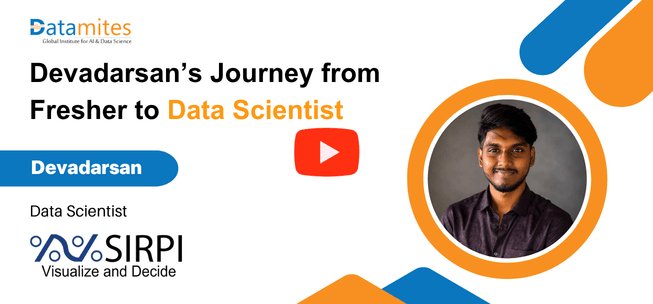
Devadarsan’s Journey from Fresher to Data Scientist
Devadarsan’s journey from a fresher to a Data Scientist showcases the power of structured learning, practical experience, and continuous skill development.
 Prerana B A
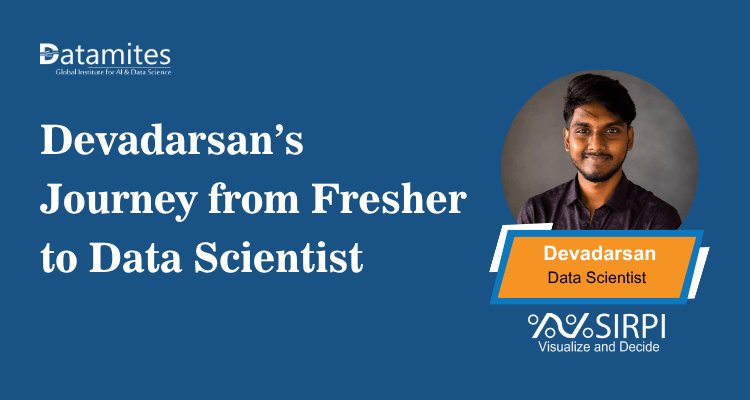
Changing careers from a non-technical background to Data Science may seem challenging, but with the right mindset, consistent practice, and quality training, it is entirely achievable. Devadarsan's journey is a perfect example of determination and continuous learning. After completing her B.Tech in Biotechnology, she decided to transition into the rapidly growing field of Data Science to explore better career opportunities.
In this DataMites success story, Devadarsan shares her experience of learning Python, SQL, Machine Learning, working on real-world projects, clearing mock interviews, and finally securing her first role as a Data Scientist at Sirpi in Bangalore. Her story offers valuable insights and practical advice for anyone planning to build a successful career in Data Science.
Devadarshini's Data Science Career Journey
Devadarshini’s data science career journey reflects the impact of focused learning, practical training, and consistent effort in building a successful career in the technology domain.Her transition into Data Science was supported by skills in Python, SQL, Machine Learning, and Data Analytics.
Q1. Could you please introduce yourself?
I'm Devadarsan. I completed my B.Tech in Biotechnology from Sathyabama Institute of Science and Technology. Since my background is non-IT, I decided to transition into Data Science because it is a rapidly growing field with excellent career opportunities. To build the required skills, I joined DataMites, where I learned Python, SQL, Machine Learning, and worked on real-time projects. Recently, I was placed as a Data Scientist at Sirpi, and I'm excited to begin my professional journey.
Q2. Which company have you been placed in, and where is the job located?
I have been placed at Sirpi, and my job location is Hebbal, Bangalore.
Q3. Where did you complete your Data Science training?:
I completed the offline Data Science training at the DataMites center in Kudlu Gate, Bangalore.
Q4. Why did you switch from Biotechnology to Data Science?
While researching career opportunities, I realized that Data Science is a rapidly growing field with strong demand across industries. I believed transitioning from Biotechnology to Data Science would open up better career opportunities, so I decided to build my skills in this field.
Q5. How was your learning experience during the course?
Initially, coming from a non-IT background, I struggled with programming. However, the trainers started from the basics, which made learning easier. With daily practice and consistent coding exercises, I gradually became comfortable with Python, SQL, and Machine Learning concepts. Working on projects also helped me understand how theoretical concepts are applied in real-world scenarios.
Q6. Was learning programming difficult for you?
At first, I was worried because I had no programming experience. Fortunately, the trainers taught everything from the basics. After every class, I practiced coding problems regularly, which helped me understand programming concepts much better.
Q7. Which subject did you enjoy learning the most?
I really enjoyed learning Machine Learning. Initially, I thought it would be difficult, but once I started implementing models in projects, I understood how different algorithms are used for different types of data. Practical implementation made the concepts much clearer.
Q8. Did you join the course with friends?
No, I joined alone. Initially, I didn't know anyone, but later I made new friends during the course. Whenever I had doubts, I approached my trainers, and their guidance helped me improve.
Q9. How many mock interviews did you attend?
My first mock interview was scheduled in March, but I attended it in May due to high demand. I wasn't selected in the first mock interview because I had prepared mainly for theoretical questions, whereas the interview focused more on practical implementation. After identifying my weak areas, I practiced SQL queries and project-related questions. I attended another mock interview in June and successfully cleared it.
Q10. How helpful were the mock interviews?
Mock interviews were extremely helpful. They increased my confidence, identified my weak areas, and prepared me for actual company interviews. Once I cleared the mock interview, I felt much more confident during placement interviews.
Q11. How many company interviews did you attend before getting selected?
I attended interviews with three companies.
The first company interviewed me for a Data Engineer role.
The second company interviewed me for a DBA role.
The third company interviewed me for a Data Scientist role, where I was selected.
Q12. What kind of technical questions were asked during the interviews?
The interviewers first focused on my projects. They asked why I chose specific machine learning models, how I evaluated model performance, and the metrics I used. They also asked questions on Python, SQL, data structures, functions, object-oriented programming, and Machine Learning algorithms such as Decision Trees and Random Forests.
Q13. How long did it take you to complete your projects?
My first project took around 30 days because I was still learning the overall project workflow. The second project took 15 days, and the third project took just one week. After gaining experience, I was able to complete projects much faster.
Q14. Have you completed your internship?
Yes, I completed my internship successfully and received my Data Scientist Internship Certificate from DataMites.
Q15. Did you receive any additional certifications?
Yes. I received certifications from IABAC and also completed the requirements for the NASSCOM FutureSkills certification.
Q16. What advice would you give to beginners who want to learn Data Science?
My advice is to be consistent. Attend every class carefully, listen to your trainers, and practice Python and SQL every day. Work on coding problems regularly, participate in mock interviews, and continue practicing after each interview. Consistency and practice are the keys to success in Data Science.
Q17. Where do you see yourself in the next two years?
My goal is to become a Senior Data Scientist at one of the leading multinational companies. I plan to continuously learn and improve my skills to achieve that dream.
Q18. What message would you like to share with aspiring Data Science professionals?
Believe in yourself, stay consistent, practice regularly, and never stop learning. If you dedicate time every day to improving your technical and interview skills, you can successfully build a career in Data Science.
Refer to these articles :
- How Rakshitha Successfully Transitioned Into Data Science
- Silpa’s Journey from Data Science Expertise to Leadership
- Career Growth in Data Science: Som Kumar’s Journey
Key Findings from Devadarsan's Data Science Success Story
Devadarsan’s journey from learning data science concepts to becoming a successful Data Scientist highlights the importance of structured training, practical exposure, and continuous skill development.
- Transitioned from a non-IT background: Devadarsan successfully moved from a Biotechnology background to a career in Data Science.
- Career shift driven by industry growth: She chose Data Science after recognizing its increasing demand and promising career opportunities.
- Built strong technical skills: She learned Python, SQL, Statistics, and Machine Learning through structured training and hands-on practice.
- Started learning from the basics: Despite having no programming experience, beginning with fundamental concepts made the learning process manageable.
- Consistent practice led to improvement: Daily coding exercises and regular revision helped her gain confidence in programming.
- Hands-on projects strengthened practical knowledge: Real-world projects enabled her to apply theoretical concepts and understand machine learning implementation.
- Machine Learning became her favorite subject: Practical exposure helped her develop a strong interest in machine learning algorithms and model selection.
- Project completion became faster with experience: Her first project took around 30 days, while later projects were completed in as little as one week.
- Mock interviews played a crucial role: Initial mock interview challenges helped her identify skill gaps and improve before actual placement interviews.
- Interview preparation focused on projects: Most technical interviews emphasized project work, machine learning models, Python, SQL, and problem-solving skills.
Devadarsan's transition from Biotechnology to Data Science is a great example of how structured training, real-world project exposure, and consistent practice can help career switchers land their first data science job even without a technical background.
Refer to these articles :
- What Are The 10 Statistical Techniques That Data Scientists Need To Master?
- Difference Between Data Science And Machine Learning
- Why Data Science Matters The Most Now?
If you're planning to build a career in Data Science, Devadarsan's journey demonstrates that consistent learning, hands-on projects, and practical interview preparation can help professionals from any academic background transition into this high-demand field. According to Business Research Insights, the global AI Training Dataset market is projected to grow from USD 2.55 billion in 2024 to USD 10.82 billion by 2032, expanding at a CAGR of 19.8%. This remarkable growth is driven by the rapid adoption of Generative AI, machine learning, and enterprise AI applications, creating significant demand for skilled professionals. As a result, Data Science, Artificial Intelligence, Machine Learning, Python, Data Engineering, and AI Engineering have emerged as some of the top IT courses, offering excellent career opportunities across industries.
Devadarsan's successful transition into a Data Scientist was made possible through structured training at DataMites. The comprehensive curriculum equipped him with practical skills in Python, SQL, Machine Learning, and Data Analytics through hands-on projects and expert mentorship. Continuous practice, mock interviews, and internship opportunities helped him gain the confidence to secure his first Data Scientist role. With globally recognized IABAC and NASSCOM FutureSkills certifications, DataMites prepares learners with industry-relevant skills, practical experience, and career support. Enrolling in a Data Science course in Noida can be a valuable step toward building a rewarding career in one of the top IT courses with strong industry demand.
Whether you're a fresher, a working professional, or someone planning a career transition like Devadarsan, DataMites makes quality Data Science education accessible. With both online and offline training centers, DataMites offers Data Science courses in Chandigarh along with programs across major cities in India. Through structured learning, real-world projects, expert mentorship, and globally recognized IABAC and NASSCOM FutureSkills certifications, learners gain the practical skills and confidence needed to succeed in the industry. Devadarsan's journey demonstrates that with the right guidance, hands-on learning, and consistent effort, building a successful career in Data Science is an achievable goal in today's rapidly evolving IT landscape.