AI Engineer vs Data Scientist in Saudi Arabia
Compare AI Engineer and Data Scientist careers in Saudi Arabia, including salary insights, key skills, job opportunities, industry demand, and career paths.
 Swagatam Sinha
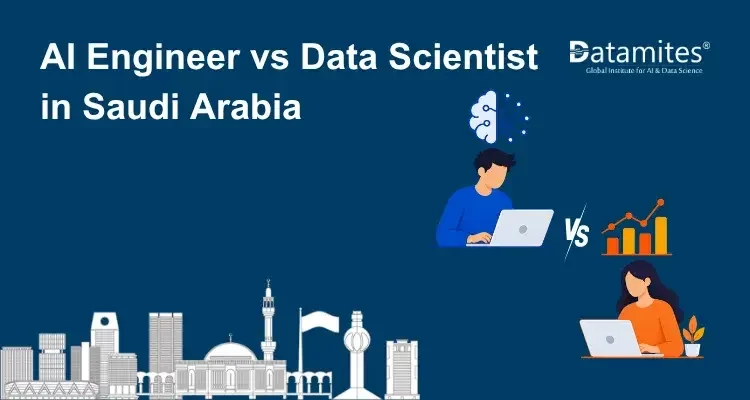
Choosing between an AI engineer and a data scientist career in Saudi Arabia depends on more than technical interests. Both professions are becoming relevant as organizations invest in artificial intelligence, automation and data-driven operations. However, their responsibilities, salary expectations and technical requirements differ. Understanding these differences can help fresh graduates and working professionals decide which career aligns with their skills and long-term goals.
Saudi Arabia's Vision 2030 initiatives, investments in digital infrastructure and growing interest in AI applications are creating new areas for technology professionals. From financial services in Riyadh to energy operations in the Eastern Province, businesses are exploring ways to use AI and data analytics. This guide compares AI engineers vs. data scientists in Saudi Arabia, including salaries, technical skills, industry applications and career progression.
Why AI and Data Science Careers Are Growing in Saudi Arabia
Artificial intelligence and data science are important parts of Saudi Arabia's plans to diversify its economy and strengthen its technology capabilities. Through Vision 2030, the Kingdom is encouraging innovation, digital transformation and the development of specialized technical skills.
The Saudi Data and Artificial Intelligence Authority (SDAIA) leads the country's National Strategy for Data and AI. Its objectives include developing national capabilities, encouraging investment and expanding the use of data and AI across sectors such as healthcare, energy, mobility and government services.
Another important development is the designation of 2026 as the Year of Artificial Intelligence in Saudi Arabia. The initiative highlights the country's focus on AI adoption, infrastructure development and talent development. According to the Saudi Press Agency (SPA), SDAIA’s training programs had reached more than 1.56 million beneficiaries by June 2026, including 14,495 specialists and experts in data and AI.
These developments provide context for people considering technology careers. Organizations need professionals who can build AI applications, analyze information, and translate technical solutions into practical business outcomes. AI engineers and data scientists contribute to these objectives in different ways.
Refer to these articles:
- Data Science and Automation: Will AI Replace Data Scientists?
- How Generative AI is Changing the Role of Data Scientists
- How To Become A Data Scientist?
AI Engineer vs Data Scientist: Roles and Responsibilities
Although both professionals work with programming, machine learning and data, their responsibilities differ.
An AI engineer develops, integrates and deploys artificial intelligence applications. The role involves machine learning models, deep learning frameworks, APIs and cloud platforms. The objective is to build systems that automate tasks, process language and recognize patterns.
A data scientist examines datasets to identify patterns, answer business questions and develop predictive models. The work involves statistics, programming, data preparation, machine learning and visualization.
| Comparison factor | AI Engineer | Data Scientist |
| Main responsibility | Develops AI applications | Analyses data and builds predictive models |
| Primary focus | Intelligent software systems | Data analysis and interpretation |
| Programming | Python, Java, SQL | Python, R, SQL |
| Technologies | TensorFlow, PyTorch, LLMs | Pandas, Scikit-learn |
| Key concepts | Deep learning, NLP, computer vision | Statistics, predictive analytics |
| Typical output | AI applications | Forecasts and analytical insights |
For example, a Saudi bank investigating suspicious transactions may use a data scientist to analyze historical records and identify fraud patterns. An AI engineer can then develop an automated system that uses these patterns to flag unusual transactions.
The two roles can work together, but they require different technical strengths.
AI and Data Science Applications Across Saudi Industries
Saudi Arabia's energy, financial, healthcare and infrastructure sectors offer several areas where AI and data analytics can be useful.
Smart cities and infrastructure
Saudi Arabia's major urban development projects involve transportation, utilities, construction and connected infrastructure.
An AI engineer may develop computer vision applications for monitoring traffic or detecting objects in real time. A data scientist can study transportation records, population movement and traffic patterns to help planners understand congestion and improve infrastructure planning.
Oil, gas and energy
The Eastern Province, including Dammam and Al Khobar, has an established energy and industrial ecosystem.
An AI engineer could build a predictive maintenance application that monitors equipment readings and identifies potential faults. A data scientist could examine historical maintenance records, operating conditions and production data to understand the factors associated with equipment failures.
For professionals based in this industrial region, an online data science course in Al Khobar can be one way to develop the analytical skills used in areas such as production forecasting, equipment monitoring and operational reporting.
Banking and financial services
Riyadh is an important center for financial institutions and technology businesses. Banks can use AI and analytics to improve fraud monitoring, customer service and risk assessment.
Data scientists work on credit-risk analysis, customer segmentation and transaction modeling. AI engineers develop applications that automate parts of these processes, including intelligent customer service tools and fraud detection systems.
People interested in developing analytical skills while continuing their existing work can consider an online data science course in Riyadh, particularly if they want to learn programming, statistical analysis and predictive modeling.
Healthcare
Hospitals and healthcare organizations can use data analytics to understand patient trends, improve resource planning and support clinical services.
A data scientist may examine hospital admission patterns and treatment records to support operational decisions. An AI engineer may develop medical imaging applications or intelligent healthcare software, subject to clinical validation and applicable regulations.
Logistics and retail
Jeddah's commercial and logistics activities, along with retail operations across the Kingdom, create opportunities for predictive analytics and automation.
A data scientist can forecast product demand by analyzing seasonal sales and purchasing behavior. An AI engineer can develop recommendation systems or intelligent inventory applications that use these predictions.
For learners interested in the analytical side of these industries, an online data science course in Jeddah can help build knowledge of SQL, Python, data visualization, and machine learning.
These are examples of how the two professions can contribute to industry operations. Actual responsibilities depend on the employer, project and technical team.
Refer to these articles:
- What is an AI Agent? Guide to Intelligent Agents in AI
- Agentic AI vs Generative AI: What’s the Difference?
- Traditional RAG vs Agentic RAG
AI Engineer vs Data Scientist Salary in Saudi Arabia (2026)
Salary expectations differ according to experience, technical expertise, employer and industry. According to Glassdoor's Saudi Arabia salary estimates, AI engineers earn a median total pay of approximately SAR 18,000 per month, compared with SAR 16,000 for data scientists.
| Job role | Median monthly total pay | Estimated monthly total pay range |
| AI Engineer | SAR 18,000 | SAR 14,000–25,000 |
| Data Scientist | SAR 16,000 | SAR 12,000–24,000 |
These figures represent estimated total monthly pay, which includes basic salary and additional compensation. The published ranges cover the 25th to 75th percentile of available salary data. They should be treated as market estimates rather than official national averages or guaranteed earnings.
Experience with machine learning deployment, cloud infrastructure, generative AI and advanced analytics may influence earning potential. Candidates should also compare housing allowances, transport benefits and medical insurance when evaluating job offers.
Technical Skills Required for AI Engineers and Data Scientists
Employers generally look for professionals who can apply technical knowledge to practical business problems. The skills required depend on the job description, but the following areas provide a useful starting point.
Skills required to become an AI engineer
AI Engineering suits people who enjoy programming, software development and building intelligent applications.
- Python programming: Used to develop AI applications, automate processes and work with machine learning libraries.
- Machine learning and deep learning: Important for training models and developing intelligent systems.
- TensorFlow and PyTorch: Frameworks used to build and train deep learning models.
- Generative AI and LLMs: Knowledge of large language models, retrieval-augmented generation (RAG) and prompt engineering is useful for developing modern AI applications.
- Cloud platforms: AWS, Microsoft Azure and Google Cloud help professionals deploy and manage AI solutions.
- MLOps and APIs: Useful for integrating models into applications, monitoring performance and maintaining production systems.
Knowledge of natural language processing and computer vision can also be valuable, especially for applications involving Arabic language technologies, document processing and image recognition.
For professionals looking to develop these capabilities through flexible learning, an online artificial intelligence course in Saudi Arabia can provide a structured introduction to machine learning, deep learning, generative AI and AI application development.
Skills required to become a data scientist
Data science is suitable for individuals who enjoy statistics, analytical thinking and working with information.
- Python and SQL: Used for data manipulation, querying databases and developing analytical models.
- Statistics and probability: Help explain relationships, distributions and uncertainty in datasets.
- Data cleaning: Involves identifying missing values, correcting inconsistencies and preparing information for analysis.
- Machine learning: Supports classification, regression, clustering and forecasting.
- Data visualization: Power BI and Tableau help communicate findings through dashboards and reports.
- Business understanding: Helps connect analytical results with organizational requirements.
For instance, a data scientist working with a Saudi retail business might use sales information to forecast demand during Ramadan or other seasonal periods. The ability to explain the findings to business teams is just as important as developing the model.
Refer to these articles:
- How to Become a Data Scientist in Saudi Arabia?
- How Much is the Data Science course fee in Saudi Arabia?
- Is Data Science and Artificial Intelligence in Demand in Saudi Arabia?
AI Engineer and Data Scientist Job Opportunities in Saudi Arabia
The type of opportunity available can differ according to location and industry. Jobseekers should consider the local business ecosystem rather than assuming that every city offers the same range of technology roles.
Riyadh: Government digital programs, financial institutions, consulting firms and technology companies make Riyadh an important location to explore. Relevant positions may involve machine learning, AI development, business intelligence and predictive analytics. People interested in building the necessary technical foundation can explore an online artificial intelligence course in Riyadh to study AI concepts and application development.
An online data science course can help aspiring professionals develop skills in Python, SQL, data analysis and machine learning for roles in Riyadh's growing technology sector.
Jeddah: Commercial activities in logistics, retail, healthcare and financial services create potential applications for customer analytics, demand forecasting, intelligent automation and business reporting. An online artificial intelligence course in Jeddah may be relevant to learners who want to understand how AI applications can support these business activities.
An online artificial intelligence course can help aspiring professionals develop foundational knowledge of machine learning, deep learning and AI applications relevant to these industries.
Dammam and Al Khobar: The Eastern Province has a strong industrial and energy presence. Professionals can explore roles connected to industrial analytics, predictive maintenance, operational data and automation. An online artificial intelligence course in Al Khobar can help interested learners build knowledge of machine learning, deep learning and AI technologies relevant to these applications.
NEOM and emerging development projects: Large-scale infrastructure and development initiatives provide potential applications for smart mobility, connected infrastructure, energy management and intelligent monitoring.
People searching for AI engineer jobs in Saudi Arabia or data scientist jobs in Saudi Arabia should compare the actual responsibilities mentioned in vacancies. Some employers use titles such as Machine Learning Engineer, AI Specialist, Data Analyst or Applied Scientist for positions involving overlapping skills.
Qualifications and Certifications for AI and Data Science Careers
Degrees in computer science, information technology, mathematics, statistics and engineering can provide a useful foundation for either career. However, a relevant degree alone does not demonstrate that someone can build an AI system or analyze a business dataset.
Fresh graduates and career switchers should develop programming fundamentals, understand machine learning and complete practical projects. A portfolio containing predictive models, data dashboards or deployed AI applications can help demonstrate technical ability.
Choosing a data science course with hands-on assignments and industry-relevant tools can help learners build a strong foundation in data analysis and predictive modelling.
Saudi Arabia has also introduced a professional development initiative through SDAIA's AI Professional Badges. The program covers two specializations: AI Engineer and Data Scientist. In September 2026, more than 150 applicants from government entities, private companies, universities, research centers, and technology organizations participated in the assessment tests. The program uses a standardized three-level framework to evaluate specialized competencies. This initiative provides a local benchmark for professionals seeking to demonstrate their technical and analytical skills.
For learners considering structured training, an online data science course in Saudi Arabia can provide a learning path covering Python, statistics, machine learning and data visualization. Those interested in developing AI applications can also consider an artificial intelligence course that introduces machine learning, deep learning, generative AI and deployment concepts.
Non-IT graduates can also work towards these careers, but they should first build a foundation in programming, mathematics and analytical problem-solving.
Which Career Is Better in Saudi Arabia for Freshers and Professionals?
The right choice depends on a person's existing experience and preferred type of work.
- Fresh graduates: Computer science graduates interested in software development may prefer AI engineering. Those who enjoy mathematics, statistics and interpreting information may find data science more suitable.
- Software developers: Professionals familiar with Python, Java, APIs and application development can build on their experience by learning machine learning, deep learning and AI deployment.
- Data analysts: People working with SQL, Excel, Power BI or Tableau can progress towards data science by learning statistics, predictive modeling, and machine learning.
- Non-IT professionals: Individuals from finance, engineering, healthcare and business backgrounds can explore either field after developing programming and analytical fundamentals.
Rather than choosing a career based only on salary, candidates should consider the technical work involved, their current skills and the type of problems they want to solve.
Career Growth and Future Scope for AI Engineers and Data Scientists
AI Engineers can progress from junior development positions to senior engineering roles, AI architecture, MLOps specialization, and technical management. Data scientists can move from junior analytical positions to senior data scientist, lead data scientist, analytics management and data strategy roles.
The development of generative AI, Arabic language models, enterprise automation and data-driven public services may create new areas of specialisation. AI engineers may focus on building and maintaining intelligent applications, while data scientists may work on advanced analytics, predictive modeling, and decision science.
Career progression will depend on practical experience, technical depth, communication skills and the needs of individual employers. Professionals in both fields should continue updating their knowledge as tools, platforms and business requirements change.
Refer to these articles:
- How to Become an Artificial Intelligence Engineer in Saudi Arabia?
- How Much is the Artificial Intelligence Course Fee in Saudi Arabia?
- How Much is the Artificial Intelligence Course Fee in Riyadh?
How to Choose the Right Career Path
Choose AI Engineering if you enjoy developing software, integrating machine learning models and building intelligent applications. Data science may be a better fit if you prefer statistics, analyzing datasets, and using predictive models to answer business questions.
Before making a decision, review job descriptions in your preferred industry, identify the skills employers request and try small projects related to each role.
AI Engineering and Data Science offer different career paths within Saudi Arabia's developing technology ecosystem. AI engineers build intelligent applications, while data scientists use information to generate insights and support business decisions. Individuals interested in these fields can explore DataMites AI Engineer and Data Scientist learning programs to develop relevant skills.
DataMites is a professional training institute offering programs in artificial intelligence, data science, machine learning, and related technology fields. With over 12 years of experience and more than 200,000 learners trained globally, the institute provides live online and blended learning options, including practical learning, internships and real-time projects.