The Role of Generative AI in Modern Healthcare
Explore how generative AI is transforming healthcare through clinical documentation, drug discovery, medical research, and patient communication, while examining its benefits, challenges, and future potential to improve patient care and healthcare delivery.
 Prerana B A
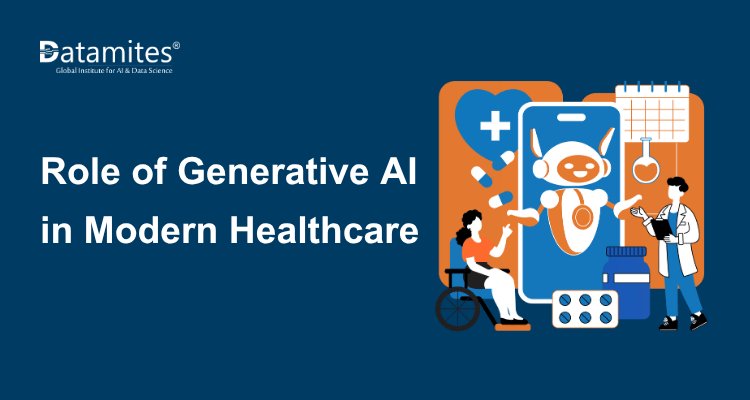
Generative AI is transforming healthcare by helping professionals manage medical information, support research, and improve patient communication. From drafting clinical notes to exploring potential drug candidates, this technology is creating new possibilities for healthcare organizations. It can also help simplify complex medical information and reduce repetitive administrative work.
The Role of Generative AI in Healthcare extends beyond automation. It includes supporting clinical documentation, medical research, patient education, and healthcare administration. As adoption grows, understanding its applications, benefits, and limitations is essential. Responsible implementation, patient privacy, and professional supervision remain critical to ensuring that AI supports healthcare professionals without compromising patient safety.
What Is Generative AI in Healthcare?
Generative AI refers to artificial intelligence systems that create new content, such as text, images, summaries, and synthetic data, based on patterns learned during training. In healthcare, these systems can summarize medical literature, draft clinical reports, and help explain health information in simpler language.
Unlike traditional AI systems that primarily classify information or predict outcomes, generative AI can generate responses based on specific instructions. Large language models (LLMs), for example, can process medical text and assist with information retrieval and documentation.
The World Health Organization guidance, Ethics and Governance of Artificial Intelligence for Health: Guidance on Large Multi-Modal Models, discusses the potential of these technologies in healthcare while highlighting risks involving accuracy, privacy, bias, and patient safety.
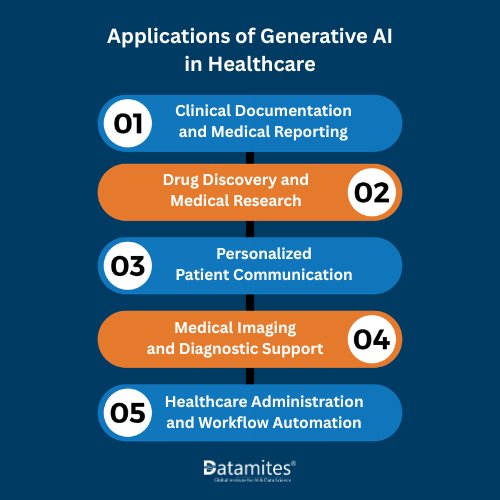
Key Applications of Generative AI in Healthcare
Explore the key applications of generative AI in healthcare, from clinical documentation and drug discovery to medical imaging, personalized patient communication, and healthcare workflow automation.
Clinical Documentation and Medical Reporting
Healthcare professionals spend considerable time preparing clinical notes, discharge summaries, referral letters, and patient records. Generative AI can help draft these documents from authorized consultation transcripts and medical information, subject to professional review.
This application is gaining attention. According to the Doximity, 2026 State of AI in Medicine Report, 54% of 3,151 surveyed US physicians reported currently using AI in clinical practice. In the November 2025 to January 2026 survey period, 29% reported using voice-based documentation tools, including ambient listening and AI scribes.
These findings highlight growing interest in documentation support. However, clinicians must review AI-generated notes for accuracy, missing information, and clinical relevance before approving them.
Generative AI in Drug Discovery and Medical Research
Drug discovery involves identifying promising compounds, testing their safety, and evaluating their effectiveness. Generative AI can help researchers explore potential molecules, analyze scientific literature, and generate hypotheses for further investigation.
A 2026 study indexed in PubMed, Artificial Intelligence-Enabled Drug Discovery: A Growing but Largely Early-Stage Clinical Pipeline, identified 129 AI-enabled therapeutic candidates that had entered human clinical trials by March 1, 2026. Of these, only five had entered or completed Phase 3 trials.
This finding demonstrates growing activity in AI-assisted drug development, but it also highlights the long path from identifying a promising candidate to establishing the safety and effectiveness of a medicine. Laboratory research and clinical trials remain essential.
Personalized Patient Communication
Medical terminology can be difficult for patients to understand. Generative AI can help healthcare providers draft simpler explanations of treatment plans, appointment instructions, discharge guidance, and educational materials.
For example, an AI tool could prepare a patient-friendly summary of a consultation for a healthcare professional to review. The clinician can then correct inaccuracies and adapt the explanation to the patient's needs.
These applications may improve access to understandable health information, but AI-generated content should not replace professional medical advice or personalized clinical assessment.
Medical Imaging and Diagnostic Support
Generative AI is being explored for synthetic medical image generation, research dataset development, and selected clinical decision-support applications. Multimodal AI systems can also process different types of information, such as medical images and clinical text.
However, generating an image or identifying a possible abnormality does not establish a diagnosis. Healthcare AI solutions intended for clinical use must undergo appropriate validation, and qualified professionals must interpret findings alongside the patient's symptoms, medical history, and other evidence.
Healthcare Administration and Workflow Automation
Hospitals and clinics manage appointments, patient enquiries, insurance documentation, internal reports, and medical records. Generative AI can assist with drafting routine communications, summarizing approved documents, and retrieving information from authorized sources.
These applications can help reduce repetitive work and organize information more efficiently. Appropriate access controls, human review, and data protection measures are necessary to prevent errors and unauthorized disclosure of patient information.
Refer to these articles:
- How AI Helps HR Teams Predict Workforce Needs
- Essential AI Skills for Marketing Professionals
- What are the ethical consideration in AI finance
Benefits of Generative AI in Healthcare
The benefits of generative AI in healthcare depend on the task, the quality of the system, and how it is implemented.
Key benefits include:
- Improved administrative efficiency: AI can assist with repetitive documentation and routine communication.
- Faster access to medical information: Researchers and healthcare professionals can use AI to summarize large volumes of approved documents and scientific literature.
- Research support: Generative models can help explore potential drug candidates and develop research hypotheses.
- Clearer patient communication: AI can help simplify complex medical terminology and prepare educational material.
- Better-organized workflows: AI-assisted tools can help teams retrieve information and prepare documents for professional review.
A study published in JAMA Network Open, Uptake of Generative AI Integrated With Electronic Health Records in US Hospitals, surveyed 2,174 US hospitals. It found that 31.5% reported using generative AI integrated with electronic health records in 2024, while 24.7% planned to adopt it within the following year.
This finding indicates growing organizational adoption. However, adoption rates alone do not establish that generative AI improves patient outcomes or guarantees cost savings.
Challenges and Limitations of Generative AI in Healthcare
Despite its potential, generative AI presents challenges that healthcare organizations must address before relying on it for patient-related tasks.
- Inaccurate information: AI may generate convincing but incorrect answers, making verification essential.
- Patient privacy: Medical information requires strong security, access controls, and responsible data handling.
- Algorithmic bias: Models trained on unrepresentative datasets may produce less reliable results for certain populations.
- Regulatory compliance: Healthcare organizations must follow applicable data protection and medical-device requirements.
- System integration: AI tools must work reliably with existing clinical systems and workflows.
- Human supervision: Qualified healthcare professionals must assess AI-generated information before it influences patient care.
A September 2026 review in BMJ Digital Health & AI, State of Clinical AI in 2026, reported that fewer than 5% of cleared US Food and Drug Administration AI and machine learning medical devices had undergone rigorous peer-reviewed evaluation. This statistic covers AI-enabled medical devices broadly, not generative AI alone, but it highlights the importance of stronger clinical evidence.
Healthcare organizations should therefore evaluate AI systems for their intended use, monitor performance after deployment, and establish clear accountability for decisions involving patient care.
Refer to these articles:
- What Are Graph Neural Networks?
- Traditional AI vs Generative AI
- What is Artificial Narrow Intelligence?
The Future of Generative AI in Healthcare
The future of generative AI in healthcare may include more advanced research assistants, AI-supported medical education, synthetic data generation, personalized patient communication, and tools that help professionals navigate complex medical information.
Multimodal AI systems may also make it easier to work with clinical text, medical images, and structured health records together. At the same time, broader adoption will require reliable validation, transparent governance, secure data practices, and collaboration between healthcare professionals and AI specialists.
Professionals interested in this field can develop skills in data science, machine learning, generative AI, and healthcare data analysis. These skills can help them understand how AI systems are developed, evaluated, and applied to practical healthcare challenges.
The Role of Generative AI in Healthcare continues to expand across clinical documentation, drug discovery, medical research, patient communication, and healthcare administration. These applications offer opportunities to improve efficiency and make medical information more accessible, but they also introduce risks involving accuracy, privacy, bias, and patient safety.
Successful adoption depends on evidence-based evaluation, responsible data handling, regulatory compliance, and human expertise. When applied to appropriate tasks under professional supervision, generative AI can support healthcare teams while keeping patient safety and quality of care at the centre of every decision.
DataMites Institute offers AI for Healthcare certification designed to help healthcare professionals understand AI fundamentals and explore applications in patient care, hospital operations, and medical research. The institute also offers specialized AI programs in HR and people analytics, finance, marketing, and business management.
Learners can choose from online classes, classroom training, and project-based internships to gain practical skills. The program provides IABAC-aligned certification leading to the Certified AI Professional in Healthcare & Clinical Operations credential. With 50+ offline centres across India, including Bangalore, Chennai, Hyderabad, Pune, Mumbai, Ahmedabad, Coimbatore, and Delhi, DataMites offers flexible learning options for healthcare professionals and individuals looking to develop their AI knowledge.