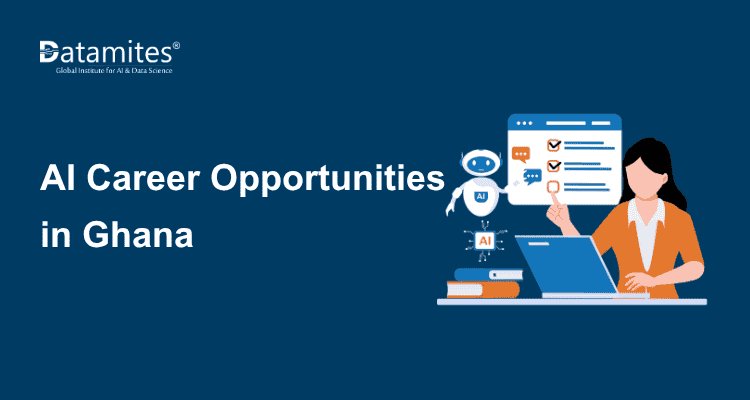
AI Career Opportunities in Ghana
Explore AI career opportunities in Ghana, including job roles, salaries, in-demand skills, hiring industries and practical steps to start an artificial intelligence career.
 Swagatam Sinha
Artificial intelligence (AI) is finding practical applications in fraud detection, customer service, demand forecasting and business automation. In Ghana, these technologies are becoming relevant to industries such as banking, telecommunications, agriculture, healthcare and logistics. As businesses explore ways to use data and automation, professionals with AI and related technical skills have more career paths to consider.
Ghana's National Artificial Intelligence Strategy for 2025–2035, launched on April 24, 2026, outlines the country's priorities for AI development, workforce readiness and responsible innovation. The government has also announced a proposed US$250 million AI Computing Center to support research and infrastructure. These initiatives indicate growing policy interest in artificial intelligence, although their effect on employment will depend on implementation and business adoption.
For graduates, freshers and working professionals exploring AI career opportunities in Ghana, understanding available job roles, required skills, salary expectations and recruitment channels can help with career planning. This guide looks at the opportunities and practical steps involved in entering the field.
What Is Driving Interest in AI Careers in Ghana?
Ghana's digital economy is developing, and technology is becoming more important to business operations. According to Ghana Statistical Service figures reported by the Ghana News Agency in September 2026, the country's economy grew by 6% in the second quarter of 2026. During the same period, the information and communication sector recorded 30.9% year-on-year growth and was identified as the leading contributor to economic expansion.
Market research also indicates increasing interest in enterprise AI applications. According to 6Wresearch's Ghana Enterprise AI Market report, updated in July 2026, the market was estimated at US$1.036 billion in 2025 and is projected to reach US$1.855 billion by 2032, representing a forecast CAGR of 12.4% between 2026 and 2032. These are market estimates, not measurements of AI employment or confirmed job vacancies.
Government programs are another part of this development. Alongside the National AI Strategy, Ghana announced plans for a US$250 million AI Computing Center. In September 2026, the Ministry of Communication, Digital Technology and Innovations reported that the One Million Coders Programme had recorded 141,954 registered accounts, with interest in subjects including AI, data analytics and cybersecurity.
For job seekers, these developments provide useful context, particularly when considering opportunities in Accra's financial services, telecommunications and technology sectors. Banks may use machine learning to identify suspicious transactions, while telecom companies can analyze customer activity to understand service issues and predict customer churn. Agriculture and healthcare organizations also have potential applications involving forecasting, image analysis, and operational planning.
However, increased investment does not automatically translate into a large number of AI vacancies. Candidates should examine actual job descriptions and develop skills that match the responsibilities employers are advertising.
Refer to these articles:
- What is an AI Agent? Guide to Intelligent Agents in AI
- Agentic AI vs Generative AI
- Human Intelligence vs Artificial Intelligence: Key Differences and Insights
Which AI Jobs Can You Pursue in Ghana?
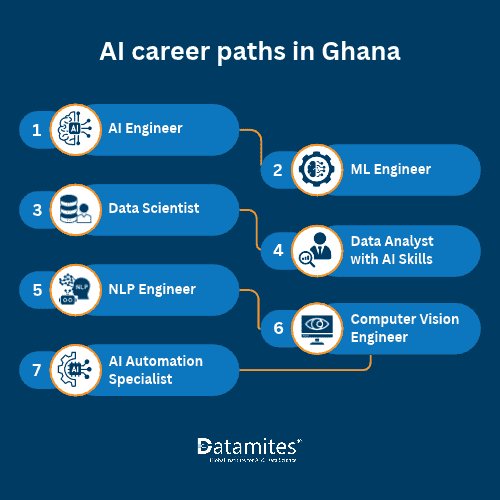
AI-related careers cover several professional areas. Some involve developing machine learning models, while others focus on integrating existing AI technologies into business applications.
1. AI Engineer
AI engineers develop software applications that use artificial intelligence. They may build customer-service assistants, integrate language models into business platforms or create systems that automate repetitive processes.
In Ghana, these applications could be relevant to financial services, e-commerce and customer support operations. Python, software development, APIs and model integration are important foundations. Knowledge of cloud platforms and retrieval-augmented generation (RAG) can also be useful.
2. Machine Learning Engineer
Machine learning engineers develop and deploy models that identify patterns in information and generate predictions. Their work may involve fraud detection, demand forecasting, customer segmentation and risk analysis.
This profession requires a good understanding of Python, statistics, algorithms and model evaluation. Professionals should also know how to test models using suitable datasets and monitor their performance after deployment.
3. Data Scientist
Data scientists use programming, statistics and business knowledge to investigate complex problems. They analyze large datasets, identify patterns and develop models that help organizations make informed decisions.
For example, a data scientist working with a financial institution could study customer behavior to understand factors associated with loan defaults. Python or R, SQL, statistical analysis, and data visualization are commonly used in this role.
4. Data Analyst with AI Skills
Data analysts organize information, prepare reports and identify trends that support business decisions. With additional AI knowledge, they can use automation and analytical tools to improve reporting and data exploration.
Banking, retail and telecommunications businesses can benefit from professionals who understand both business requirements and data. SQL, spreadsheets, dashboard tools and basic Python are useful starting points.
5. Natural Language Processing Engineer
Natural Language Processing (NLP) engineers develop systems that work with written and spoken language. Their responsibilities can include text classification, document processing, speech recognition and conversational applications.
Ghana offers interesting possibilities for language technology involving Akan, Ewe, Ga and other local languages. Developing reliable applications in these areas requires suitable language datasets, Python programming and careful model evaluation.
6. Computer Vision Engineer
Computer vision engineers create systems that interpret images and videos. Their work may involve object detection, image classification and visual inspection.
Potential applications in Ghana include crop monitoring, agricultural disease detection and industrial quality checks. Python, image processing and deep learning are useful skills for entering this field.
7. AI Automation Specialist
AI automation specialists develop workflows that reduce repetitive tasks across business operations. They may connect AI tools with customer service platforms, document management systems and other business applications.
This role often involves API integration, workflow design, programming and process analysis. Unlike some machine learning positions, it may focus more on implementing existing technologies than developing models from scratch.
Which Industries in Ghana Could Use AI Skills?
The potential use of AI extends beyond technology companies. Several established industries can apply these tools to improve operations, analyze information, and support business decisions.
- Banking and fintech: Financial institutions can use machine learning for transaction monitoring, fraud detection, credit-risk analysis and customer segmentation.
- Telecommunications: Telecom companies can analyze network performance, forecast demand and identify customers who may discontinue their services.
- Agriculture: AI applications can support crop monitoring, pest identification, yield forecasting and agricultural supply chain planning.
- Mining and manufacturing: Predictive maintenance and equipment monitoring can help identify operational problems before they cause major disruptions.
- Healthcare: Image analysis, administrative automation and service planning are possible applications, provided appropriate privacy protections and clinical oversight are maintained.
- Retail and logistics: Businesses can use forecasting and customer analytics to improve inventory management, delivery planning and purchasing decisions.
These examples also provide useful ideas for candidates developing their portfolios. Someone interested in agriculture could analyze crop production data, while an aspiring financial technology professional could build a basic transaction classification model using an appropriate public dataset.
The important part is to explain the problem, data preparation, methodology, results and limitations of the project.
Refer to these articles:
- The Future of Coding: Can AI Replace Software Engineers?
- LLMs vs. SLMs: Key Differences and How to Choose the Right Model
- How Knowledge-Augmented Generation (KAG) Is Solving AI Hallucinations
AI Engineer and Machine Learning Engineer Salary in Ghana
The AI engineer salary in Ghana depends on experience, technical ability, employer and the responsibilities associated with the position.
According to the Global Salary Guide for Ghana, the estimated mid-career median annual salaries are:
| Job role | Estimated annual median salary |
| AI Engineer | GHS 412,000 |
| Machine Learning Engineer | GHS 396,000 |
These figures provide a reference for comparing the two professions. However, the published figures should not be interpreted as guaranteed earnings. The available source does not provide sufficient detail here about its salary sample size, collection methodology or gross-versus-net calculation.
Actual compensation can differ according to an employee's experience, organization, technical specialization, and employment arrangement. Candidates should compare these estimates with current job advertisements and salary information shared by employers before making career decisions.
What AI Skills Are Employers Looking For in Ghana?
The skills required depend on the position. An AI engineer may need stronger software development knowledge, while a data scientist needs a solid understanding of statistics and analytical methods. However, several technical foundations are useful across these professions.
- Python and SQL: Python is widely used for data processing, machine learning and application development. SQL helps professionals retrieve and organize information stored in databases.
- Statistics and machine learning: Probability, regression, classification and model validation help professionals understand how predictive systems work and evaluate their accuracy.
- Generative AI and language models: Familiarity with language models, APIs, RAG and output evaluation can help developers create applications using existing AI technologies.
- Data visualization: Charts, dashboards and reporting tools help communicate findings to business teams that may not have a technical background.
- Software development and deployment: Git, APIs, testing, cloud platforms and application monitoring are useful when moving projects from development into practical use.
- Communication and responsible AI: Professionals should be able to explain their findings, protect sensitive information and recognize problems such as biased data and unreliable predictions.
For someone interested in Ghana's local market, a project involving mobile money transaction analysis, retail demand forecasting or document processing can demonstrate how these skills work together.
If you are based in Accra and want to develop these competencies alongside your existing commitments, an online artificial intelligence course in Accra may be worth considering. Compare the curriculum, practical projects and learning format before selecting a programme.
How Can Freshers and Career Changers Start an AI Career in Ghana?
Entering the AI field does not always require previous experience in artificial intelligence. The learning path will depend on your educational background, current technical knowledge and preferred profession.
Here are some practical steps to follow:
- Choose a suitable career path: Decide whether you are more interested in AI engineering, machine learning, data science, data analytics or automation. Understanding the responsibilities of each role will help you select relevant subjects.
- Learn the technical foundations: Start with Python and SQL if you want to work in data-related positions. Add statistics and mathematics for machine learning, or strengthen software development skills if you are interested in building AI applications.
- Work on practical projects: Develop a simple forecasting model, analyse a business dataset or create a basic AI application. Begin with manageable problems instead of attempting complex systems immediately.
- Build a portfolio: Document your work through GitHub or another suitable portfolio platform. Include the problem, dataset, tools, approach, results and limitations.
- Prepare for technical interviews: Practice explaining your project decisions, data preparation methods, model evaluation and the problems you encountered.
- Apply for relevant positions: Look at internships, graduate opportunities, junior analytical positions and entry-level software roles. Apply according to the skills and experience requested in each vacancy.
People already working in technology can build on their existing knowledge. Software developers may focus on AI application development, while data analysts can expand into statistical modeling and machine learning. Professionals from finance, agriculture or healthcare can also combine their industry knowledge with technical training.
If you prefer a structured learning path, comparing an online artificial intelligence course in Ghana can help you evaluate the curriculum, hands-on projects, learning format and level of instruction before choosing a program.
Refer to these articles:
- CrewAI vs AutoGen vs LangGraph: Top Multi-Agent Frameworks for 2026
- Who is an AI Product Manager?
- AI Product Development Life Cycle Explained
What Challenges Should You Expect in Ghana's AI Job Market?
Although AI offers several possible career paths, entering the field requires preparation. Some positions demand strong programming and mathematical knowledge, while others expect experience with software integration and deployment.
Another challenge is gaining access to suitable datasets and computing resources. Beginners may find it difficult to work on complex projects without the infrastructure available to larger organizations. Starting with public datasets and smaller projects can help build practical experience.
Employers may also expect candidates to demonstrate more than theoretical knowledge. A portfolio should show how a problem was approached, how the data was handled and whether the results were reliable.
For professionals interested in local language technologies, the availability and quality of training datasets can be an additional challenge. Models must be evaluated carefully to ensure they work effectively across different languages and contexts.
Ghana's National AI Strategy provides a framework for developing the country's AI ecosystem, but planned investments and policy initiatives should not be treated as guarantees of employment. Job seekers should continue to assess actual recruitment activity and develop skills that match employer requirements.
AI career opportunities in Ghana cover several areas, including engineering, machine learning, data science, analytics, natural language processing, and automation. Growth in the information and communication sector and the country's National AI Strategy provide useful context for understanding the direction of the technology market. However, actual job availability and compensation depend on employer demand and individual capabilities.
For freshers and working professionals, choosing a suitable role, learning the required technical skills and completing practical projects are useful starting points. Monitoring local vacancies can also help identify which skills employers currently expect.
DataMites Institute is a globally recognized training institute with more than 12 years of trust and over 200,000 learners globally. It offers programs in artificial intelligence, data science, machine learning, data analytics, and Python, with structured learning and practical projects to help fresh graduates, working professionals and career changers develop relevant technical knowledge.