Career Transition Tips for Aspiring AI Product Managers
Explore essential career transition tips for aspiring AI Product Managers. Learn how to become an AI product manager, key AI product manager skills, AI product lifecycle management, and strategies to build a successful AI product manager career.
 Kriti Maurya
Artificial Intelligence is reshaping industries across the globe, creating new opportunities for professionals who want to lead innovation-driven products. As businesses increasingly adopt AI-powered solutions, the demand for skilled AI Product Managers continues to rise. Professionals from software development, marketing, business analysis, data analytics, and project management backgrounds are now exploring the ai product manager career path due to its strong growth potential and strategic importance.
The role of an AI Product Manager combines technical understanding, product strategy, customer insights, and business decision-making. For aspiring professionals, understanding how to become an AI product manager requires more than just product management knowledge. It involves building expertise in AI technologies, data-driven decision-making, and product lifecycle management.
The global artificial intelligence market is witnessing significant growth and is expected to rise from USD 294 billion in 2025 to nearly USD 2.48 trillion by 2034, driven by increasing investments from businesses and governments. (Source: Fortune Business Insights)
Here will explore essential career transition tips, required skills, challenges, and practical steps for professionals aiming to establish a successful career in AI Product Management.
Understanding the AI Product Manager Roles and Responsibilities
An AI Product Manager leads the development, launch, and optimization of AI-powered solutions that solve real business challenges. Professionals in this role collaborate with data scientists, engineers, and stakeholders to drive innovation through data driven product management and AI product lifecycle management.
With rising AI adoption across industries, the AI product manager career path is gaining strong demand. Understanding customer needs, AI technologies, and business strategy is essential for professionals exploring how to become an AI product manager and building a successful AI product manager roadmap.
Refer to the articles below:
- Top AI Career Opportunities in Finance for Future Professionals
- Best AI Platform for Finance Data Analysis in 2026
- AI Trends That Will Transform Marketing and Advertising
Why Professionals Are Transitioning into AI Product Management
The growing demand for AI-powered solutions is driving a major career transition to AI product management across industries. Professionals are choosing an AI product manager career because it combines innovation, leadership, strategic planning, and technology-driven decision-making. Organizations need experts who can bridge business goals with AI capabilities through effective data driven product management practices.
A Gartner industry analysis for 2026–2028 reveals that more than 60% of enterprise AI applications continue to depend on traditional machine learning models for functions such as forecasting, automation, and risk analysis.
Key reasons for transitioning include:
- High demand for AI product managers
- Strong salary and leadership opportunities
- Growing adoption of AI across industries
- Opportunities for professionals from tech and business backgrounds
- Increasing focus on AI Product Development LifeCycle management and product innovation
For professionals exploring how to become an AI product manager, this career offers long-term growth and future-ready opportunities.
Essential Skills Required for AI Product Managers
Building a successful AI product manager career requires a combination of technical expertise, business knowledge, communication abilities, and leadership skills. Since the AI product manager roles and responsibilities connects multiple departments within an organization, aspiring professionals must develop a diverse skill set.
- Technical Understanding of AI and Machine Learning: Professionals pursuing an AI product manager career should understand machine learning, neural networks, predictive analytics, natural language processing, and computer vision. This knowledge helps AI Product Managers collaborate effectively with technical teams and evaluate AI solutions based on business goals. Understanding these concepts is a crucial step in the AI product manager roadmap.
- Product Management Expertise: Strong product strategy, market research, agile methodologies, customer analysis, and product launch planning are essential AI product manager skills. Knowledge of AI product lifecycle management helps professionals manage AI products through development, deployment, monitoring, and optimization stages.
- Data-Driven Decision Making: AI Product Managers rely heavily on data driven product management to analyze user behavior, product performance, and business insights for better decision-making and customer experience improvement.
- Communication and Strategic Thinking: Professionals undergoing an AI product manager career transition should develop leadership, stakeholder communication, collaboration, and strategic planning skills to align AI products with business objectives.
Professionals pursuing an ai product manager career transition should focus on developing both technical and business-oriented perspectives to remain competitive in the industry.
How to Build a Career as AI Product Manager in 2026
Professionals interested in learning how to become an AI product manager should follow a structured learning and career development approach. Transitioning successfully into AI Product Management requires continuous skill development, hands-on experience, and industry exposure.
1. Build Foundational AI Knowledge
The first step in the AI product manager roadmap is developing a strong understanding of AI technologies and data analytics concepts. Learning topics such as machine learning, AI workflows, predictive modeling, cloud platforms, and data visualization can significantly improve career readiness.
Professionals can pursue certifications, online courses, workshops, and practical projects to strengthen their AI knowledge.
2. Gain Product Management Experience
Understanding traditional product management practices is equally important. Aspiring AI Product Managers should learn about agile methodologies, customer journey mapping, product roadmaps, market analysis, and feature prioritization.
Experience in product planning and execution helps professionals manage the complexities of ai product lifecycle management more effectively.
3. Work on AI-Driven Projects
Hands-on project experience is crucial for building credibility during an AI product manager career transition. Professionals should participate in AI-focused projects involving automation, analytics, recommendation systems, chatbots, or predictive solutions.
Practical exposure demonstrates the ability to apply theoretical concepts in real business environments.
4. Develop Analytical Thinking
Strong analytical skills are essential in data driven product management. AI Product Managers should become comfortable interpreting dashboards, analyzing KPIs, evaluating customer data, and making evidence-based product decisions.
Learning AI Product Manager Tools related to business intelligence and analytics can further strengthen career opportunities.
5. Improve Cross-Functional Collaboration Skills
Since AI Product Managers coordinate with technical and business teams, professionals should focus on improving leadership, communication, and stakeholder management capabilities.
Professionals transitioning from technical backgrounds may need to strengthen business communication, while business professionals may need deeper technical exposure.
6. Stay Updated with AI Trends
The AI industry evolves rapidly, making continuous learning essential. Professionals should stay informed about advancements in generative AI, automation, ethical AI practices, AI governance, and emerging product management trends.
Keeping up with industry developments strengthens long-term success in the ai product manager career journey.
Refer to the articles below:
- A Complete Guide to AI in Marketing
- Essential AI Tools for finance Smarter Analysis
- Popular AI Tools in Healthcare for 2026
Common Challenges in Transitioning to AI Product Manager Career
Although the opportunities are promising, professionals often face several challenges during their career transition to ai product management. Understanding these challenges can help aspiring AI Product Managers prepare more effectively.
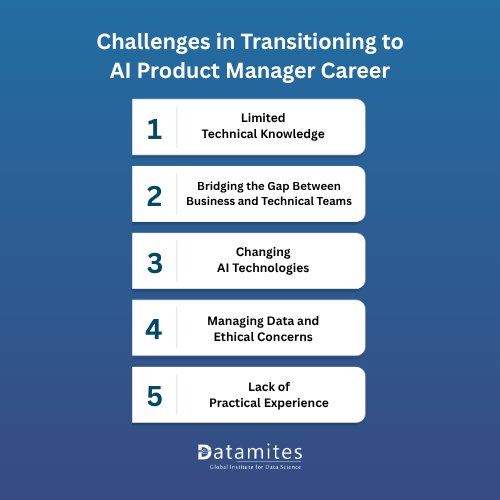
1. Limited Technical Knowledge
One of the most common barriers is the lack of technical AI understanding. Professionals from business or marketing backgrounds may initially struggle with machine learning concepts and AI development processes.
However, continuous learning and practical exposure can gradually improve technical confidence.
2. Difficulty Bridging Gap between Business and Technical Teams
AI Product Managers serve as a bridge between technical experts and business stakeholders. Many professionals find it challenging to communicate effectively with both groups simultaneously.
Developing strong communication and collaboration abilities is essential for overcoming this challenge.
3. Rapidly Changing AI Technologies
AI technologies evolve quickly, requiring professionals to continuously update their knowledge and skills. Staying relevant in the industry requires consistent learning and adaptability.
Professionals pursuing AI product manager roadmap should adopt a mindset of continuous improvement.
4. Managing Data and Ethical Concerns
AI products depend heavily on data collection, analysis, and automation. This creates challenges related to data privacy, bias, compliance, and ethical AI usage.
Understanding responsible AI practices is becoming increasingly important for modern AI Product Managers.
5. Lack of Practical Experience
Many aspiring professionals struggle to gain practical AI product experience during their AI product manager career transition. Building a portfolio through internships, freelance projects, certifications, and collaborative work can help address this issue.
Despite these challenges, the long-term career potential remains extremely strong for professionals willing to invest in learning and skill development.
Refer to the articles below:
- CrewAI vs AutoGen vs LangGraph: Top Multi-Agent Frameworks for 2026
- Green AI Guide: Quantization and FinOps to Reduce LLM Costs
- How AI Is Reshaping Careers and Professional Job Roles
The rapid growth of artificial intelligence is creating strong demand for professionals pursuing an AI Product Career. Understanding how to become an AI product manager requires a blend of technical expertise, strategic thinking, and data driven product management skills. Developing essential AI product manager skills, gaining practical experience, and mastering AI product lifecycle management can help professionals succeed in this evolving field.
DataMites Institute offers an industry-oriented AI product manager course program focused on AI-driven product strategy and business innovation. The course covers AI Product Management, Generative AI, AI for Marketing, AI for Finance, Healthcare, and HR Analytics. With live online, classroom, and internship training options, the globally recognized IABAC-certified program is available across Bangalore, Chennai, Hyderabad, Pune, Mumbai, Ahmedabad, and Coimbatore.