Predictive Analytics in Marketing: Benefits, Uses, and Examples
Discover how predictive analytics in marketing helps businesses forecast customer behavior, personalize campaigns, improve customer segmentation, optimize marketing budgets, and increase ROI. Explore key benefits, practical uses, and real-world examples of data-driven marketing strategies.
 Kriti Maurya
Predictive analytics in marketing helps businesses anticipate customer behavior, identify high-potential leads, improve customer retention, and optimize marketing campaigns. By analyzing historical data with statistical techniques and machine learning, marketers can estimate which customers are most likely to purchase, respond to an offer, or disengage from a brand.
Instead of relying solely on past campaign performance or intuition, businesses can use predictive marketing analytics to make more informed decisions about audience targeting, personalization, demand forecasting, and marketing budget allocation.
However, successful implementation requires more than a predictive model. Businesses also need reliable data, measurable objectives, ongoing performance evaluation, and responsible data practices.
This guide explains what predictive analytics in marketing is, how it works, its key benefits, practical applications, real-world implementation examples, and best practices for using predictive insights effectively.
What Is Predictive Analytics in Marketing?
Predictive analytics in marketing is the process of using historical customer data, statistical modeling, and machine learning to estimate future customer behavior and marketing outcomes.
Marketers analyze information such as purchase histories, website interactions, email engagement, customer demographics, and CRM records to identify patterns associated with specific outcomes.
For example, a business might use predictive analytics to estimate:
- Which prospects are most likely to become customers.
- Which existing customers are likely to make another purchase.
- Which subscribers may cancel their subscriptions.
- Which products a customer may be interested in.
- Which marketing campaigns are likely to generate conversions.
- How demand for a product may change over time.
These predictions help marketing teams prioritize opportunities and tailor their strategies to customer needs.
Refer to the articles below:
- Top AI Product Manager Skills in 2026
- The Role of AI in Investment and Portfolio Analysis
- The 2026 Guide to Implementing AI in HR Analytics
Predictive Analytics vs. Descriptive and Prescriptive Analytics
Marketing analytics generally includes several complementary approaches.
| Analytics type | Main question | Marketing example |
| Descriptive analytics | What happened? | Reviewing last month's email open and conversion rates. |
| Diagnostic analytics | Why did it happen? | Investigating why conversions declined in a particular audience segment. |
| Predictive analytics | What is likely to happen? | Estimating which prospects are most likely to convert. |
| Prescriptive analytics | What should we do? | Recommending which audience, offer, or channel to prioritize under a budget constraint. |
Descriptive vs Predictive vs Prescriptive Analytics estimates possible outcomes, while prescriptive analytics uses predictions alongside objectives and constraints to recommend actions.
Together, these approaches help businesses move from reporting historical performance to planning and improving future marketing activities.
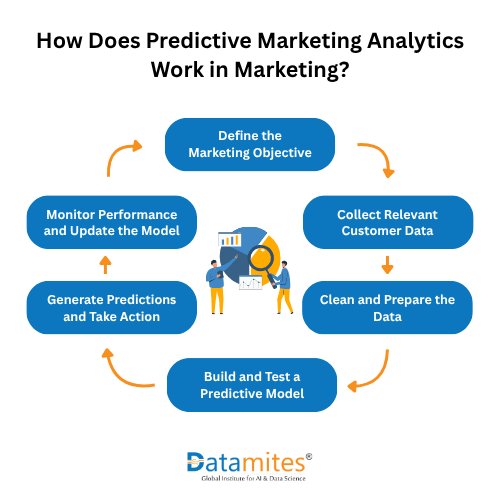
How Does Predictive Marketing Analytics Work?
Predictive marketing analytics typically follows a structured workflow. The exact process depends on the business objective, available data, and complexity of the prediction.
1. Define the Marketing Objective
Start by identifying the business problem you want to solve.
Examples include improving lead conversion, reducing subscription cancellations, increasing repeat purchases, or forecasting campaign demand.
Define a measurable outcome before selecting a model. For instance, a lead-scoring project might aim to improve the percentage of sales-qualified leads that become customers.
A clearly defined objective makes it easier to select relevant data, evaluate model performance, and measure business impact by leveraging top AI tools for marketing.
2. Collect Relevant Customer Data
Gather data from appropriate sources, including:
- Customer relationship management (CRM) systems.
- Website visits and product interactions.
- Purchase and transaction histories.
- Email clicks and campaign engagement.
- Customer service interactions.
- Subscription and account activity.
- Advertising and campaign performance records.
The data collected should be relevant to the prediction being made. A churn model, for example, may benefit from subscription history and changes in customer engagement, while a product recommendation model may rely more heavily on browsing and purchase patterns.
Businesses should also ensure that data collection and usage comply with applicable privacy requirements and consent obligations.
3. Clean and Prepare the Data
Raw marketing data often contains missing values, duplicate records, inconsistent formats, and outdated customer information.
Data preparation involves resolving these problems, standardizing fields, matching records where appropriate, and selecting useful features for the model.
It is also important to prevent data leakage. This happens when a model receives information that would not actually have been available at the time a prediction is supposed to be made.
For example, a model intended to predict whether a customer will purchase next week should not use information about a purchase that occurs next week.
4. Build and Test a Predictive Model
Depending on the objective, marketers and data analysts may use statistical models or machine learning algorithms.
Common methods include:
- Logistic regression: Estimates the probability of an outcome, such as whether a lead will convert.
- Decision trees: Identify decision rules associated with Customer Behavior Analysis.
- Random forests and gradient boosting: Capture more complex relationships across customer and campaign data.
- Clustering: Groups customers with similar characteristics or behaviors; it is often used for segmentation rather than direct outcome prediction.
- Time-series forecasting: Estimates future demand, sales, or campaign activity based on historical patterns.
The selected method should match the business problem, available data, and need for interpretability.
Models should be evaluated on data that was not used to train them. Depending on the task, useful metrics may include precision, recall, ROC-AUC, calibration, forecast error, or lift over a baseline.
5. Generate Predictions and Take Action
Once a model has been validated, its predictions can support marketing decisions.
A lead-scoring model might assign higher priority to prospects with a greater estimated probability of conversion. A churn model might identify customers who could benefit from additional support or a relevant retention offer.
Predictions should inform decisions rather than automatically determine them. Marketers should consider customer preferences, business constraints, campaign costs, and the potential consequences of incorrect predictions.
6. Monitor Performance and Update the Model
Customer preferences, market conditions, and campaign strategies change over time. A model that performs well today may become less accurate as these patterns shift.
Marketing teams should compare predictions with actual outcomes, monitor performance across customer segments, and retrain or recalibrate models when necessary.
They should also track business results, not just technical model metrics. A more accurate prediction is valuable only when it helps improve decisions or outcomes.
Refer to the article below:
Benefits of Predictive Analytics in Marketing
Predictive analytics can improve marketing effectiveness by helping businesses anticipate customer needs and allocate resources more strategically.
1. Improved Marketing Personalization
Predictive models can identify patterns in browsing behavior, purchase history, and customer preferences to help marketers deliver more relevant messages, content, and product recommendations.
For example, an online retailer might recommend complementary products based on a customer's previous purchases and browsing activity.
Personalization should remain relevant and respectful of customer privacy. Predictions should not be treated as certain facts about an individual's preferences.
2. Better Customer Retention
Acquiring new customers can require significant marketing and sales investment. Predictive analytics helps businesses identify patterns associated with declining engagement or potential customer churn.
A subscription company might flag accounts showing reduced product usage, fewer interactions, or repeated service issues.
The marketing or AI for customer segmentation can then investigate the reasons for disengagement and provide appropriate support, onboarding guidance, or retention offers.
Churn predictions are most useful when businesses can identify meaningful interventions rather than simply label customers as likely to leave.
3. More Effective Lead Scoring
Predictive lead scoring estimates how likely a prospect is to become a customer.
A model may use factors such as company characteristics, previous interactions, product interest, and engagement with marketing materials.
Sales teams can use the resulting scores to prioritize outreach, while marketing teams can adjust nurturing campaigns for prospects at different stages of the buying journey.
Lead scoring should be evaluated using actual conversion outcomes to ensure that higher scores correspond to better sales opportunities.
4. Campaign Optimization
Predictive analytics can help marketers estimate how different audience segments may respond to emails, advertisements, promotions, or other campaigns.
These estimates can inform audience selection, channel allocation, campaign timing, and message testing.
However, predicting who is likely to respond is not the same as determining who will respond because of a campaign. Where appropriate, randomized experiments and holdout groups can help measure whether a marketing intervention actually causes incremental conversions.
5. More Informed Marketing Budget Allocation
Marketing teams often need to decide how to divide limited budgets among channels, audiences, and campaigns.
Predictive forecasts can help estimate expected conversions, revenue, or demand under different scenarios.
For example, a team might compare projected outcomes for search advertising, email marketing, and customer retention campaigns before allocating additional resources.
These estimates should account for uncertainty, campaign costs, profit margins, and diminishing returns. Historical attribution alone does not establish that a channel caused a particular outcome.
6. Better Demand Forecasting
Predictive analytics can estimate future product demand by analyzing historical sales, seasonality, promotions, pricing, and other relevant variables.
More informed demand forecasts can help marketing teams plan campaigns, coordinate with inventory teams, and reduce the risk of promoting products that may be unavailable.
Forecasts should be updated when market conditions change or unexpected events affect customer demand.
Real-World Applications of Predictive Analytics in Marketing
Predictive analytics can support marketing decisions across e-commerce, subscription services, business-to-business sales, and digital advertising.
The below scenarios showing how businesses could leverage Applications of AI in Marketing. They are not claims about the performance of specific companies.
Example 1: Predicting Purchase Intent in E-Commerce
- Business challenge: The biggets Challenges in AI Marketing for online retailer is that they wants to identify visitors who may be interested in purchasing a product.
- Data used: Product page visits, search activity, cart additions, previous orders, and campaign interactions.
- Predictive approach: A model estimates the probability of purchase within a defined period using information available at prediction time.
- Marketing action: The retailer can use the results to personalize product recommendations, prioritize relevant follow-up messages, or test different promotional approaches.
- How to measure success: Track conversion rate, incremental revenue, average order value, and gross profit. Use an appropriate control group to determine whether the intervention improves outcomes compared with business-as-usual activity.
Example 2: Predicting Customer Churn
- Business challenge: A subscription business wants to identify customers who may cancel their subscriptions.
- Data used: Subscription history, product usage, renewal dates, support interactions, and changes in engagement.
- Predictive approach: A churn model estimates the probability that a customer will cancel within a specified period.
- Marketing action: The business can investigate potential reasons for disengagement and test suitable interventions, such as improved onboarding, customer support, or relevant plan information.
- How to measure success: Compare cancellation rates, retention rates, and customer lifetime value between intervention and comparison groups. Account for the cost of retention campaigns when evaluating profitability.
Example 3: Improving Predictive Lead Scoring
- Business challenge: A B2B company generates more leads than its sales team can contact immediately.
- Data used: Lead source, company characteristics, content engagement, previous sales interactions, and historical conversion outcomes.
- Predictive approach: A model estimates each lead's probability of becoming a customer within a defined period.
- Marketing action: The team prioritizes promising leads, adapts nurture campaigns, and reviews whether the scoring system works consistently across relevant segments.
- How to measure success: Evaluate lead-to-opportunity conversion, opportunity-to-customer conversion, sales cycle length, and revenue per qualified lead.
Example 4: Forecasting Email Campaign Response
- Business challenge: A marketing team wants to improve email campaign performance.
- Data used: Previous email interactions, purchase history, customer lifecycle stage, and campaign characteristics.
- Predictive approach: A model estimates the probability of a recipient completing a defined action, such as making a purchase or registering for an event.
- Marketing action: The team tests relevant content, offers, or send-time strategies for suitable audience segments.
- How to measure success: Track delivered-message conversion rate, revenue per recipient, unsubscribe rate, and incremental results against a control group.
Email opens alone should be interpreted cautiously because privacy features and automated systems can make them unreliable indicators of genuine engagement.
A Practical Predictive Analytics Example: Calculating Lead Conversion Probability
Consider a hypothetical B2B marketing team that wants to prioritize leads based on their likelihood of converting.
Suppose a validated model produces the following estimates:
| Lead | Predicted conversion probability | Suggested next step |
| Lead A | 75% | Prioritize relevant sales follow-up. |
| Lead B | 48% | Continue targeted nurturing and evaluate sales readiness. |
| Lead C | 18% | Provide educational content and gather more qualifying information. |
These percentages are illustrative predictions, not observed results or guarantees.
If Lead A has a predicted conversion probability of 75%, the model estimates that a lead with similar characteristics has a 75% probability of converting under the outcome definition and conditions represented by the model.
It does not mean the lead is certain to convert or that contacting the lead will cause a purchase.
Before implementing this system, the marketing team should:
- Define conversion precisely, including the prediction period.
- Train the model using historical data with reliable outcome labels.
- Evaluate probability calibration and performance on unseen data.
- Compare the scoring approach with the existing lead-prioritization process.
- Monitor conversion rates, sales workload, and revenue over time.
This process helps ensure that predictive lead scoring supports real business decisions rather than simply producing numerical rankings.
How to Measure the Effectiveness of Predictive Marketing Analytics
A predictive marketing initiative should be evaluated using both model-performance metrics and business outcomes.
| Objective | Useful metrics | What they help assess |
| Lead scoring | Precision, recall, conversion rate | Whether high-priority leads are genuinely more likely to convert. |
| Churn prediction | Recall, precision, calibration, retention rate | Whether at-risk customers are identified and retention actions work. |
| Campaign optimization | Incremental conversion, cost per acquisition, return on ad spend | Whether campaigns improve outcomes relative to an appropriate baseline. |
| Demand forecasting | Mean absolute error, weighted absolute percentage error where appropriate | How closely forecasts match actual demand. |
| Personalization | Incremental revenue, conversion lift, customer experience measures | Whether recommendations improve results without creating negative experiences. |
No single metric is appropriate for every project. For example, a churn model may need strong recall if missing at-risk customers is expensive, while a sales team with limited capacity may prioritize precision among the leads it contacts.
Whenever feasible, use randomized controlled experiments or suitable holdout groups to distinguish genuine incremental impact from outcomes that would have occurred anyway.
Best Practices for Implementing Predictive Analytics in Marketing
Businesses can improve the likelihood of success by following these practices:
- Start with a specific business problem. Choose a clear objective, such as improving lead conversion or reducing churn, rather than adopting predictive analytics without a defined purpose.
- Use relevant, reliable data. Establish data-quality standards and ensure that data collection and use are appropriate.
- Select a model that fits the task. Begin with a reasonable baseline and use more complex methods only when they provide meaningful additional value.
- Validate predictions before deployment. Test the model on unseen data and evaluate metrics that reflect the business objective.
- Connect predictions to practical actions. Decide in advance how marketing or sales teams will use the results and what interventions are appropriate.
- Measure incremental business impact. Use experiments or comparison groups where feasible to determine whether model-guided actions improve outcomes.
- Monitor fairness, privacy, and model drift. Review performance regularly and update the system when data, behavior, or business conditions change.
- Document decisions and limitations. Record how predictions are generated, what assumptions they depend on, and where they should not be used.
Predictive Analytics in Marketing works best when it is integrated into an ongoing decision-making process rather than treated as a one-time technology project.
According to Grand View Research, the global artificial intelligence in marketing market was valued at USD 27.0 billion in 2025 and is expected to reach USD 35.4 billion in 2026, growing to USD 194.8 billion by 2033 at a CAGR of 27.6% during 2026–2033. North America held the largest market share, accounting for 32.2% of global revenue in 2025.
Refer to the article below:
- CrewAI vs AutoGen vs LangGraph: Top Multi-Agent Frameworks
- Green AI Guide: Quantization and FinOps to Reduce LLM Costs
- How Knowledge-Augmented Generation (KAG) Is Solving AI Hallucinations
Predictive analytics in marketing helps businesses forecast customer behavior, improve retention, identify opportunities, and optimize campaigns. By leveraging historical data and machine learning, marketers can make informed decisions. Successful implementation requires reliable data, model validation, performance measurement, privacy protection, and human judgment to achieve sustainable results.
DataMites Institute offers industry-focused Best AI marketing courses designed to help professionals build expertise in AI-powered marketing strategies and business applications. The institute also offers specialized programs in AI for Finance, AI Product Management, and Generative AI for Business Leaders. Through online and on demand classroom training, and practical case studies, learners develop essential skills in marketing technology and data-driven decision-making.
The IABAC-accredited Certified AI Professional in Marketing Analytics course helps learners enhance their professional qualifications and practical knowledge. With training centers across India, including Pune, Bangalore, Hyderabad, Mumbai, Coimbatore, Chennai, Delhi, and Ahmedabad, DataMites Institute provides accessible AI education for aspiring and experienced marketing professionals.