Data Analyst vs Data Scientist in Nigeria
Compare Data Analysts and Data Scientists in Nigeria, including salary expectations, key skills, job opportunities, industry demand, and career paths to help you choose the right role.
 Swagatam Sinha
A bank wants to understand why customers are leaving, an online retailer needs to estimate future demand, and a fintech company wants to flag suspicious transactions. All three businesses use data, but the people working on these problems may have different responsibilities.
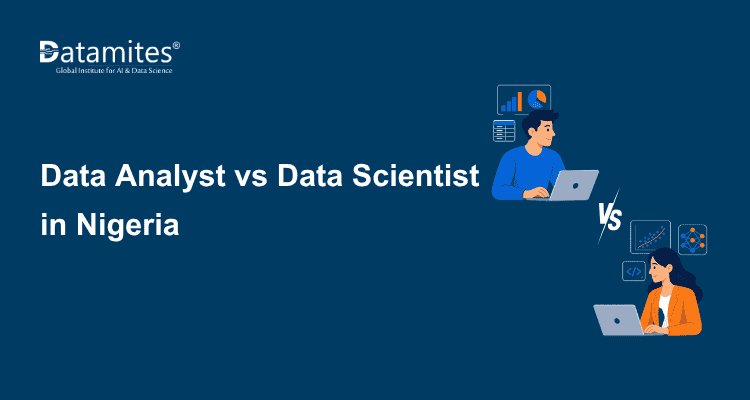
Data Analysts examine business information to explain what has happened and where improvements may be needed. Data Scientists use programming, statistics, and machine learning to investigate complex questions and develop predictive models.
For graduates, freshers, and working professionals in Nigeria, choosing between these careers involves more than comparing salaries. The skills required, type of work, entry-level opportunities, and preparation time also matter.
What Is the Difference Between a Data Analyst and a Data Scientist?
A data analyst works with existing data to identify trends, measure performance and answer business questions. A data scientist often handles more complex analytical tasks, including building and evaluating statistical or machine learning models.
| Area | Data Analyst | Data Scientist |
| Main responsibility | Explain business performance. | Investigate complex problems and predict outcomes. |
| Common tasks | Reporting, dashboards, and trend analysis | Predictive modeling, experiments, and machine learning |
| Common tools | Excel, SQL, Power BI, and Tableau | Python, SQL, and machine learning libraries |
| Typical output | Reports, insights and recommendations | Predictive models and analytical solutions |
| Starting skills | Data handling, visualization, and basic statistics | Programming, statistics and mathematical reasoning |
The distinction is not absolute. Some data analysts use Python and forecasting, while data scientists also spend time cleaning data, writing SQL queries and preparing reports. The difference usually comes down to the problem being solved and the methods required.
Refer to these articles:
- How to Become a Data Scientist With No Experience
- Data Science vs Cyber Security: Which Has a Better Future?
- Data Mesh vs Data Fabric
How the Two Roles Solve a Business Problem
Consider a retailer operating several branches in Nigeria. Sales have declined in two locations, but the management team does not know why.
A data analyst could compare monthly revenue, product sales, customer activity and branch performance. The analysis might reveal that a particular product category is selling poorly or that sales dropped after a price change.
A data scientist could use historical sales, seasonal patterns and other relevant variables to estimate future demand. The retailer could then use the forecasts to plan stock levels and reduce the risk of overstocking or shortages.
Both roles contribute to better decisions. Neither is automatically more valuable than the other; the choice depends on the business problem.
Data Analyst and Data Scientist Job Market in Nigeria
Nigeria's digital economy provides opportunities for businesses to use data, but growth in technology does not guarantee vacancies for every data-related job title. Job seekers need to understand both the broader market and the requirements employers list in their advertisements.
The Nigerian Institute of Social and Economic Research (NISER) published its Q1 2026 Job Vacancy Analysis Report, examining 778 advertised vacancies between January and March 2026. The report discusses regional differences in formal recruitment, limited entry-level opportunities and challenges in sectors including ICT. For new graduates, this reinforces the importance of practical skills and a clear understanding of employer requirements.
Nigeria is also planning further investment in digital infrastructure. In August 2026, the Federal Ministry of Communications, Innovation and Digital Economy announced a National Digital Cloud Policy. The government set targets of mobilizing US$250 million within 12 months and US$750 million within 24 months.
These are investment targets, not confirmed funding or evidence of a specific number of new jobs. If implementation progresses, cloud services and digital infrastructure could create additional uses for data management, analytics and governance. Actual hiring will depend on investment, business needs and the skills employers require.
Digital activity offers another useful indicator. A September 2026 KPMG Nigeria Smartphone Study, covering 13,251 respondents across 12 cities, cites Nigerian Communications Commission figures of 157 million internet subscribers in May 2026 and data consumption exceeding 1.5 million terabytes. Digital businesses can use this information to understand customers, monitor performance and improve services, although these figures do not measure data analyst or data scientist vacancies.
Data Analyst vs Data Scientist Salary in Nigeria
Salaries for data analysts and data scientists in Nigeria vary depending on experience, employer, industry and technical skills. According to Glassdoor, both roles have different reported salary ranges, although actual earnings depend on the responsibilities and seniority of each position.
Data Analyst Salary in Nigeria
According to Glassdoor's Data Analyst salary report for Nigeria, the median total pay is approximately ₦266,000 per month, with a reported base-pay range of around ₦150,000 to ₦350,000 per month.
These figures provide a general reference for salary expectations. Actual pay may differ according to experience, location, company size and the technical skills required for the position.
Data Scientist Salary in Nigeria
According to Glassdoor's Data Scientist salary report for Nigeria, the median total pay is approximately ₦292,000 per month, with a reported total-pay range of around ₦157,000 to ₦503,000 per month.
Data scientists may earn different amounts depending on their experience with Python, statistics, machine learning and predictive modeling. Employers and industries also influence compensation.
These Glassdoor estimates suggest a difference between the reported median salaries for the two roles, but they do not guarantee that data scientists will always earn more than data analysts. Before accepting a position, compare the responsibilities, experience requirements, benefits and salary offered by several employers.
Refer to these articles:
- Guide to Data Analyst Career
- How to Use Statistical Methods in Data Analytics
- Top 10 Data Analyst Projects for Beginners
Skills Required for Data Analysts and Data Scientists in Nigeria
The two careers share some foundations, particularly SQL, data preparation and analytical thinking. The main difference is how far you need to go into programming, statistics and modeling.
Data Analyst Skills: SQL, Excel and Power BI
Data analysts organize information and turn it into findings that managers and teams can use. For entry-level roles, focus on these skills:
- Excel: Use formulas, pivot tables and lookup functions to organize data and prepare reports.
- SQL: Retrieve, filter and combine records from databases.
- Power BI or Tableau: Build dashboards that make trends and business performance easier to understand.
- Basic statistics: Interpret averages, percentages, variation and comparisons.
- Communication: Explain findings and show how they relate to a business decision.
For beginners who prefer guided learning, an online data analyst course in Nigeria can help build practical skills in SQL, Excel, data visualization and reporting.
For example, an e-commerce company could ask an analyst to investigate falling orders. The analyst might compare order volumes by location, identify products with declining sales and examine whether delivery delays or changes in customer demand coincide with the drop.
The useful outcome is not just a dashboard. It is a clear explanation of what the available data shows and what the business could investigate next.
Data Scientist Skills: Python, Statistics and Machine Learning
Data Scientists need many of the same analytical foundations, but their work often requires additional programming and model evaluation skills.
- Python: Use libraries such as pandas and NumPy to prepare and analyze data.
- Statistics and probability: Test assumptions, study relationships and interpret uncertainty.
- Machine learning: Build models for tasks such as demand forecasting or customer churn prediction.
- Data preparation: Handle missing values, inconsistent records and data-quality problems.
- Model evaluation: Test performance on unseen data and understand where a model may fail.
- SQL: Extract the information needed for analysis and modeling.
A fintech company, for instance, might want to flag unusual transactions for further investigation. A data scientist could prepare historical transaction data, select relevant features and evaluate a model's ability to identify suspicious activity. The model would need testing and monitoring before being relied on in a real operation.
Which Skills Should Beginners Learn First?
If you are new to data, start with Excel, basic statistics and SQL. Add Power BI or Tableau, then complete a project that answers a business question.
For data science, build on that foundation with Python, probability, statistical modeling, and machine learning. Learn to evaluate results and explain limitations instead of collecting tool names without understanding how to use them.
An online data science course in Nigeria can provide a structured way to learn these concepts and practise them through projects based on real-world problems.
Where Can Data Analysts and Data Scientists Work in Nigeria?
Data professionals work across industries, not just technology companies. The tasks vary according to the information available and the decisions each organization needs to make.
- Banking and fintech: Analysts can investigate transaction volumes, customer activity and changes in business performance. Data scientists may develop and test models that help identify unusual transactions or assess credit risk.
- Telecommunications: Analysts can examine service complaints, usage patterns and customer retention. Data scientists may use historical records to forecast demand or identify customers who could be at risk of leaving.
- E-commerce and retail: Analysts measure sales, stock movement and campaign performance. Data scientists may develop demand forecasts or product recommendation models.
- Healthcare and agriculture: Analysts may examine service usage, supply requirements or crop-related data. Depending on the available data and the organization's needs, data scientists could work on forecasting or predictive analysis.
Job titles can be misleading. Some business analyst and research analyst vacancies involve extensive data work, while some data scientist positions require substantial software development experience. Read the responsibilities and required skills before deciding whether a vacancy matches your background.
Data Analyst vs Data Scientist: Which Career Is Right for You?
Data analytics may suit you if you enjoy working with spreadsheets, investigating business performance and explaining findings. It can be a practical route for people coming from accounting, finance, marketing, operations or other fields who want to develop technical skills.
Data science may appeal to you if you enjoy programming, quantitative problem-solving and testing ways to predict outcomes. It usually requires more preparation in coding and statistics, particularly if you are starting without a technical background.
Building a data science career in Nigeria requires a strong foundation in programming, statistics and machine learning, along with practical projects that demonstrate your ability to solve real business problems.
Your degree is one part of your profile. Employers may also assess your projects, ability to work with data, understanding of the business problem and skill in explaining your decisions.
Refer to these articles:
- Star Schema vs Snowflake Schema
- Data Engineer vs Analytics Engineer vs Data Analyst
- How Looker, Tableau, and Power BI Are Revolutionizing Data Analytics
How to Prepare for Your First Data Role in Nigeria
Start with current vacancies rather than trying to learn every data tool. Review five to ten advertisements for your preferred role and record the qualifications, software, experience and responsibilities that appear repeatedly. Use this list to plan your learning.
Learners based in the capital can also consider an online data analyst course in Abuja to develop the technical skills required for entry-level analytics roles.
For a data analyst portfolio, build a retail sales dashboard, customer survey analysis or product performance report. Explain how you cleaned the data, chose the measures and arrived at your findings. Include a short summary of the business question and any limitations in the dataset.
For a data science portfolio, try a customer churn or demand forecasting project. Describe the problem, how you prepared the data, why you chose a particular method and how you tested the model. Explain its limitations instead of presenting the result as a guaranteed prediction.
Use public datasets where possible and document your work clearly. A focused project that shows your reasoning is more useful than a portfolio that only lists programming languages and software tools.
Career Growth for Data Analysts and Data Scientists
Data Analysts can move into senior analytics, business intelligence, product analytics or analytics management. Some transition into Data Science after developing stronger programming, statistics and modelling skills.
Data Scientists may progress into senior or lead data science roles, machine learning engineering or technical leadership. These paths are not automatic; progression depends on experience, the complexity of the work and the opportunities available at an organisation.
For professionals in Abuja who want to build stronger programming and modelling skills, an online data science course in Abuja may offer a flexible way to study alongside existing commitments.
If you prefer investigating business performance and explaining what the numbers mean, start by exploring Data Analyst vacancies. If you are more interested in programming, statistics and predictive models, examine Data Scientist roles and the preparation they require.
Review real Nigerian job advertisements and compare them with your current skills. Then choose one role, identify the most important skill gaps and build a project that demonstrates your ability to solve a relevant problem. This gives you a practical basis for choosing a career instead of relying on job titles or salary figures alone.
For those looking to build practical skills in data analytics or data science, DataMites Institute offers training programmes designed to help learners develop their technical knowledge through structured learning and hands-on projects. With more than 12 years of trust and over 200,000 learners globally, the institute provides learning options for beginners and working professionals exploring data-related career paths.