Evolving Data Careers: Data Analysts vs. Data Scientists
Explore evolving data careers with a comparison of Data Analysts vs. Data Scientists. Understand their roles, skills, responsibilities, career opportunities, salary potential, and growth prospects to choose the right path for your future in the data-driven industry.
 Datamites Team
In 2026, careers in data continue to offer an exciting combination of analytical thinking, problem-solving, and innovation. As organizations increasingly rely on data and AI to drive business decisions, professionals in this field play a vital role in transforming complex information into actionable insights. With evolving technologies, diverse industry applications, and strong career opportunities, data-driven careers are well suited for individuals who enjoy exploring trends, solving problems, and making informed decisions.
In this article, we explore the evolving landscape of data careers in 2026, with a focus on Data Analysts and Data Scientists. We’ll compare these career paths, examine the skills and opportunities associated with each role, and help aspiring professionals determine which option best aligns with their interests and career goals in today’s data-driven world.
Core Skills and Education for Data Analysts and Data Scientists
Data Analysts are professionals focused on interpreting and visualizing data to help businesses make informed decisions. Core skills include expertise in SQL for database management, proficiency in data visualization tools like Tableau, and a strong foundation in statistical analysis. A background in mathematics or business analytics is often beneficial.
Data Scientists, on the other hand, delve deeper into predictive modeling and advanced analytics. They require a solid understanding of machine learning algorithms, programming skills in Python or R, and the ability to handle large datasets. Educational backgrounds in computer science, statistics, or data science are common, with many professionals also pursuing specialized courses or certifications in machine learning and big data technologies.
Both roles require a commitment to continuous learning to stay abreast of evolving technologies and methods in the dynamic field of data science.
Read these articles:
- Guide to Data Analyst Career
- Exploring Data Analyst Job Opportunities and Salaries Worldwide
- Guide to Data Science Career
- A Comprehensive Guide on the Data Science Lifecycle
Job Market and Industry Demand for Data Analysts and Data Scientists
Data Analysts: Job Market and Industry Demand
In 2026, Data Analysts continue to be in demand across sectors such as marketing, finance, healthcare, e-commerce, and technology. Organizations rely on Data Analysts to interpret large datasets, uncover actionable insights, support data-driven decision-making, and improve business strategies and operational efficiency. Their expertise in data visualization and interpretation makes them indispensable for businesses aiming to understand market trends and consumer behavior. On top of that, The size of the global data analytics market reached USD 49.03 billion in 2022 and is expected to experience a Compound Annual Growth Rate (CAGR) of 26.7% from 2023 to 2030, according to grand view research.
Data Scientists: Job Market and Industry Demand
Data Scientists are highly sought after in 2026, particularly in technology, e-commerce, and telecommunications. Their role in predictive modeling and advanced data analysis is crucial for driving innovation and strategic decisions. The data science platform market is anticipated to witness substantial growth, escalating from $81.47 billion in 2022 to $484.17 billion by 2029. This projection reflects a robust Compound Annual Growth Rate (CAGR) of 29.0% during the forecast period, as stated by fortune business insights.
With their skills in machine learning and handling complex datasets, Data Scientists are key players in helping companies stay ahead in a rapidly evolving digital landscape.
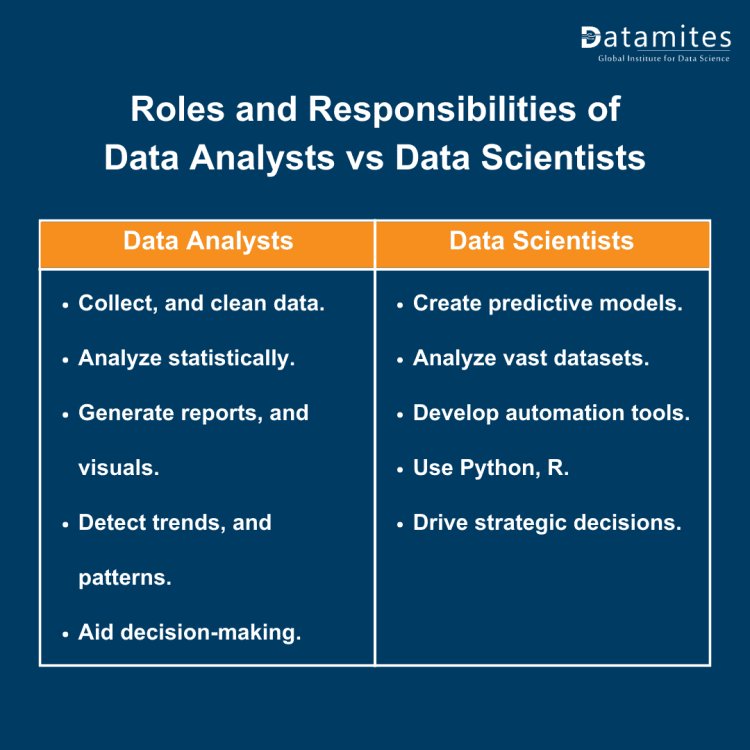
Roles and Responsibilities of Data Analysts vs Data Scientists
Data Analysts:
- Gather and clean data from various sources.
- Conduct statistical analysis to interpret data.
- Create reports and visualizations using tools like SQL, Excel, Tableau, or Power BI.
- Identify trends and patterns to provide actionable business insights.
- Support decision-making with data-driven evidence.
Data Scientists:
- Design and implement predictive models using machine learning algorithms.
- Analyze large, complex datasets for deeper insights.
- Develop tools for automating and streamlining data processes.
- Use programming languages like Python and R for advanced data manipulation.
- Contribute to strategic decision-making and innovation with data-driven forecasts and solutions.
Career Path and Progression for Data Analysts and Data Scientists
Data Analysts:
- Their career often begins at the junior level, where they learn the basics of data handling and analysis.
- As they gain experience, they move to mid-level roles, handling more complex data sets and analyses.
- Senior positions involve strategic data analysis and possibly leading teams.
- With further education in advanced analytics, they can transition to data science roles.
Data Scientists:
- They start at junior positions, focusing on learning and applying machine learning algorithms and data processing.
- Mid-level roles involve more complex projects and possibly leading smaller initiatives or teams.
- Senior positions often include overseeing large data projects and contributing to strategic decisions.
- Leadership roles like Chief Data Officer involve broader oversight and strategy formulation.
- Specializing in areas like AI involves deep technical expertise and often further academic research.
Educational Paths and Certifications:
- Continuous learning through workshops, seminars, and courses keeps skills relevant.
- Certifications provide recognition of skill proficiency and are often favored by employers.
- Higher education, like a Master’s or Ph.D. in relevant fields, can open doors to advanced roles and specializations.
Refer these articles:
- Data Science Career Scope in India
- Data Analyst Career Scope in India
- Data Scientist Salary in India
- Data Analyst Salary in India
Expanding on the challenges and opportunities for Data Analysts and Data Scientists:
Data Analysts: They face rapid technological advancements, requiring constant upskilling. Efficiently managing large and varied data sets is a key challenge, along with ensuring data accuracy and integrity. They must also balance technical skills with business acumen. Opportunities include involvement in a wide range of industries, impacting business decisions through data-driven insights, a growing demand in multiple sectors, and career growth through continuous skill development.
Data Scientists: Challenges include keeping up with the fast-paced developments in machine learning and Artificial Intelligence, effectively handling complex and unstructured data, addressing ethical issues related to data use, and collaborating across diverse teams. Opportunities lie in leading innovation with advanced technologies, exploring diverse career paths and specializations, high demand in tech-centric sectors, and playing a significant role in shaping industry trends and practices.
Salary and Compensation Trends for Data Analysts and Data Scientists
Data Scientists:
- Data Scientists:
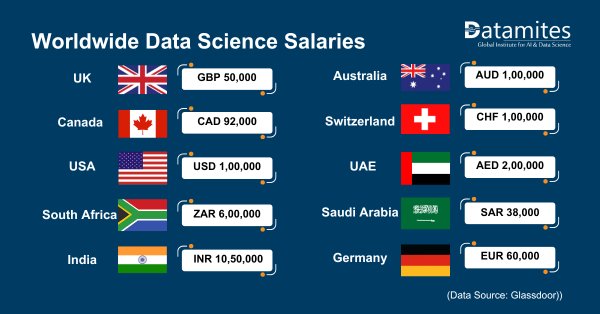
- The annual average salary for data scientists in the United Kingdom is £70,000 - £100,000 per year, as reported by Glassdoor.
- Data scientists in Canada earn an average annual salary of CAD 100,000 - CAD 130,000 per year, according to Glassdoor.
- With an average of $130,000 - $160,000 per year, the United States offers some of the highest data scientist salaries, as reported by Glassdoor.
- According to Glassdoor, the average annual salary for data scientists in South Africa is between ZAR 4L - ZAR 7L/yr.
- The average annual salary of data scientists in India is ₹12,00,000 - ₹34,00,000 per year, as reported by Glassdoor.
- Data scientists in Australia earn an average annual salary of A$95K - A$1L/yr, according to Glassdoor.
- Switzerland boasts an average annual data scientist salary of CHF 94K - CHF 1L/yr, as reported by Glassdoor.
- Data scientists in UAE earn an average of AED 14K - AED 30K per year, according to Glassdoor.
- In Saudi Arabia, data scientists earn an average annual salary of SAR 10K - SAR 20K/yr, according to Glassdoor.
- The average annual data scientist salary in Germany is €80,000 - €110,000 per year, as reported by Glassdoor.
Data Analysts:
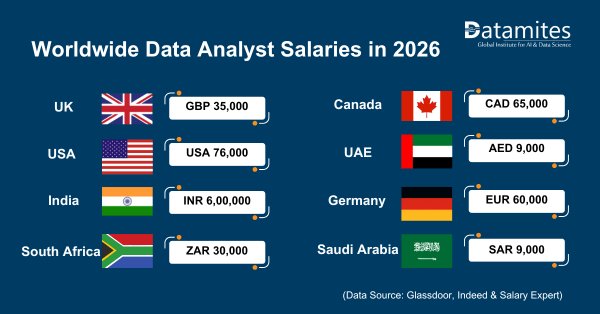
- A data analyst in the UK earns an annual salary ;between £28K - £44K per year with an average base pay of £35K/yr.
- According to Glassdoor, the annual salary for a data analyst in the USA ranges from $59K - $98K per year with an average base pay of $76K/yr.
- Glassdoor reports that annual salaries for data analysts in India can vary, potentially between ₹4L - ₹9L per year with average base pay of ₹6L/yr
- In South Africa, data analysts can earn up to ZAR 21K - ZAR 40K/mo with average base pay of ZAR 30K/mo
- The data analysts in Canada can earn up to CA$54K - CA$79K with average base pay of CA$65K/yr.
- According to Glassdoor, data analysts in the UAE can earn as much asAED 5K - AED 15K/mo with average base pay of AED 9K/mo.
- The data analysts in Germany can expect an annual salary starting at €50K - €65K/yr with average base pay of €60K/yr.
- Data analysts in Saudi Arabia have varying annual salaries, potentially reaching SAR 6K - SAR 14K/mo with average base pay of SAR 9K/mo.
Case Studies and Success Stories of Data Analysts and Data Scientists
Data Analysts:
- The journey from a fresher to a Data Analyst is an inspiring story of someone entering the field from a non-technical background. This case study showcases the transformative power of targeted training and dedication in data analytics.
- Sherin Shana's story as a fresher who successfully transitioned into data analysis emphasizes the importance of hands-on experience and specialized education in this rapidly evolving field.
- An example featuring a mechanical engineer transitioning into data analysis showcases the flexibility and broad appeal of the field. This highlights how an engineering background can establish a solid groundwork for a thriving career in data analytics.
Data Scientists:
- Mohammed Imran's data science career success story reflects a significant shift from a different professional background, underscoring the importance of specialized training and a persistent approach in this field.
- The transition from electrical engineering to data science highlights the interdisciplinary nature of data science, showing how skills from various fields can be effectively applied in this domain.
- Suvesh's career growth in data science demonstrates the potential for rapid advancement and diverse opportunities in the field, highlighting its dynamic and evolving nature.
Read the following articles:
- Data Science Course Fee in India
- Data Analyst Course Fee in India
- Artificial Intelligence Course Fee in India
- Python Course Fee in India
Enhanced Future Outlook for Data Analysts and Data Scientists
Data Analysts:
- Technological Integration: Expect a deeper integration with AI and machine learning, enhancing data interpretation capabilities.
- Sectoral Expansion: Anticipate a broader role in emerging sectors like renewable energy and smart cities, beyond traditional fields.
- Advanced Tools: Evolution in analytics tools will make data more accessible and interpretable, even for non-specialists.
- Strategic Roles: Data Analysts are likely to play a more strategic role in organizational decision-making.
Data Scientists:
- AI and Machine Learning: Continued advancements in AI, particularly in areas like neural networks, will revolutionize data science methodologies.
- Real-Time Analytics: Increased focus on real-time data processing for instantaneous decision-making.
- Ethical and Privacy Concerns: As data becomes more integral, ethical use and privacy will become central issues.
- New Frontiers: Expect data science to make significant inroads in fields like quantum computing and augmented reality.
These predictions suggest a future where data roles are not only more technologically advanced but also more integrated into the strategic fabric of diverse industries.
Data Analysts and Data Scientists continue to have promising and evolving career opportunities. Data Analysts focus on transforming data into actionable insights, while Data Scientists work with advanced analytics, machine learning, and predictive analytics to solve complex business problems. As organizations increasingly adopt AI and data-driven decision-making, professionals in both roles need to continuously upgrade their technical and analytical skills. With growing demand across industries, careers in data offer strong opportunities for professional development, specialization, and long-term growth.
DataMites Institute is a leading provider of data science and analytics training, offering comprehensive courses that equip learners with in-demand skills. These courses also include prestigious certifications from IABAC and NASSCOM Futureskills, ensuring industry recognition and credibility. With over 50,000 learners having successfully surpassed milestones, DataMites prioritizes practical learning through features like internship opportunities, job assistance, and access to cloud labs. Additionally, students engage in capstone and client projects, providing hands-on experience essential for real-world applications. DataMites Institute stands out for its commitment to producing highly skilled professionals ready to excel in the data science domain.