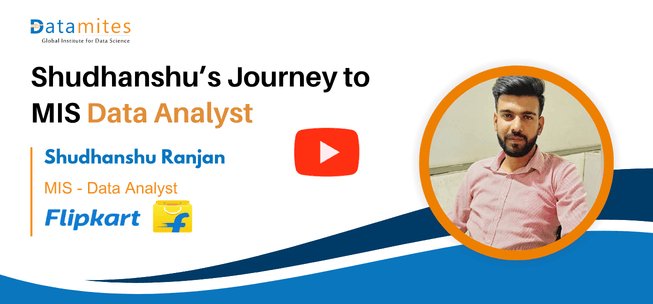
From Non-IT Professional to Data Analyst: Sudhanshu Ranjan’s Data Analyt Career
Read Sudhanshu Ranjan’s career journey from a non-IT background to becoming a Data Analyst at Flipkart, including his learning experience, interview preparation, skills, and professional growth.
 Kriti Maurya
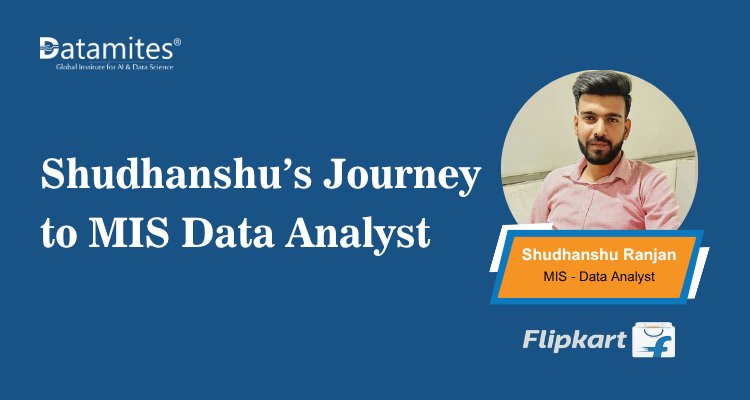
Starting a career in IT after working in a non-IT field can be challenging, particularly when technical concepts have not been used for several years. Sudhanshu Ranjan’s journey shows how continuous learning, interview preparation, practical exposure, and adaptability can help professionals make a successful career transition. After completing his MCA in 2024, Sudhanshu joined a DataMites data science program to refresh his technical knowledge. His persistence eventually helped him secure a Data Analyst role at Flipkart.
Sudhanshu’s Journey from a Non-IT Background to a Data Analyst
Sudhanshu Ranjan is an MCA graduate with around three years of prior work experience in a non-IT field. While pursuing his MCA, he continued working outside the IT industry. After completing his degree in 2024, he decided to move toward the technology sector and strengthen the technical skills he had previously learned.
To restart his technical learning, Sudhanshu joined DataMites in Bangalore and enrolled in a data science batch. Exploring IT Courses in Bangalore helped him focus on technical concepts and interview readiness. His journey included several interview rejections, but he continued improving his skills. Eventually, an opportunity at Flipkart led him to a Data Analyst position, where he began working with real-world business data and operational requirements.
1. Who is Sudhanshu Ranjan and what is his educational background?
Sudhanshu Ranjan is an MCA graduate who completed his degree in 2024. Before entering the IT industry, he had approximately three years of work experience in a non-IT field.
Because he had been away from technical work for some time, he wanted to refresh his programming and other technical concepts before pursuing an IT career.
2. Why did Sudhanshu choose to transition into the IT industry?
Although Sudhanshu had studied technical subjects during his education, his non-IT work experience meant that he was no longer actively using many of those concepts.
After completing his MCA, he decided to rebuild his technical foundation and explore opportunities in the IT and data field. This motivated him to join a data science program and begin preparing for the industry.
Refer to these Articles:
- Exploring Data Analyst Job Opportunities and Salaries Worldwide
- Best Practices for Data Analysts in Data Visualization
- The Data Analytics Lifecycle: A Step-by-Step Guide for Data Analysts
3. How did DataMites support Sudhanshu’s learning journey?
Sudhanshu joined DataMites in Bangalore after completing his MCA. He enrolled in a data science batch and used the learning experience to revisit technical concepts he had previously studied.
The training helped him prepare for the transition into the IT industry and gave him a structured environment in which to work on his technical knowledge.
4. How did Sudhanshu prepare for his job interviews?
Interview preparation became an important part of Sudhanshu’s career journey. He used ChatGPT extensively to practice technical and communication skills.
He used the audio conversation feature to simulate interview discussions and answer questions verbally. This approach was particularly useful for improving his confidence in communicating during virtual interviews.
5. How did ChatGPT help Sudhanshu improve his interview skills?
Sudhanshu used ChatGPT to practice questions related to Python, SQL, and other technical topics. Rather than simply reading answers, he responded verbally as though he were participating in an actual interview, helping him strengthen his data analyst Skills.
After the practice session, ChatGPT provided feedback about areas such as grammatical mistakes, incorrect answers, and topics that required improvement. He could then work on those areas and repeat the practice.
6. Did Sudhanshu face rejections during his job search?
Yes. Sudhanshu faced multiple rejections before securing his current opportunity.
He mentioned appearing for around four or five interviews and being rejected for different reasons, including Python knowledge, SQL, and soft skills. These experiences helped him identify areas that needed additional preparation.
7. Was Sudhanshu initially selected for a Data Scientist role at Flipkart?
No. His initial interview at Flipkart was for a Data Scientist position, but he received a rejection after that interview.
However, the rejection did not end the opportunity. Around 15 to 20 days later, Flipkart contacted him again and explained that although his Python skills needed improvement, his SQL skills were good.
8. How did Sudhanshu eventually secure a Data Analyst role at Flipkart?
After the initial Data Scientist rejection, Flipkart offered Sudhanshu an opportunity to interview for a Data Analyst position.
He appeared for the interview again and was eventually shortlisted. This became an important milestone in his transition from a non-IT background into the data analytics industry.
9. What was Sudhanshu’s experience after joining Flipkart?
At the time of the alumni discussion, Sudhanshu had been working at Flipkart for approximately three months.
His experience was different from what he initially expected. Before joining, he thought he would primarily work with tools such as Power BI. However, his actual role introduced him to a different set of business requirements.
10. What is Sudhanshu’s current role at Flipkart?
Sudhanshu works in the last-mile operations area. His team focuses on preventing losses involving customers and sellers.
A key part of his responsibility is providing visibility to ground-level teams so that they can understand their numbers, pending work, and operational information more easily.
11. Did Sudhanshu use Power BI in his initial role?
Not in the way he had originally expected. When he joined Flipkart, he was told that he would not be given access to Power BI for his particular work. Instead, he needed to create dashboards and provide operational visibility through Google Sheets.
The ground-level teams he supported were more familiar with spreadsheets, helping him understand that real-world data roles can involve different tools depending on users and business requirements.
12. What tools is Sudhanshu currently using?
Sudhanshu explained that Google Sheets plays an important role in his current work. He creates automated dashboards and trackers using Google Sheets.
He also works with App Script, which allows him to automate and improve spreadsheet-based processes. At the time of the discussion, he had created several dashboards and was managing multiple trackers.
13. What new skill is Sudhanshu currently learning?
Sudhanshu is currently focusing on App Script because it is closely connected to his work with Google Sheets.
He also emphasized the importance of understanding the basics behind a technology rather than relying entirely on AI. According to his experience, having foundational knowledge makes it easier to understand problems and use AI effectively.
14. Why does Sudhanshu consider Excel and Google Sheets important?
Based on his first few months of industry experience, Sudhanshu observed that many organizations still rely heavily on Excel and Google Sheets.
While tools such as Power BI may be used by managers and other higher-level teams, executive and ground-level employees may continue to work primarily with spreadsheets. Therefore, spreadsheet skills remain valuable for aspiring data professionals.
Key Findings from Sudhanshu’s Career Journey
Sudhanshu’s inspiring career journey stands as a DataMites Success Story, highlighting how persistence, interview preparation, adaptability, and continuous learning supported his transition into the IT industry.
- Career transitions are possible: Sudhanshu moved from a non-IT work background into the technology industry after completing his MCA.
- Refreshing technical skills is important: He joined DataMites after his MCA to revisit concepts he had learned earlier.
- AI can support interview preparation: He used ChatGPT’s audio feature to practice technical questions and communication.
- Interview rejection can become a learning opportunity: He faced multiple rejections and used them to identify areas requiring improvement.
- SQL became an important strength: His SQL skills helped him receive another opportunity after his initial Data Scientist rejection.
- Flexibility matters in the workplace: His expected Power BI-focused role became a spreadsheet and automation-focused role.
- Google Sheets remains valuable: His current work demonstrates how spreadsheets continue to support business operations.
- Automation skills can expand career opportunities: He is developing App Script skills to improve his ability to automate Google Sheets workflows.
- Real-world data experience matters: He plans to build experience working with actual company data and large datasets.
- Excel remains an important skill: Learners should move beyond basic formulas and explore macros, VBA, and automation.
- AI works best with foundational knowledge: Understanding the basics helps professionals use AI more effectively and troubleshoot problems.
- Persistence can create new opportunities: His journey from rejection to a Data Analyst position highlights the importance of continuing to apply and improve.
- Adaptability supports career growth: His willingness to learn new technologies and work according to business requirements has helped him take on new responsibilities.
Sudhanshu’s journey from a non-IT professional and MCA graduate to a Data Analyst at Flipkart demonstrates that building a career in data requires more than learning a list of tools. His experience highlights the importance of technical fundamentals, interview practice, communication, real-world exposure, and adaptability. Most importantly, his story shows that rejection can be part of the learning process.
Refer to these Articles:
- Wasim Career Transition from BCom to Data Analytics
- Parthamit’s career switch from Test Engineer to Data Analyst
- Ayushi’s Inspiring Journey from Fresher to Data Analyst
DataMites is a globally recognized data science and analytics training provider that helps aspiring professionals build industry-relevant skills through practical, career-focused learning. DataMites data analytst course in Bangalore is designed to provide structured learning, practical exposure, and career preparation for aspiring data professionals.
Accredited by IABAC and NASSCOM FutureSkills, DataMites offers online and offline learning modes, flexible schedules, mock interviews, placement assistance, and lifetime access to learning resources. DataMites has also received the Best Skill Development EdTech award from BW Businessworld for its contribution to skill development and career-focused learning. With numerous offline centres across India, DataMites Pune offers learners opportunities to develop practical and career-focused skills. DataMites also operates offline training centres in major cities such as Mumbai, Pune, Hyderabad, Chennai, Delhi, Kolkata, Coimbatore, Ahmedabad, Chandigarh, and several others.