How Multi-Agent AI Systems Coordinate Multiple Intelligent Agents
Explore how Multi-Agent AI Systems coordinate intelligent agents, distribute tasks, share information, and collaborate to solve complex problems across industries.
 Prerana B A
Artificial intelligence is advancing beyond single-system applications, with Multi-Agent AI Systems enabling multiple specialized agents to collaborate on complex tasks. Each agent performs a specific role, such as collecting data, analyzing information, or generating recommendations. Through communication and task coordination, they work together to achieve shared objectives.
As businesses increasingly adopt intelligent automation, multi-agent technology is gaining importance across industries, including healthcare, finance, and customer service. According to Grand View Research, the global multi-agent systems market is projected to grow at a 45.3% CAGR from 2026 to 2033, reaching US$153.6 billion by 2033, compared with US$11.3 billion in 2026. This growth highlights the increasing demand for collaborative AI solutions that can manage complex workflows and support smarter decision-making.
What Are Multi-Agent AI Systems?
Multi-Agent AI systems are artificial intelligence frameworks where two or more autonomous agents work together to complete individual or shared tasks. Each agent has specific responsibilities and capabilities, allowing it to process information, make decisions, and perform actions. By exchanging information and coordinating their activities, these agents work towards common objectives and manage complex tasks efficiently.
How Are Multiple AI Agents Different From a Single AI Agent?
A single AI agent generally handles tasks using its own capabilities and available tools. In comparison, a multi-agent approach distributes responsibilities among different agents.
For example, consider an automated market research system:
- One agent collects information about customer preferences.
- Another agent studies competitor activities.
- A third agent analyses market trends.
- A reporting agent combines the findings into a structured report.
Each agent performs a specific activity, while the overall system coordinates their contributions to complete the larger task.
This collaborative structure makes AI systems more flexible because different agents can specialize in particular activities rather than depending on one agent to manage everything.
Refer to these articles:
- How AI is Transforming Customer Analytics in 2026
- LLM Fine-Tuning vs Prompt Engineering: Which Is Better?
- Top AI Trends That Will Shape 2026
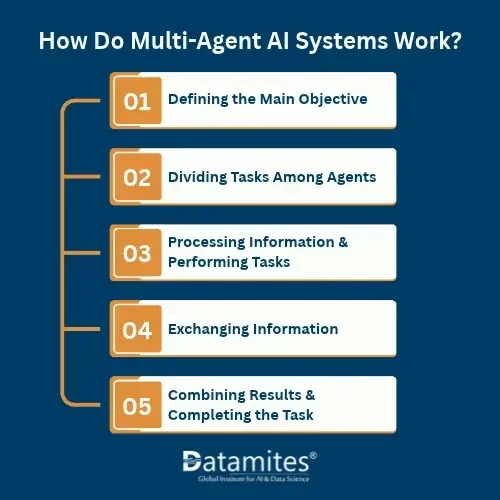
How Do Multi-Agent AI Systems Work?
Understanding how multi-agent AI works requires looking at the process through which agents receive instructions, perform activities, exchange information, and contribute to a shared objective.
Although the architecture varies depending on the AI application, most systems follow a series of interconnected steps.
1. Defining the Main Objective
The process begins when a user or an external system provides a task. The system identifies the expected outcome and determines which activities are necessary to complete it.
For example, if an organization wants to analyze customer feedback, the system may identify activities such as collecting reviews, categorizing comments, identifying customer concerns, and preparing a summary.
2. Dividing Tasks Among Agents
Once the objective is established, the system distributes smaller tasks among specialized agents. Each agent receives instructions based on its assigned responsibility.
Task distribution helps prevent unnecessary duplication and allows different activities to be performed independently or simultaneously.
3. Processing Information and Performing Tasks
Individual agents process the information available to them using their models, tools, and instructions. Depending on their responsibilities, they may search databases, analyze documents, generate responses, or perform calculations.
4. Exchanging Information
Agents share relevant findings with other agents or a coordinating mechanism. This communication helps maintain consistency and allows agents to use information generated during earlier stages.
5. Combining Results and Completing the Task
After individual activities are completed, the system brings the results together. A coordinating agent or another processing mechanism may review the outputs, identify missing information, and prepare the final result.
The system can also repeat certain steps if additional information or corrections are required.
Key Components of Multi-Agent AI Systems
A collaborative AI environment requires several technical components to ensure that individual agents can operate effectively and work towards common objectives.
1. Individual AI Agents
Agents are the primary working units of the system. Each agent performs a particular responsibility based on its assigned instructions, capabilities, and available tools.
2. Communication Mechanisms
Communication mechanisms allow agents to exchange messages, share findings, and request information. Depending on the architecture, communication may happen through APIs, shared databases, messaging systems, or structured messages.
3. Task Allocation and Management
Task allocation determines which agent should handle a particular activity. A task manager or coordinating agent may distribute responsibilities based on agent capabilities, workload, and task requirements.
4. Shared Memory and Knowledge
Shared memory allows agents to access relevant information from previous activities. It helps maintain context and reduces the need to repeatedly process the same information.
5. Coordination and Monitoring
Coordination mechanisms track task progress, manage dependencies, and identify problems. Monitoring also helps ensure that agents follow their assigned instructions and contribute to the expected outcome.
Together, these components create an environment where specialized agents can perform individual responsibilities while remaining connected to the overall workflow.
Refer to these articles:
- Artificial Intelligence Career Scope in India
- How to Become an Artificial Intelligence Engineer in India?
- What are the Best Artificial Intelligence and Deep Learning Courses in India?
How Do Multiple AI Agents Coordinate With Each Other?
Coordination is essential in collaborative AI systems to prevent task duplication, conflicting outputs, and workflow failures. Different coordination methods help agents work together effectively based on the application's requirements and complexity.
1. Role-Based Task Distribution
Each agent receives a specific role according to its capabilities. For example, in an automated customer support workflow, one agent may understand customer questions, another may retrieve relevant account information, and a third may prepare a response.
2. Centralized Coordination
In a centralized structure, a primary agent or orchestrator manages the activities of other agents. It distributes tasks, tracks progress, and combines their outputs.
This approach provides a clear management structure and can be useful when tasks require a defined sequence of operations.
3. Decentralized Coordination
In decentralized systems, agents communicate and make decisions without depending entirely on a single central controller. They coordinate through shared information, communication rules, and agreed objectives.
This structure can support flexible collaboration, although managing communication and consistency may become more challenging.
4. Communication and Conflict Resolution
Agents exchange information to understand task progress and share relevant findings. When two agents produce different recommendations, the system may use predefined rules, additional verification, or another decision-making process to resolve the disagreement.
For example, a research agent and a data analysis agent may identify different trends. A coordinating mechanism can compare their findings and request further validation before producing the final result.
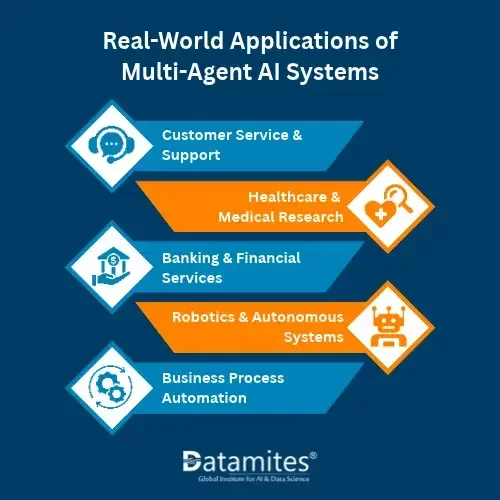
Real-World Applications of Multi-Agent AI Systems
Multi-agent architectures are increasingly relevant in industries where tasks involve several activities, different information sources, and coordinated decision-making.
Customer Service and Support
Multiple agents can manage different stages of customer interactions by identifying customer needs, retrieving relevant information, and preparing suitable responses. This approach helps organisations handle complex queries and automate repetitive support tasks.
Healthcare and Medical Research
Healthcare is an emerging application area for multi-agent AI Systems. Specialized AI agents can support medical research, retrieve patient information, assist with clinical documentation, and coordinate administrative workflows. According to Mordor Intelligence, the healthcare and life sciences segment of the multi-agent systems market is projected to grow at a 29.34% CAGR through 2031, highlighting its growing market potential.
Banking and Financial Services
Financial institutions can use collaborative agents for transaction monitoring, risk assessment, fraud detection, and data analysis. One agent can identify unusual transactions, while another examines historical data to support further investigation.
Robotics and Autonomous Systems
In robotics, multiple robots can coordinate tasks such as warehouse operations, inventory movement, and environmental monitoring. Each robot performs a specific role while sharing information to improve overall efficiency.
Business Process Automation
Organizations can use specialized agents to manage activities such as document processing, report preparation, data analysis, and workflow monitoring. Coordinated agents can connect different business operations and reduce repetitive manual work.
What Is the Future of Multi-Agent AI Systems?
The future of multi-agent AI systems is expected to bring better collaboration, task automation, and intelligent decision-making. According to MarketsandMarkets, the multi-agent systems segment of the AI agents market is projected to grow at a 48.5% CAGR between 2025 and 2030, highlighting its growing market potential.
Some important developments include:
- Advanced AI orchestration: Improved orchestration frameworks may help coordinate larger groups of specialized agents across complex workflows.
- Better collaboration: Improvements in communication protocols and shared memory may help agents exchange information more effectively.
- Business automation: Organizations may increasingly explore agent-based systems for research, customer support, reporting, and operational management.
- Human supervision: Human oversight will remain important for reviewing critical decisions, managing risks, and ensuring responsible AI use.
- Improved security: Stronger access controls, monitoring, and validation mechanisms will be necessary as autonomous agents gain access to more tools and business information.
However, challenges related to reliability, data privacy, coordination complexity, and operational costs must also be addressed. Successful adoption will depend on developing systems that are not only capable but also transparent, secure, and accountable.
Refer to these articles:
- What is Artificial Narrow Intelligence?
- Traditional AI vs Generative AI: Key Differences, Examples, and Use Cases
- What Are Graph Neural Networks? Simple Guide for Beginners
Multi-Agent AI systems are transforming how artificial intelligence handles complex tasks by enabling specialized agents to communicate, share information, and work towards common goals. From customer service and healthcare to finance and robotics, these systems offer opportunities to improve efficiency and problem-solving. As AI orchestration and autonomous technologies advance, multi-agent systems will play an increasingly important role in building flexible and intelligent workflows.
For learners interested in exploring these emerging technologies, DataMites Institute offers industry-oriented artificial intelligence training. Those searching for the top artificial intelligence course in Chennai can consider its 8-month Artificial Intelligence program, which covers statistics, machine learning, AI, and data analytics through practical training and project-based learning. The institute also offers specialized programs such as Certified Agentic AI Professional (CAAIP), Certified AI Architect, and AI for Business Leaders, focusing on autonomous AI applications, advanced system design, and AI-driven business strategies.
With 50+ training centres across India, 200,000+ learners, and a presence in 30+ countries, DataMites offers flexible online and classroom learning options. Learners seeking the best artificial intelligence training in Bangalore can benefit from hands-on projects, industry-focused learning, and expert mentorship. These programs help students, freshers, and working professionals develop relevant technical skills and explore career opportunities in the evolving artificial intelligence industry.