How Agentic AI Is Reshaping Human Resource Management
Explore how Agentic AI is transforming human resource management by automating HR tasks, improving recruitment, enhancing employee engagement, and supporting smarter workforce planning and data-driven decision-making.
 Prerana B A
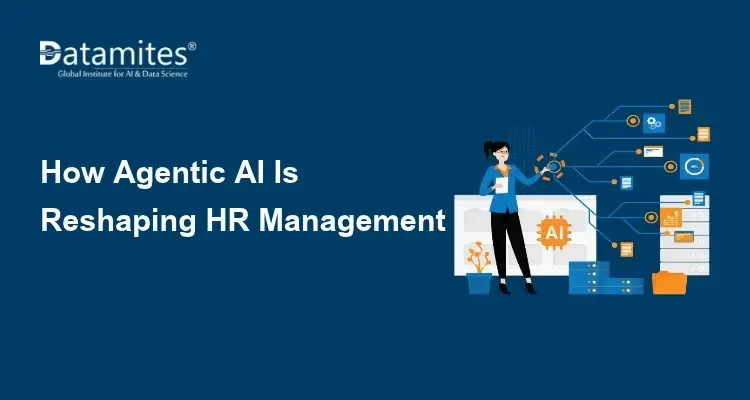
Artificial intelligence is changing how businesses manage recruitment, employee development, workforce planning, and daily HR activities. One emerging development is Agentic AI in HR, which enables AI systems to handle multi-step tasks, coordinate workflows, and support decisions with limited human intervention.
Unlike traditional automation, which follows predefined instructions, Agentic AI can interpret goals, plan actions, use connected tools, and respond to changing situations. For example, an AI agent can coordinate interview schedules, send candidate updates, and track recruitment progress while keeping recruiters informed.
As organisations explore more intelligent HR systems in 2026, Agentic AI is becoming an important part of discussions around workplace efficiency and employee experience. However, successful implementation still depends on human supervision, responsible data practices, and clear organisational policies.
What Is Agentic AI in Human Resource Management?
Agentic AI in human resource management refers to AI systems that can independently perform a series of connected tasks to achieve a specific objective within defined permissions. These systems can understand requests, plan steps, access authorised information, and complete activities through connected applications.
It is useful to understand the difference between three technologies:
- Traditional automation: Performs repetitive tasks using predefined rules, such as sending automatic interview reminders.
- Generative AI: Creates content such as job descriptions, employee communications, and training materials in response to prompts.
- Agentic AI: Coordinates multiple activities to complete a broader task, such as managing interview scheduling, updating recruitment records, and notifying candidates.
For example, when an HR manager requests support with onboarding, a traditional system may send a standard welcome email. A generative AI assistant can draft a personalised message, while an AI agent can coordinate document collection, share training resources, create onboarding tasks, and follow up on pending activities.
This ability to manage connected workflows makes Agentic AI applications in HR different from conventional AI tools.
Refer to these articles:
- Essential AI Skills for Marketing Professionals in 2026
- How AI Agents Are Changing Healthcare Operations
- The Role of AI in Investment and Portfolio Analysis
How Agentic AI Is Transforming HR Operations
Agentic AI can support several HR functions by reducing repetitive work and connecting activities across different departments.
Recruitment and Talent Acquisition
Recruitment involves multiple stages, from publishing job descriptions to communicating with candidates and arranging interviews. AI agents can help recruiters coordinate these activities.
Some practical applications include:
- Reviewing resumes against job-related requirements.
- Identifying candidates whose experience matches a vacancy.
- Sending application updates and interview reminders.
- Coordinating interview schedules with hiring managers.
- Updating recruitment records and tracking application progress.
For example, when a candidate applies for a position, an AI agent can organise application information, check whether required documents are available, and coordinate interview scheduling.
However, recruiters should review candidate assessments and retain control over important hiring decisions. Automated screening must also be monitored for bias and inaccurate recommendations.
Employee Onboarding
Employee onboarding requires coordination between HR teams, IT departments, managers, and new employees.
Agentic AI can simplify this process by coordinating document collection, sharing company policies, creating onboarding checklists, and tracking pending tasks.
For instance, when a new employee joins, an AI agent can send joining instructions, guide them through document submission, coordinate system access requests, and share relevant training materials.
This helps HR teams manage onboarding activities more consistently while allowing employees to access information when they need it.
Employee Engagement and Support
HR departments regularly receive questions about leave policies, payroll procedures, benefits, attendance, and workplace guidelines.
AI-powered HR assistants can respond to common queries using approved company information. Agentic AI can take this further by directing unresolved requests to the appropriate department, tracking their progress, and notifying employees about updates.
It can also help HR teams identify recurring employee concerns through aggregated feedback and support information.
For sensitive matters involving grievances, harassment, or employee well-being, requests should be directed to qualified HR professionals rather than handled entirely by AI.
Workforce Planning and People Analytics
Workforce planning involves understanding current employee capabilities and identifying future staffing requirements.
AI agents can analyse authorised workforce information, identify potential skill gaps, and help managers explore staffing trends. They can also prepare reports using information from connected HR systems.
For example, if a company plans to expand its technology department, an AI agent can help compare existing employee skills with anticipated role requirements and identify areas where recruitment or employee training may be needed.
These insights support AI in workforce management by helping HR professionals make more informed planning decisions.
Learning and Development
Employee training is another area where Agentic AI can support HR teams.
AI agents can recommend learning resources based on job responsibilities, existing skills, and development goals. They can also coordinate training schedules, send reminders, and track course completion.
For example, an employee moving into a data-related role may receive recommendations for relevant technical courses and learning materials. Managers can then review progress and provide additional guidance.
This supports more personalised learning experiences and helps organisations connect employee development with business requirements.
Benefits of Agentic AI in HR Management
The benefits of Agentic AI in HR extend beyond automating individual tasks. Its ability to coordinate connected workflows can improve how HR departments manage their responsibilities.
Key benefits include:
- Reduced administrative work: Handles repetitive activities such as reminders, scheduling, and document follow-ups.
- Faster workflow coordination: Connects recruitment, onboarding, and employee support activities.
- Improved employee support: Helps employees access approved HR information and track routine requests.
- More efficient recruitment operations: Supports candidate communication and interview coordination.
- Better workforce insights: Helps HR teams analyse skills, staffing requirements, and workforce trends.
- Personalised employee learning: Recommends relevant training based on employee development needs.
- More strategic HR activities: Gives HR professionals additional time to focus on employee relationships, organisational planning, and talent development.
According to SHRM's 2026 research, 39% of organisations were using AI in their HR functions. The research also identified recruitment as a leading area of adoption, demonstrating the growing practical role of AI in HR operations.
Importantly, these findings concern AI adoption broadly, not Agentic AI adoption specifically.
Challenges of Implementing Agentic AI in HR
Despite its potential, implementing Agentic AI in HR management requires careful planning. HR teams work with confidential employee information and decisions that can directly affect people's careers.
Some important challenges include:
- Employee data privacy: AI agents may access personal information, salary records, and performance data. Organisations must establish strict access controls and data protection practices.
- Bias in recruitment: AI systems may produce unfair recommendations if their training data or evaluation criteria contain historical biases.
- Transparency and accountability: Employees and managers should understand when AI is involved in HR processes and who is responsible for its actions.
- System integration: Connecting AI agents with existing HR management systems, payroll platforms, and recruitment software can be complex.
- Human oversight: Important decisions involving hiring, promotions, performance evaluations, and employee termination should remain under appropriate human supervision.
- Accuracy and reliability: AI-generated recommendations may contain errors or incomplete information, requiring verification before action is taken.
The NIST AI Risk Management Framework provides guidance for identifying and managing AI-related risks. Organisations can use such frameworks to develop responsible AI policies, monitor system performance, and establish accountability.
A successful implementation should begin with clearly defined tasks, limited permissions, regular monitoring, and human approval for sensitive actions.
Refer to these articles:
- Supervised vs. Unsupervised Learning: What’s the Difference?
- Generative AI and Predictive AI: Key Differences Explained
- Guide to Artificial Intelligence Career
What Is the Future of Agentic AI in Human Resource Management?
The future of Agentic AI in HR management will likely involve more connected HR workflows. AI agents may coordinate recruitment, onboarding, employee support, and training activities through integrated systems.
For example, when an employee changes roles, an AI agent could update documentation, identify training needs, notify relevant departments, and track the transition.
However, HR professionals will still need to evaluate AI recommendations, interpret workforce data, and manage potential risks. The World Economic Forum's Future of Jobs Report highlights the growing importance of AI, big data, analytical thinking, and technological literacy, making continuous upskilling essential.
For HR professionals, some important skills to develop include:
- AI literacy and understanding of AI agents.
- People analytics and data interpretation.
- Responsible AI practices and data privacy.
- Strategic workforce planning.
- Communication and employee relationship management.
The combination of technological knowledge and human skills will help HR professionals work effectively alongside intelligent systems.
Agentic AI is reshaping human resource management by helping organisations coordinate recruitment, onboarding, employee engagement, workforce planning, and learning activities. Its ability to manage multiple connected tasks makes it a promising development beyond traditional HR automation.
However, Agentic AI in HR should support rather than replace human expertise. Responsible implementation requires data protection, transparent processes, regular monitoring, and human involvement in important employee-related decisions.
As organisations continue exploring AI-powered HR automation, professionals who understand AI applications, workforce analytics, and responsible technology practices will be better prepared for the changing HR landscape.
DataMites Institute provides an industry-oriented AI for HR and People Analytics course designed to help HR professionals use artificial intelligence for effective workforce planning and informed decision-making. The curriculum covers AI fundamentals, people analytics, talent acquisition, employee engagement, performance management, and workforce planning. Explore the AI for human resource course at DataMites, along with other specialized AI programs in healthcare, finance, marketing, and product management.
The program offers flexible learning formats, including online classes, classroom training, and project-based internships. Learners can also pursue IABAC-accredited certification and the Certified AI Professional in People Analytics certification. With 50+ offline centres across India, including Bangalore, Chennai, Hyderabad, Pune, Mumbai, Ahmedabad, Coimbatore, and Delhi, DataMites makes AI and people analytics training accessible to professionals seeking to strengthen their skills and career opportunities.