How TamilSelvan Landed His First Job as an AI/ML Engineer
Learn how TamilSelvan's commitment to mastering AI and Machine Learning, building real-world projects, and preparing for interviews helped him land his first AI/ML Engineer role. His journey offers valuable insights for aspiring AI professionals.
 Priyanka BR
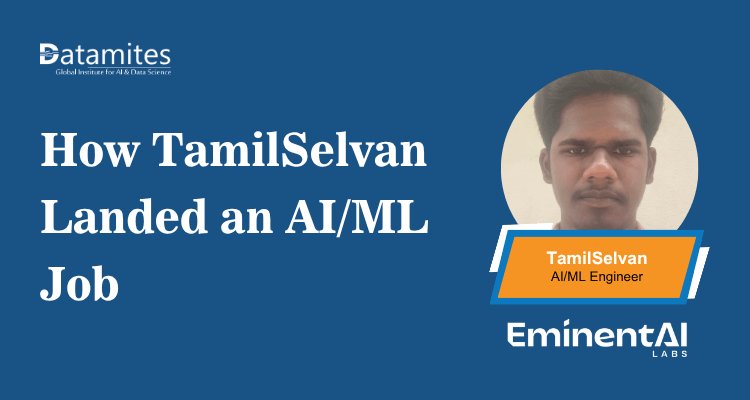
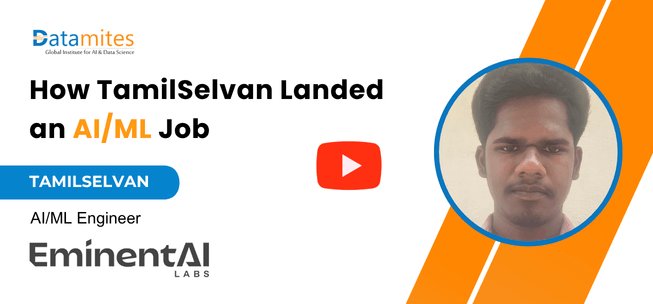
Have you ever wondered whether someone from a completely non-technical background can build a successful career in Artificial Intelligence? Meet TamilSelvan, a 2023 graduate in Food Testing and Quality Evaluation who transformed his passion for AI into a rewarding career as an AI/ML Engineer at Eminent AI Labs.
His journey wasn't straightforward. With no prior exposure to programming, mathematics, or computer science, TamilSelvan initially found coding and machine learning challenging. However, through consistent learning, hands-on projects, internships, and structured mentorship at DataMites, he gradually built the confidence and technical skills needed to break into the AI industry.
If you're a student or career changer wondering whether it's possible to transition into Artificial Intelligence, TamilSelvan's inspiring story proves that determination, practical experience, and the right guidance can help you land your first AI job, even without a technical background.
How TamilSelvan Launched His AI Career with DataMites
TamilSelvan's journey from a Food Testing and Quality Evaluation graduate to an AI/ML Engineer at Eminent AI Labs highlights how determination and the right guidance can lead to a successful career transition. Through DataMites' structured training, practical projects, internships, and placement support, he developed industry-ready AI skills and successfully secured his first full-time role in Artificial Intelligence.
1. Can you introduce yourself?
My name is TamilSelvan. I completed my Bachelor's degree in Food Testing and Quality Evaluation from GRD Institute in 2023. After graduation, I developed a strong interest in Data Science and Artificial Intelligence, which inspired me to switch careers. Today, I am starting my professional journey as an AI/ML Engineer at Eminent AI Labs.
2. How did your journey into Artificial Intelligence begin?
Initially, I enrolled in a Data Science program where I learned Excel, Power BI, SQL, Python, Statistics, Machine Learning, and completed several practical projects. Later, after moving to Bengaluru, I specialized further by enrolling in an Artificial Intelligence program where I studied Deep Learning, Computer Vision, Natural Language Processing (NLP), and Generative AI with Large Language Models (LLMs).
3. What practical experience did you gain during your AI learning journey?
Along with classroom learning, I completed an internship where I worked on several real-world AI applications. My projects included gender detection, traffic sign detection, food classification, and an LLM-powered "Chat with Documents" application. These projects gave me practical exposure to solving real business problems using AI.
4. Is this your first full-time job?
Yes. Although I had completed internships during my learning journey, this is my very first full-time job in the AI industry.
5. Will you be working remotely or from the office?
Initially, I will be working from home for about two to three months. After that, I will relocate and begin working from the company's office location.
6. Was Artificial Intelligence always your career goal?
Yes. My original interest was always Artificial Intelligence. However, before joining my AI specialization, I started with Data Science because it provided the essential foundation required for AI. Looking back, that decision helped me understand the fundamentals much better before moving into advanced Artificial Intelligence concepts.
7. Coming from a food science background, was learning programming difficult?
Absolutely. The first two to three months were challenging because my bachelor's degree had no exposure to mathematics, coding, or programming. Everything was completely new to me. However, with regular practice and consistency, programming gradually became easier. Once I understood the basics, learning advanced topics became much smoother.
8. Can students from non-technical backgrounds build a career in AI?
Definitely. Your educational background is not the deciding factor. What matters most is your willingness to learn programming and your genuine interest in Artificial Intelligence. Anyone who is committed to learning can successfully transition into AI regardless of their previous field of study.
9. How did the placement preparation process help you?
After completing two capstone projects, the placement team conducted an assessment interview. They carefully reviewed my resume, suggested improvements, and helped me prepare it professionally. Once the resume was ready, they regularly shared job openings and supported me throughout the recruitment process, from job applications to interview preparation.
10. Did you customize your resume for different companies?
Yes, but only slightly. The overall structure remained the same, while I made minor changes based on the company and job role. Having a strong base resume made customization much easier.
11. What was your interview experience like?
Most interviews followed a similar pattern. Interviewers first asked me to explain the projects I had completed. After discussing my projects, they tested my understanding of Machine Learning, Deep Learning, Natural Language Processing, and increasingly, Large Language Models (LLMs). Many interviewers also asked questions about how ChatGPT and LLMs work.
12. How deep should freshers study technical concepts before interviews?
Freshers don't need to master every advanced topic. A strong understanding of the fundamentals is much more important. If your basics are clear and you can write code confidently, you already have a solid foundation for cracking fresher interviews.
13. What projects would you recommend for aspiring AI professionals?
I recommend building projects from GitHub repositories, Kaggle competitions, internship assignments, or company assessment tasks. Instead of stopping after completing the model, try deploying it using Flask or Streamlit and create an interactive web application. A deployed project demonstrates practical skills and makes your portfolio stand out from other candidates.
14. How many interviews did you attend before receiving your job offer?
I applied to more than 20 companies. Out of those applications, I received interview opportunities from eight companies. Seven interviews resulted in rejection, and one finally turned into a job offer. Some companies also rejected my application because my educational qualification did not exactly match their requirements.
15. How did you stay motivated after multiple rejections?
I understood that not every company is the right fit for every candidate. Instead of getting discouraged, I continued applying, improving my interview performance, and learning from each experience. Persistence eventually paid off.
16. What advice would you give freshers preparing for AI interviews?
Focus on mastering the fundamentals rather than trying to learn everything in depth. Build practical projects, improve your coding skills, and understand your own work thoroughly. During interviews, confidence in your basics matters much more than memorizing advanced concepts.
17. What role did mentorship and support play in your success?
The guidance I received throughout my learning journey made a significant difference. The placement team supported me with resume building, interview preparation, and job opportunities. I am also grateful to my personal coordinator, who constantly guided and encouraged me during my interview process.
Refer to these articles:
- What is a Confusion Matrix in Machine Learning?
- Supervised vs. Unsupervised Learning: What’s the Difference?
- Generative AI and Predictive AI: Key Differences Explained
TamilSelvan's Key Takeaways on Starting a Career in AI
TamilSelvan's journey demonstrates that a non-technical background is no barrier to building a successful career in Artificial Intelligence. With structured learning, practical experience, and perseverance, he successfully transitioned into the AI industry.
- Background: TamilSelvan completed his Bachelor's degree in Food Testing and Quality Evaluation from GRD Institute in 2023.
- Career Transition: Despite coming from a food science background, he developed a strong interest in Data Science and Artificial Intelligence and decided to change careers.
- Training Choice: He began with a Data Science program at DataMites before enrolling in the Artificial Intelligence program to build advanced AI skills.
- Learning Focus: He gained expertise in Excel, Power BI, SQL, Python, Statistics, Machine Learning, Deep Learning, Computer Vision, Natural Language Processing (NLP), and Generative AI.
- Practical Exposure: During his internship, he worked on real-world projects including gender detection, traffic sign detection, food classification, and an LLM-powered Chat with Documents application.
- Placement Support: The DataMites placement team helped him with resume building, interview preparation, mock interviews, and job application support.
- Interview Experience: He attended eight interviews after applying to more than 20 companies, using each interview as an opportunity to improve.
- Career Breakthrough: TamilSelvan secured his first full-time role as an AI/ML Engineer at Eminent AI Labs.
- Project Portfolio: He recommends building practical AI projects and deploying them using tools like Flask or Streamlit to create interactive applications.
- Learning Strategy: He believes freshers should focus on mastering AI fundamentals and coding basics rather than trying to learn every advanced topic.
- Challenges Faced: Adjusting to programming, mathematics, and AI concepts was difficult initially, but persistence helped him build confidence.
- Mentorship Impact: Guidance from trainers, the placement team, and his personal coordinator played an important role in his job preparation.
TamilSelvan's journey proves that a non-technical background is no barrier to building a successful career in Artificial Intelligence. After graduating in Food Testing and Quality Evaluation, he transitioned into AI by enrolling in one of the best IT courses at DataMites. Through comprehensive Data Science and advanced AI training, hands-on projects, internship experience, expert mentorship, and placement support, he built strong industry-ready skills. His dedication and practical learning helped him secure his first full-time role as an AI/ML Engineer at Eminent AI Labs, inspiring aspiring professionals to confidently pursue the best IT courses and transform their careers in the rapidly growing AI industry.
Refer to these articles:
- How Khushi Became a Lead ML Engineer in the AI Industry
- Manikanta’s Career Transition into Software Python Developer
- How Dinkar Cracked His First Agentic AI Engineer Job as a Fresher
DataMites Institute offers a 9-month Artificial Intelligence course with 780 learning hours through flexible online and classroom training. With 40+ offline training centers across cities including Bangalore, Hyderabad, Pune, Chennai, Ahmedabad, Coimbatore, Mumbai, and Delhi, the program provides hands-on learning in Python, machine learning, deep learning, NLP, computer vision, and Generative AI. Backed by IABAC and NASSCOM FutureSkills certifications, along with internships and placement support, the course prepares learners for successful careers in Artificial Intelligence.
Students and professionals in Tamil Nadu can enroll in DataMites' classroom Artificial Intelligence training at its centers in Coimbatore and Chennai. Those looking for an artificial intelligence course in Coimbatore can gain practical experience through hands-on projects, expert mentorship, internships, and placement support, helping them develop industry-ready AI skills and build successful careers.
Similarly, students and professionals in Delhi can enroll in artificial intelligence courses in Delhi to gain practical experience through hands-on projects, expert mentorship, internships, and placement support. These industry-focused programs help learners develop job-ready AI skills and build successful careers in Artificial Intelligence.