Top AI Product Manager Trends Shaping 2030
Discover the top AI product manager trends shaping 2030, including AI-driven product decisions, automation, ethical AI, product analytics, and hyper-personalization. Learn the essential skills and strategies needed to succeed in the future of product management.
 Kriti Maurya
As organizations increasingly rely on intelligent technologies to drive innovation, the role of product managers is evolving beyond traditional responsibilities. By 2030, AI-powered tools, predictive analytics, automation, and human-AI collaboration will redefine how products are conceived, developed, launched, and optimized.
The growing influence of AI is creating new opportunities for professionals who can bridge technology, business strategy, and customer needs. Understanding the latest trends in product management is becoming essential for organizations seeking sustainable growth and professionals aiming to build successful product management careers.
Here will explore the most important AI product manager trends expected to shape the future of the profession by 2030, the skills required to stay competitive, and practical steps to prepare for a successful career in AI-powered product management.
The Evolving Role of AI Product Managers
The role of AI product managers is rapidly evolving as organizations increasingly adopt artificial intelligence to drive innovation and business growth. Unlike traditional product managers, today's professionals must combine business strategy, customer insights, and technical knowledge to lead AI-powered product development. One of the key AI product manager trends is the growing reliance on AI-Driven Product Decisions, predictive analytics, and automation to improve product outcomes.
A report by McKinsey reveals that approximately 73% of organizations have implemented AI in at least one business function, highlighting the technology’s growing role as a strategic driver of innovation, efficiency, and competitive advantage.
As the future of product management becomes more data-centric, professionals must develop strong product managers skills in AI, Product Analytics, and customer experience design. Those who can align AI product strategy with business goals will play a critical role in shaping the future of product manager career.
Refer to the articles below:
- AI Product Development Life Cycle Explained
- Who is an AI Product Manager? Key Roles and Responsibility
- Career Transition Tips for Aspiring AI Product Managers
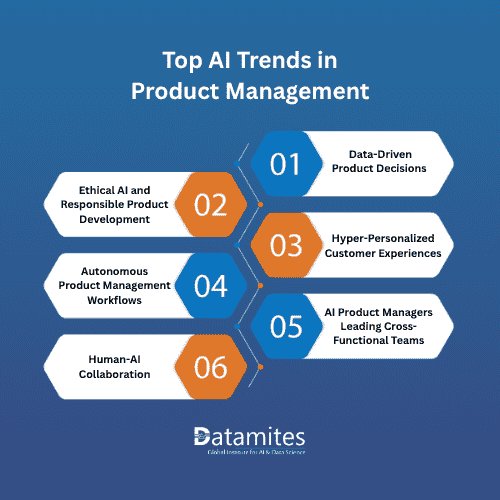
Top AI Trends in Product Management Shaping 2030
As artificial intelligence continues to transform industries, several key AI product manager trends are expected to redefine the future of product management by 2030. Product leaders will increasingly rely on AI-powered technologies to improve decision-making, streamline operations, and deliver greater customer value. Here are the top trends shaping the next generation of product management.
1. Data-Driven Product Decisions at Scale
One of the most impactful trends in product management is the rise of data-driven decision-making. By 2030, AI systems will process vast amounts of customer, operational, and market data in real time, enabling product managers to make faster and more accurate decisions. Advanced Product Analytics platforms will help teams identify user behavior patterns, forecast market demands, and optimize product roadmaps. These AI-Driven Product Decisions will reduce uncertainty, improve product performance, and support long-term business growth.
2. Ethical AI and Responsible Product Development
As AI becomes central to product development, ethical considerations will play a crucial role in shaping business strategies. Product managers will be responsible for ensuring transparency, fairness, privacy, and compliance in AI-powered products. Organizations that adopt responsible AI practices will build stronger customer trust and create sustainable, customer centric products. Ethical governance frameworks will become a core component of every successful AI product strategy.
3. Hyper-Personalized Customer Experiences
Personalization will reach new heights with AI-driven technologies. Future products will continuously adapt to individual customer preferences, behaviors, and needs. AI algorithms will analyze customer interactions and provide highly customized experiences that increase engagement and loyalty. This trend will drive significant digital product innovation, helping businesses differentiate themselves in competitive markets while delivering more relevant and meaningful user experiences.
4. Autonomous Product Management Workflows
Automation is expected to transform everyday product management activities. AI-powered systems will handle tasks such as customer feedback analysis, market research, competitor tracking, sprint planning, and reporting. These autonomous workflows will improve efficiency and allow product managers to focus on innovation, strategy, and business growth. Among emerging AI product manager trends, workflow automation is poised to become a major productivity driver.
5. AI Product Managers Leading Cross-Functional Teams
The increasing complexity of AI-powered products will require stronger collaboration across engineering, data science, marketing, design, and business teams. Product managers will serve as strategic leaders who align stakeholders around common objectives. Strong communication, leadership, and product managers skills will be essential for managing cross-functional teams and ensuring successful product outcomes.
6. Human-AI Collaboration as a Competitive Advantage
While AI will automate many processes, human expertise will remain critical. The future of product manager roles will involve combining AI-generated insights with human creativity, empathy, and strategic thinking. Organizations that successfully balance human intelligence with AI capabilities will gain a significant competitive advantage. This collaborative approach will strengthen innovation, improve decision-making, and shape the future of successful product management careers.
Essential Skills AI Product Managers Need by 2030
As the profession evolves, product managers must continuously expand their capabilities to remain competitive.
- Data Literacy and Product Analytics: AI product managers must interpret data, track performance metrics, and use Product Analytics to support informed, data-driven decisions.
- AI and Technical Knowledge: Understanding AI, machine learning, and automation technologies is crucial for building effective AI product strategy and collaborating with technical teams.
- Strategic Business Thinking: Strong product managers skills are needed to align innovation with business goals, customer expectations, and market opportunities.
- Leadership and Cross-Functional Collaboration: Effective communication and stakeholder management help product managers lead diverse teams and drive successful product outcomes.
- Adaptability and Modern Tools Expertise: Continuous learning, ethical AI awareness, and proficiency with advanced AI Product Manager Tools workflows are essential for success in the future of product management.
Additionally, proficiency with modern tools for product manager workflows including AI-powered analytics platforms, customer intelligence solutions, experimentation tools, and roadmap management systems will become essential.
How to Prepare for an AI Product Management Career
The growing demand for AI-powered products is creating significant career opportunities for aspiring professionals to become AI Product Manager.
1. Build Strong Product Management Fundamentals
Start by mastering core product management concepts such as market research, customer discovery, product roadmap planning, stakeholder management, and business strategy. These foundational skills are essential for succeeding in modern product management careers.
2. Develop Data-Driven Decision-Making Skills
Learn to work with Product Analytics, customer insights, key performance metrics, and experimentation frameworks. Strong analytical abilities enable AI-Driven Product Decisions and help create more effective, customer-focused solutions.
3. Gain Knowledge of AI and Emerging Technologies
Understanding artificial intelligence, machine learning, automation, and AI product strategy is crucial. Familiarity with these technologies helps professionals contribute to innovative product development and support the future of product management.
4. Continuously Upgrade Your Skills
Pursue certifications, training programs, workshops, and practical projects to stay updated with evolving AI product manager trends and industry best practices.
5. Build Practical Experience and Industry Connections
Work on real-world AI projects, explore modern tools for product manager workflows, and engage with professional communities. Combining technical expertise, business acumen, and customer-centric thinking prepares you for the future of product manager roles.
As AI reshapes industries, professionals with strong business, technical, and analytical expertise will thrive. Key AI product manager trends including AI-Driven Product Decisions, automation, ethical AI, and Product Analytics are redefining the future of product management and creating new opportunities for successful product management careers.
Refer to the articles below:
- AI Trends That Will Transform Marketing and Advertising
- How AI Help Business in Marketing and Customer Behavior Analysis
- Top AI Career Opportunities in Finance for Future Professionals
DataMites Institute offers a comprehensive AI for Product Managers course that equips professionals with the skills to integrate AI into product strategy, innovation, and decision-making. The course covers AI Product Management, AI for Finance, Marketing, HR, Healthcare, and Generative AI. With live online, classroom, and internship-based learning options, the globally recognized IABAC-accredited certification provides practical industry exposure across major Indian cities.
DataMites has established its presence in leading Indian cities such as Hyderabad, Ahmedabad, Chennai, Bangalore, Pune, Mumbai, and Coimbatore. Learners can choose flexible formats, including online and classroom training, along with real-time project-based internships for hands-on experience.