Top AI Product Manager Skills in 2026
Explore the top AI product manager skills in 2026, including AI product strategy, machine learning, Generative AI, data analytics, prompt engineering, AI ethics, and product management. Discover essential technical and soft skills, practical ways to develop them, and career opportunities in AI-powered product management.
 Kriti Maurya
Artificial intelligence is transforming how businesses develop products, understand customer needs, and make strategic decisions. Understanding the top AI product manager skills in 2026 can help aspiring and experienced product managers prepare for this evolving field.
An AI product manager oversees the development and improvement of products that use artificial intelligence to solve real-world problems.Unlike traditional product management, AI product management also involves managing model performance, data quality, uncertainty, and ongoing evaluation.
Here, we’ll explore the most important AI product manager skills required to succeed in 2026 and beyond, including technical expertise, data-driven decision-making, AI ethics, strategic thinking, and stakeholder management. We’ll also cover practical ways to develop these skills and prepare for a successful career in AI-powered product management.
What Skills Does an AI Product Manager Need in 2026?
AI product managers need a balanced skill set to identify valuable opportunities, collaborate with technical teams, and deliver products that meet business and customer expectations. The following are some of the most important AI product manager skills in 2026.
1. AI and Machine Learning Fundamentals for AI Product Managers
AI product managers should understand how artificial intelligence and machine learning work, even if they do not develop models themselves. Knowledge of supervised learning, unsupervised learning, deep learning, large language models (LLMs), and generative AI helps them evaluate technical possibilities and communicate effectively with engineering teams.
For example, a product manager developing an AI-powered customer support assistant should understand how language models generate responses, why incorrect answers occur, and how retrieval-augmented generation (RAG) can help provide responses grounded in approved information.
2. Data Analysis and Data-Driven Decision-Making
Data literacy is essential for evaluating AI products and making informed decisions. Product managers must interpret user behavior, product adoption, model evaluation results, and business performance metrics.
Important capabilities include understanding SQL fundamentals, interpreting dashboards, defining key performance indicators (KPIs), and analyzing experiments. These skills help product managers determine whether an AI feature improves user experience or simply adds technical complexity.
For instance, an AI recommendation feature should be evaluated using appropriate measures such as click-through rate, conversion rate, user engagement, and customer satisfaction rather than relying on a single metric.
3. AI Product Strategy and Roadmap Planning
AI product strategy involves identifying business problems that AI can solve effectively and determining which opportunities deserve investment. Product managers must assess customer needs, technical feasibility, expected value, implementation costs, and potential risks.
They should also prioritize features based on business impact and available resources. A clear roadmap helps align AI Product development life cycle with organizational objectives while allowing teams to adapt as new evidence emerges.
4. Generative AI and Prompt Engineering
Generative AI knowledge has become increasingly relevant to product managers working with chatbots, content-generation tools, coding assistants, and intelligent business applications.
Prompt engineering helps product managers design and test instructions for large language models. They should also understand concepts such as context windows, hallucinations, model selection, RAG, and structured outputs.
These capabilities help them prototype AI experiences, evaluate output quality, and identify where human review or additional safeguards are necessary.
5. AI Product Discovery and User Research for product development
Product discovery helps determine whether an AI solution addresses a genuine user problem. Product managers should conduct interviews, analyze customer feedback, identify recurring pain points, and validate proposed use cases before committing resources.
They must distinguish between problems that genuinely benefit from AI and those that can be solved more reliably through conventional software or process improvements.
For example, a company may explore AI-powered document processing to reduce manual work. Before development begins, the product manager should establish the expected time savings, accuracy requirements, user needs, and consequences of processing errors.
Refer to the articles below:
- Top AI Skills for Finance Professionals
- Top AI Career Opportunities in Finance for Future Professionals
- AI in Marketing Funnel Analysis for Effective Decision-Making
6. Responsible AI, Privacy, and Governance
AI products can introduce risks related to bias, privacy, security, transparency, and inaccurate outputs. Product managers should recognize these risks and collaborate with legal, security, data science, and compliance teams to address them.
Important skills include identifying sensitive data, defining human oversight requirements, evaluating potential bias, and documenting appropriate product limitations.
Responsible AI practices should be incorporated throughout product discovery, development, testing, deployment, and monitoring rather than added only at the end.
7. AI Product Evaluation and Performance Monitoring
AI products require continuous evaluation because model outputs can vary across inputs and performance may change as user behavior or underlying data changes.
Product managers should understand how to assess output quality, reliability, latency, operating costs, user adoption, and business outcomes. They should work with technical teams to define evaluation criteria and establish monitoring processes.
This enables teams to identify performance issues, compare alternative models, and improve products after launch.
Essential Technical vs. Non-Technical Skills for AI Product Managers
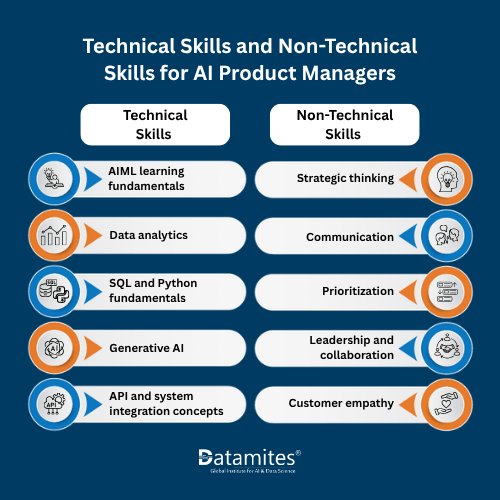
Successful AI product management requires both technical understanding and strong business and interpersonal capabilities. Technical skills help product managers evaluate what is possible, while non-technical skills help them decide what should be built and how to deliver it successfully.
Technical Skills for AI Product Managers
Technical skills provide the foundation for understanding AI systems, evaluating their limitations, and collaborating with engineering teams.
Key technical skills include:
- AI and machine learning fundamentals: Understanding model types, training, inference, and evaluation.
- Data analytics: Interpreting datasets, dashboards, KPIs, and experimentation results.
- SQL and Python fundamentals: Understanding data queries and basic analytical workflows.
- Generative AI: Working knowledge of LLMs, prompt engineering, RAG, and AI agents.
- API and system integration concepts: Understanding how AI models connect with applications and existing systems.
- Model evaluation: Assessing output quality, accuracy, reliability, latency, and cost.
Product managers do not necessarily need to become expert programmers. However, sufficient technical knowledge helps them ask better questions, identify dependencies, and make informed trade-offs.
Non-Technical Skills for AI Product Managers
Non-technical skills help translate business objectives into practical product requirements and coordinate teams throughout the product lifecycle.
Important capabilities include:
- Strategic thinking: Connecting AI initiatives with business goals and customer needs.
- Communication: Explaining technical concepts to stakeholders with different levels of technical knowledge.
- Prioritization: Selecting features based on impact, feasibility, cost, and risk.
- Leadership and collaboration: Aligning engineering, design, data science, marketing, and business teams.
- Customer empathy: Understanding user problems and evaluating the usefulness of AI solutions.
- Decision-making under uncertainty: Making evidence-based decisions when model performance and user outcomes are not fully predictable.
Which Skills Should Beginners Prioritize?
Beginners should focus on the following sequence:
- Product management fundamentals, including user research, prioritization, and roadmaps.
- AI and machine learning fundamentals.
- Data literacy, product metrics, and experimentation.
- AI Product Manager Tools and basic prototyping.
- AI evaluation and responsible AI.
- Practical project delivery and stakeholder communication.
This sequence establishes a foundation before moving into more advanced topics such as AI agent architecture, model optimization, and complex enterprise integrations.
How to Develop AI Product Management Skills
Developing AI product management skills requires a structured learning approach that combines conceptual knowledge with hands-on practice. Professionals can follow these steps to build relevant capabilities.
Step 1: Learn AI and Machine Learning Fundamentals
Begin with the basic principles of machine learning, generative AI, and LLMs. Focus on understanding how models generate outputs, how data influences performance, and why AI systems sometimes fail.
You do not need to master every algorithm. Concentrate on the concepts required to assess use cases, understand limitations, and communicate with technical teams.
Step 2: Strengthen Product Management Fundamentals
Learn how to conduct discovery, define requirements, prioritize features, plan roadmaps, and measure outcomes.
Practice writing a product requirements document (PRD) that includes:
- Problem statement and target users.
- User needs and existing alternatives.
- Proposed solution and scope.
- Functional and non-functional requirements.
- Success metrics and guardrails.
- Dependencies and risks.
- Acceptance criteria and launch requirements.
For AI products, include evaluation criteria and define how the team will handle incorrect or uncertain outputs.
Step 3: Experiment With AI Tools and Platforms
Use generative AI tools and model APIs to understand how different design choices affect product behavior.
A useful exercise is to create a customer feedback summarizer. Test it with different input lengths, contradictory feedback, ambiguous comments, and missing information. Evaluate whether the output is accurate, consistent, useful, and appropriately grounded in the source material.
Document any failures and propose improvements rather than focusing only on the best outputs.
Step 4: Build a Portfolio of AI Product Projects
A portfolio demonstrates your ability to connect customer needs, AI capabilities, and measurable business outcomes.
Each project should include:
- Business problem and target audience.
- User research or clearly stated assumptions.
- AI approach and rationale.
- Product requirements and user journey.
- Prototype or demonstration.
- Evaluation plan and sample results.
- Privacy, safety, and reliability considerations.
- Product roadmap and prioritization decisions.
If you do not have real production data, use a test dataset and label the results as experimental. Do not present simulated outcomes as actual business achievements.
Step 5: Learn Responsible AI and Model Evaluation
Develop a working understanding of privacy, security, fairness, and human oversight. Learn how to create test cases and measure model behavior across typical and challenging scenarios.
For higher-risk applications, involve appropriate domain experts and establish stronger evaluation and review procedures.
Step 6: Seek Practical Experience and Feedback
Collaborate with engineers, designers, data scientists, and business stakeholders whenever possible.
Participate in product case studies, contribute to AI prototypes, and seek feedback from experienced product professionals. Structured training can also help organize learning across AI fundamentals, discovery, strategy, planning, and execution.
The goal is to demonstrate how you make product decisions, not simply which tools you have used.
Refer to the articles below:
- Popular AI Tools in Healthcare for 2026
- The 2026 Guide to Implementing AI in HR Analytics
- Roadmap to Become an AI Product Manager
Real-World Case Studies of AI Product Management
AI product managers combine technical understanding, customer research, data analysis, and business strategy to develop AI-powered solutions. The following real-world examples demonstrate how organizations apply AI to solve business problems and highlight the skills required to manage successful AI products.
1. AI-Powered Customer Support: Klarna
Klarna, a global payments and shopping service, introduced an AI assistant powered by OpenAI to handle customer service inquiries. According to Klarna and OpenAI, the assistant handled approximately two-thirds of customer service chats during its first month, with average resolution times decreasing from 11 minutes to under two minutes.
Key product management skills: AI product managers working on customer support solutions must understand conversational AI, customer experience, response accuracy, and escalation workflows. They also need to define performance metrics, monitor customer satisfaction, and ensure that complex or sensitive queries can reach human support agents.
2. AI Recommendation Systems: Netflix
Netflix uses recommendation technology to personalize the viewing experience. Its system considers factors such as viewing history, interactions with titles, and information about available content to suggest movies and television shows relevant to individual members.
Key product management skills: Developing recommendation products requires an understanding of personalization, user behavior, data analysis, and experimentation. AI product managers must identify meaningful success metrics, such as engagement and content discovery, while balancing personalization with content diversity and user preferences.
3. AI-Powered Document Processing: JPMorgan Chase
JPMorgan Chase developed COiN (Contract Intelligence), a machine learning-based system designed to analyze commercial loan agreements and extract important information. The company reported that the technology could review thousands of agreements and reduce the time spent on repetitive manual document analysis.
Key product management skills: This use case highlights the importance of identifying repetitive business processes suitable for AI automation. Product managers must understand document-processing workflows, model accuracy, data security, compliance requirements, and human review procedures before deploying AI solutions in financial services.
4. Predictive Customer Churn: Dialog Axiata
Telecommunications provider Dialog Axiata used Amazon SageMaker to develop machine learning models that predict customer churn risk. The solution analyzes customer and network-related information to identify subscribers who may discontinue their service, enabling targeted retention initiatives.
Key product management skills: AI product managers need to understand predictive analytics, customer segmentation, and model performance monitoring. They must also connect predictions to business actions, such as personalized offers or proactive customer support, and measure whether these interventions improve retention.
Future Opportunities in AI Product Management
As organizations explore generative AI, AI agents, intelligent automation, and AI-enabled enterprise software, product managers may find opportunities across industries such as financial services, healthcare, retail, education, and software technology.
Several capabilities are likely to remain valuable:
- Evaluating AI use cases and technical feasibility.
- Designing reliable, user-centered AI experiences.
- Managing model quality, costs, and performance.
- Establishing responsible AI and governance practices.
- Measuring business outcomes and product adoption.
- Coordinating multidisciplinary teams.
The future of AI product management will not depend solely on knowing the latest AI tools. Professionals who can translate emerging capabilities into useful, reliable, and commercially viable products will be better positioned to contribute. The World Economic Forum estimates that nearly 39% of workers' existing skill sets will be transformed or become outdated between 2025 and 2030.
Refer to the articles below:
- How AI is Transforming Customer Analytics in 2026
- Explainable AI: Why Black‑Box Models Are Losing Trust
- How Knowledge-Augmented Generation (KAG) Is Solving AI Hallucinations
The top AI product manager skills in 2026 combine AI and machine learning fundamentals, data analysis, product strategy, generative AI, user research, technical communication, and responsible AI practices. Developing these capabilities enables product managers to identify meaningful opportunities, guide cross-functional teams, and evaluate AI products using measurable outcomes.
DataMites Institute offers a comprehensive AI for Product Managers Course is designed to help professionals develop the skills needed to incorporate AI into product strategy, innovation, and business decision-making. The program covers AI Product Management, AI applications in Finance, Marketing, HR, and Healthcare, along with Generative AI. Learners can benefit from live online sessions, classroom training, and internship-based learning opportunities, gaining practical exposure through industry-oriented projects and an IABAC-accredited certification.
With a presence in major Indian cities, including Hyderabad, Ahmedabad, Chennai, Bangalore, Pune, Mumbai, and Coimbatore, DataMites provides flexible learning options to suit different professional needs. Learners can choose online or classroom training and gain hands-on experience through real-time projects and practical internships to strengthen their AI product management skills.