AI in Marketing Funnel Analysis for Effective Decision-Making
Learn how AI in marketing funnel analysis helps businesses track customer journeys, identify conversion gaps, analyze customer behavior, optimize campaigns, improve lead generation, and make data-driven marketing decisions to boost conversions, enhance customer engagement, and maximize marketing ROI.
 Kriti Maurya
Modern organizations rely on customer insights to optimize marketing campaigns and drive better conversion outcomes. This is where marketing funnel analysis plays a critical role. By examining how prospects move through different stages of the marketing funnel, businesses can identify opportunities to improve engagement and maximize conversions.
The integration of Artificial Intelligence (AI) is revolutionizing this process. Through advanced algorithms, machine learning models, and predictive capabilities, AI enables organizations to gain deeper insights into customer behavior and make data-driven decisions with greater accuracy. AI-Powered Marketing Analytics is helping marketers move beyond traditional reporting by providing real-time insights, predictive recommendations, and automated optimization strategies.
According to HubSpot research, 67% of marketers believe that AI will significantly reshape marketing roles, processes, and workflows by 2030, highlighting its growing influence on the future of the industry.
The Role of AI in Marketing Funnel Analysis
Traditional marketing funnel analysis relies heavily on historical data and manual interpretation, which often limits an organization's ability to understand today's complex customer journeys. With customers interacting across websites, social media, email campaigns, advertisements, and customer support channels, businesses require more advanced analytical capabilities. AI addresses this challenge by processing large volumes of structured and unstructured data in real time, enabling deeper insights into customer behavior.
Through AI for Customer Behavior Analysis, organizations can identify behavioral patterns, detect drop-off points, and understand the factors influencing customer decisions at each stage of the funnel. Machine learning models continuously learn from customer interactions, improving prediction accuracy and revealing opportunities for optimization.
Additionally, AI enhances Marketing Decision-Making by providing data-driven recommendations that help marketers refine targeting strategies, optimize budgets, and improve campaign performance. As a result, AI-Driven Marketing Strategies are becoming essential for improving customer engagement, increasing conversions, and maximizing overall marketing effectiveness.
Refer to the articles below:
- Essential AI Tools for finance Smarter Analysis
- Top AI Tools in HR Transforming Tech Companies
- The Rise and Evolution of AI in Healthcare
Why Marketing Funnel Analysis Matters in Modern Marketing
Marketing funnels provide a structured framework for understanding how prospects move from awareness to conversion. Effective marketing funnel analysis enables organizations to identify bottlenecks, optimize customer experiences, and improve revenue generation.
The increasing integration of Artificial Intelligence into marketing operations is driving significant market growth. Statista projects that the global AI in marketing market will grow from $47 billion in 2025 to more than $107 billion by 2028, highlighting the rising demand for AI-powered marketing solutions.
1. Identifying conversion bottlenecks
Machine learning and behavioral analytics can help identify segments, channels, or journey steps associated with unusually high abandonment rates.
For example, a business may discover that mobile visitors frequently leave during checkout. Further investigation might reveal slow page loading, unexpected delivery costs, or a complicated payment process.
AI can help prioritize these patterns, but marketers should investigate the underlying cause before implementing changes.
2. Predicting customer intent
Predictive models can estimate the likelihood that a prospect will complete a purchase, submit a lead form, or disengage from a campaign.
These estimates help marketing teams prioritize follow-ups and tailor communications. Predictions should be evaluated against actual outcomes to determine whether they provide meaningful improvement over simpler rules-based methods.
3. Improving personalization
AI can use relevant behavioral and transactional signals to support personalized recommendations, product suggestions, email content, and advertising audiences.
Personalization should be based on appropriate data, respect customer preferences, and avoid collecting or using information without a valid basis.
4. Supporting marketing budget allocation
AI-assisted analysis can help marketers compare channel performance, estimate customer acquisition costs, and identify opportunities for additional testing.
However, last-click attribution alone can misrepresent channel contribution. Where feasible, marketers should use controlled experiments, incrementality testing, or other suitable measurement methods to determine whether campaigns actually generate additional conversions.
Without proper analysis, businesses risk losing potential customers at critical stages of the funnel. AI enhances visibility into these stages by enabling advanced Customer Journey Analysis, allowing marketers to understand how users interact with content, products, and services throughout their buying journey.
This holistic perspective allows organizations to implement more effective Marketing Funnel Optimization strategies and improve overall campaign performance.
How AI Analyzes Each Stage of the Marketing Funnel
AI enhances marketing funnel analysis by delivering actionable insights across every stage of the customer journey. Through AI-Powered Marketing Analytics, businesses can understand customer behavior, improve engagement, and optimize conversions more effectively.
1. Awareness: Understanding Audience Reach
At the awareness stage, marketers aim to attract relevant prospects and increase brand visibility.
AI can analyze website traffic, advertising performance, search queries, social media engagement, and audience characteristics to identify patterns associated with valuable visitors.
Potential applications include:
- Audience segmentation based on relevant behavioral patterns.
- Identification of content topics associated with qualified traffic.
- Forecasting campaign engagement and traffic and popular AI trends for Marketing.
- Detection of unusual changes in channel performance.
- Optimization of advertising creative through structured experiments.
For example, an online education provider may compare the performance of organic search, paid advertising, and social media campaigns. Instead of evaluating success solely through clicks, it can examine which channels attract visitors who subsequently register for courses or request information.
The objective is not simply to maximize reach. It is to attract audiences who are more likely to engage meaningfully with the business.
2. Consideration: Understanding Customer Intent
During consideration, prospects evaluate their options before making a decision.
AI can help analyze product-page visits, content consumption, email engagement, search behavior, and other permitted interactions to understand which experiences are associated with stronger purchase intent.
Marketers can use these insights to:
- Recommend relevant educational content.
- Identify frequently viewed product features.
- Personalize lead-nurturing sequences.
- Recognize prospects who may need additional information.
- Identify common questions or concerns in customer feedback.
For example, a software company may observe that prospects who review pricing information and implementation guides are more likely to request a product demonstration. The company can test whether offering a relevant demonstration invitation improves qualified lead generation.
Such patterns are useful starting points, but correlation does not establish causation. Controlled testing can help determine whether the proposed intervention changes customer behavior.
3. Conversion: Reducing Purchase Barriers
The conversion stage focuses on turning qualified prospects into customers or completing another defined business objective.
AI can help marketers investigate factors associated with abandonment, identify potentially high-intent visitors, and prioritize landing-page improvements.
Common applications include:
- Predicting the probability of conversion.
- Identifying pages associated with high abandonment.
- Analyzing search terms and customer feedback.
- Recommending relevant products or content.
- Supporting experiments involving page layouts, messaging, and calls to action.
Consider an e-commerce business experiencing a high checkout abandonment rate. AI-assisted analysis might identify a relationship between abandonment and mobile device type, shipping costs, or particular checkout steps.
The marketing and product teams can investigate these findings and test specific improvements against a control group.
The final evaluation should measure completed purchases, revenue, customer acquisition costs, and other relevant outcomes rather than relying exclusively on clicks or predicted conversion probabilities.
4. Retention: Improving Customer Loyalty
Marketing funnel analysis should not stop after the first purchase. Retention is especially important for subscription businesses, online education providers, and organizations that depend on repeat purchases.
Predictive analytics can help identify customers who may be at risk of disengagement or cancellation.
Potential Applications of AI in Marketing include:
- Identifying changes in purchase frequency.
- Detecting declining engagement with customer communications.
- Estimating customer lifetime value.
- Identifying patterns associated with subscription cancellation.
- Supporting targeted customer education and retention campaigns.
For example, a subscription business may find that customers who stop using a core product feature are more likely to cancel. It could test an educational email or personalized onboarding session for this group.
AI leverages Predictive Analytics in Marketing to identify churn risks, analyze customer satisfaction, and forecast future behavior. These insights enable businesses to implement targeted retention strategies, improve customer experiences, and strengthen long-term loyalty, contributing to effective Marketing Funnel Optimization and sustainable business growth.
Key Metrics for AI-Powered Marketing Funnel Analysis
AI becomes more useful when its recommendations are connected to measurable business objectives.
| Metric | Formula or measurement | Purpose |
| Stage conversion rate | Conversions at a stage ÷ eligible visitors or prospects entering that stage × 100 | Measures progression through the funnel |
| Drop-off rate | 1 − stage conversion rate, expressed as a percentage | Identifies where prospects leave the journey |
| Customer acquisition cost (CAC) | Relevant acquisition costs ÷ new customers acquired | Measures the cost of acquiring customers |
| Cost per lead (CPL) | Campaign spend ÷ leads generated | Evaluates lead-generation efficiency |
| Return on ad spend (ROAS) | Revenue attributed to advertising ÷ advertising spend | Measures attributed advertising revenue relative to spend |
| Customer lifetime value (CLV) | Estimated value generated over the customer relationship, using an appropriate business model | Supports longer-term customer investment decisions |
| Customer retention rate | Customers at End−New Customers Acquired ÷ customers at the start of the period × 100 | Measures customer retention |
Metric definitions should remain consistent across reporting periods. For example, a funnel conversion rate can differ substantially depending on whether the denominator includes all website visitors, qualified leads, or visitors who entered a particular checkout stage.
AI model performance should also be evaluated separately from business performance. A model may predict likely purchasers accurately without actually increasing the number of purchases generated by a campaign.
Key AI Technologies Used in Marketing Funnel Analysis
The effectiveness of AI-driven funnel analysis depends largely on the AI tools for Marketing and technologies organizations use to collect, process, and analyze customer data.
Machine Learning
Machine learning models identify patterns in historical and current data. Depending on the use case, marketers may use classification models to estimate conversion probability, clustering to explore customer segments, or regression models to forecast business outcomes.
Model quality depends on appropriate features, representative training data, reliable outcome labels, and regular evaluation. Teams should monitor whether model performance deteriorates as customer behavior and market conditions change.
Predictive Analytics
Predictive analytics uses statistical techniques and machine learning to estimate future outcomes.
In marketing, these methods can support lead scoring, churn prediction, demand forecasting, and customer lifetime value estimation.
Predictions are most valuable when they inform a specific decision. For example, a churn-risk score can help prioritize retention experiments, but it does not explain why a customer might leave or prove that an intervention will prevent cancellation.
Customer Data Platforms
Customer data platforms (CDPs) help organizations unify customer information from compatible data sources.
A more consistent customer view can support funnel analysis across websites, advertising platforms, email campaigns, and customer relationship management systems.
Organizations must address identity resolution, duplicate records, consent preferences, and inconsistent event definitions. Integrating more data does not necessarily improve accuracy if the underlying information is unreliable.
Natural Language Processing
Natural language processing (NLP) helps analyze text from customer reviews, surveys, support interactions, and other appropriate sources.
Sentiment analysis and topic extraction can help identify recurring complaints, frequently requested features, or concerns that prevent customers from completing a purchase.
Automated sentiment classifications can misinterpret sarcasm, context, or industry-specific language. Teams should validate outputs against human-reviewed examples, particularly when decisions have significant consequences.
Generative AI
Generative AI can assist with drafting marketing messages, creating content variations, summarizing customer feedback, and developing campaign concepts.
Its outputs should be reviewed for accuracy, originality, brand consistency, and compliance. Personalization should not be treated as a substitute for experimentation or customer research.
Their ability to automate content production further enhances marketing efficiency while improving engagement outcomes.
Refer to the articles below:
- AI Product Development Life Cycle Explained
- Roadmap to Become an AI Product Manager
- Who is an AI Product Manager? Key Roles and Responsibility
A Practical Example of AI-Driven Funnel Optimization
Consider a hypothetical online retailer that wants to improve its checkout conversion rate.
The following example illustrates how a marketing team might structure its analysis. The figures are illustrative and do not represent verified results from an actual company.
Suppose the retailer records 10,000 eligible checkout sessions during a defined measurement period. Of these sessions, 2,000 result in a completed purchase.
The checkout conversion rate is:
2,000 ÷ 10,000 × 100 = 20%
The analytics team then investigates checkout behavior and identifies a potential association between mobile checkout errors and abandoned sessions.
The team could follow this workflow:
Step 1: Consolidate relevant data: Combine checkout events, device categories, page performance, transaction outcomes, and customer support feedback, subject to applicable privacy requirements.
Step 2: Identify potential causes: Use funnel reports and analytical models to identify steps and customer segments associated with elevated abandonment.
Step 3: Validate the findings: Reproduce suspected checkout errors, review customer feedback, and determine whether the observed association reflects a genuine usability problem.
Step 4: Implement a test: Introduce a specific checkout improvement for a randomly assigned treatment group while maintaining an appropriate control group.
Step 5: Measure the results: Compare completed purchases, revenue per eligible session, error rates, and other predefined metrics between groups.
If the treatment group performs better, the team should assess statistical uncertainty, implementation costs, and possible unintended effects before rolling out the change more broadly.
This workflow demonstrates an important principle: AI can help identify opportunities, but reliable experimentation determines whether a proposed intervention improves outcomes.
Benefits of AI-Powered Marketing Funnel Analysis
Organizations adopting AI for marketing funnel analysis experience several measurable benefits.
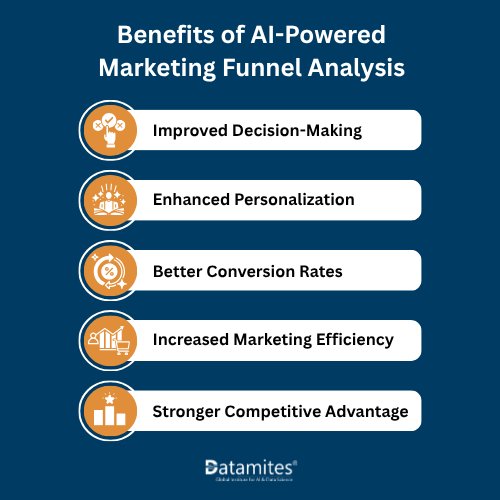
- Improved Decision-Making: AI provides real-time insights that support more informed Marketing Decision-Making. Businesses can quickly identify performance issues and implement corrective actions before they affect results.
- Enhanced Personalization: Personalized experiences have become a key differentiator in modern marketing. AI enables organizations to tailor content, recommendations, and offers based on individual customer preferences.
- Better Conversion Rates: Through advanced Customer Conversion Analysis, AI helps identify opportunities to improve conversion performance and optimize customer journeys.
- Increased Marketing Efficiency: Automation reduces manual analysis requirements, allowing teams to focus on strategy and innovation rather than routine reporting tasks.
- Stronger Competitive Advantage: Organizations leveraging AI-Driven Marketing Strategies can respond more quickly to market changes, customer expectations, and competitive pressures.
By leveraging data-driven intelligence and predictive analytics, businesses can make smarter marketing decisions, enhance customer experiences, and achieve sustainable growth in an increasingly competitive digital landscape.
Challenges of Implementing AI in Funnel Analysis
While AI significantly improves marketing funnel analysis, organizations must overcome several challenges to maximize the effectiveness of AI-Powered Marketing Analytics and data-driven decision-making.
1. Data Quality and Integration
Customer information may be incomplete, duplicated, outdated, or inconsistent across systems. Before developing advanced models, organizations should standardize event definitions, verify tracking, and establish clear data ownership.
2. Privacy and Regulatory Compliance
Marketing analytics must account for applicable data protection requirements, consent preferences, data minimization, and appropriate retention practices.
Organizations should review relevant regulations, including the General Data Protection Regulation where applicable, and obtain qualified legal guidance when needed. Data collection and profiling practices should be transparent and proportionate to the intended purpose.
3. Model Bias and Reliability
Historical marketing data may reflect existing biases or exclude important customer groups. Models can also become less reliable when market conditions or customer behavior change.
Teams should evaluate model performance across relevant segments, monitor drift, and provide appropriate human oversight.
4. Skills and Infrastructure
AI implementation may require investments in data engineering, analytics, software, cloud infrastructure, and employee training.
Businesses should begin with a defined problem and assess whether a simpler analytical approach can achieve the same objective before adopting more complex models.
5. Measuring Incremental Business Value
Attribution reports can make a campaign appear successful even when many conversions would have happened without it.
Where practical, use randomized experiments, holdout groups, or other suitable causal measurement methods to estimate incremental impact. This helps distinguish predictive accuracy and attributed conversions from genuine business improvement.
Refer to the articles below:
- Top AI Trends That Will Shape 2026
- LLM Fine-Tuning vs Prompt Engineering: Which Is Better
- Why Agentic AI Is the Most In-Demand Skill for Data Scientists
How to Implement AI Marketing Funnel Analysis: A Step-by-Step Framework
Organizations can approach implementation through the following process.
- Define the business objective: Identify a specific problem, such as low lead-to-customer conversion, checkout abandonment, or customer churn.
- Map the funnel: Define the stages, qualifying events, entry criteria, and conversion outcomes.
- Audit the data: Check tracking coverage, missing values, duplicate identities, and consistency across systems.
- Establish a baseline: Measure conversion rates, acquisition costs, retention, and other relevant metrics before making changes.
- Select an appropriate method: Begin with funnel reporting and segmentation, then introduce predictive models if they offer additional value.
- Test an intervention: Use a suitable experiment to assess whether a recommendation improves the desired outcome.
- Monitor performance: Track business results, model quality, data changes, privacy risks, and unintended effects.
- Document and improve: Record the methodology, findings, limitations, and decisions to support future analysis.
This phased approach enables organizations to demonstrate value before expanding their investment in AI.
While implementing AI in marketing presents challenges, organizations that successfully adopt it can gain deeper customer insights, optimize conversions, improve decision-making, and enhance engagement. AI-powered marketing funnel analysis enables businesses to increase ROI, strengthen customer relationships, and drive sustainable long-term growth.
DataMites Institute empowers marketing and business professionals with industry-focused training in AI Marketing Course, supported by globally recognized certifications from IABAC aligned with the EU competency and through expert-led instruction, internship opportunities, and case study based approach, learners gain practical skills in AI-powered marketing. The institute offers a Certified AI Professional in Marketing Analytics Course while maintaining training centers across major cities, including Bangalore, Pune, Hyderabad, Chennai, Delhi, Kolkata, Coimbatore, Ahmedabad, Chandigarh, and more, enabling learners to build future-ready marketing expertise in the AI-driven digital landscape.