Key Challenges and Opportunities in AI Product Management
Explore AI product management challenges and opportunities, including data quality, model reliability, responsible AI, generative AI, product metrics, and practical strategies for building successful AI products.
 Kriti Maurya
Generative AI assistants, predictive recommendation systems, intelligent automation, and AI-powered analytics are creating new possibilities for solving customer problems and improving business operations. However, building a successful AI-powered product involves more than selecting a model and integrating it into an application. Product teams must address data quality, model reliability, algorithmic bias, privacy, security, infrastructure costs, and changing user expectations.
These challenges make AI product management a discipline that combines product strategy, technical understanding, customer research, experimentation, and responsible decision-making.
This guide explains the key challenges and opportunities in AI product management, practical approaches to evaluating AI features, and the AI Product manager skills product managers need to build useful, reliable, and sustainable AI-powered products.
What Does an AI Product Manager Do?
An AI product manager identifies customer needs, defines product strategies, and oversees the development and improvement of products powered by artificial intelligence (AI) and machine learning (ML). In addition to traditional product management responsibilities, the role involves evaluating data quality, model performance, AI reliability, and ongoing monitoring. AI product managers work closely with technical and business teams to ensure AI solutions deliver measurable value while maintaining usability, security, and responsible AI practices.
Key AI Product Manager Roles and Responsibilities :
- Product Discovery: Identify customer problems that AI can solve and validate product ideas based on user needs and business objectives.
- AI Feasibility Assessment: Collaborate with technical teams to evaluate data availability, model capabilities, limitations, and integration requirements.
- Product Strategy: Define the target audience, value proposition, become product manager full roadmap, and business case to align AI initiatives with organizational goals.
- Evaluation and Experimentation: Establish success metrics, conduct product testing, evaluate model performance, and define launch criteria.
- Responsible AI Management: Address privacy, fairness, security, transparency, and potential risks throughout the product development lifecycle.
- Product Lifecycle Management: Monitor product performance, analyze user feedback, manage model updates, and identify opportunities for continuous improvement.
What are Key Challenges in AI Product Management
1. Data Quality and Availability
AI systems depend on relevant, accurate, sufficiently representative, and appropriately collected data. Missing values, duplicate records, outdated information, and inconsistent formats can reduce model performance.
Data problems can also emerge after deployment. Customer preferences change, new products are introduced, and real-world conditions may differ from the data used during development.
For example, an e-commerce recommendation system trained primarily on historical purchases may fail to reflect new customer interests or newly introduced products.
How product managers can address this challenge:
- Establish data quality standards and validation processes.
- Check for missing values, duplication, inconsistencies, and representation gaps.
- Verify that data collection and usage comply with applicable privacy requirements.
- Monitor changes in input data and user behaviour after launch.
- Assign responsibility for maintaining datasets, pipelines, and knowledge sources.
- Document data sources, limitations, and update schedules.
Data quality should be treated as an ongoing product responsibility rather than a one-time engineering task.
Refer to the articles below:
- The Role of AI in Investment and Portfolio Analysis
- AI in Marketing Funnel Analysis for Effective Decision-Making
- Popular AI Tools in Healthcare for 2026
2. Ethical AI, Algorithmic Bias, and Data Privacy in AI Product Management
AI systems can produce unfair outcomes when training data, model design, or deployment conditions disadvantage particular individuals or groups. Products that process personal information may also create privacy and security risks.
Consider an AI-assisted recruitment tool trained on historical hiring data. If that data reflects discriminatory practices, the system may reproduce or reinforce those patterns.
Removing sensitive attributes alone may not solve the problem because other variables can act as proxies for protected characteristics.
How product managers can address this challenge:
- Assess datasets for coverage gaps and potential sources of bias.
- Evaluate model performance across relevant user groups.
- Minimize personal data collection and retention.
- Apply appropriate access controls, security safeguards, and data governance.
- Communicate important limitations and uncertainties to users.
- Provide suitable human review and appeal mechanisms for high-impact decisions.
Establish procedures for investigating and correcting harmful outcomes.
The Fortune Business Insights reports, the global artificial intelligence market is projected to expand from USD 294 billion in 2025 to approximately USD 2.48 trillion by 2034, fueled by rising investments from businesses and governments across industries. As AI adoption expands, addressing algorithmic bias, ethical concerns, and data privacy becomes increasingly important.
The appropriate safeguards depend on the product's intended use, potential impact, and applicable legal requirements.
3. Technical Complexity and Model Reliability
AI systems can behave differently across inputs and operating conditions. Generative AI models may produce incorrect statements, omit important information, or respond inconsistently to similar questions.
A successful demonstration does not prove that a model is ready for production. Teams must evaluate its performance against realistic user tasks, edge cases, and the consequences of errors.
For example, a customer support assistant may answer frequently asked questions correctly but struggle with ambiguous requests, outdated policies, or questions outside its knowledge base.
How product managers can address this challenge:
- Define measurable quality criteria before selecting a model.
- Create representative test datasets and realistic evaluation scenarios.
- Compare AI performance with an appropriate non-AI baseline.
- Measure task completion, accuracy, latency, and operating costs.
- Test unsupported requests, harmful outputs, and failure scenarios.
- Use human evaluation when automated metrics are insufficient.
- Establish monitoring, fallback, and rollback mechanisms.
Metrics should reflect the intended use. A fraud detection system may prioritize precision, recall, false-positive rates, and missed-fraud costs. A generative AI assistant may require measures of factual accuracy, relevance, groundedness, and task completion.
4. Cross-Functional Collaboration
AI product development requires close coordination between technical teams and business stakeholders. Miscommunication can produce unrealistic expectations, unclear requirements, and features that demonstrate technical capability without solving a meaningful customer problem.
For instance, a stakeholder may expect an AI assistant to answer every question accurately, while the engineering team knows that the model has limitations and needs fallback mechanisms.
How product managers can address this challenge:
- Define shared objectives and measurable acceptance criteria.
- Involve engineering, data science, design, and risk specialists during discovery.
- Document assumptions, dependencies, and model limitations.
- Clarify ownership of evaluation, deployment, monitoring, and incident response.
- Translate technical trade-offs into customer and business implications.
- Agree on launch criteria before development is complete.
The AI product manager connects customer needs, technical feasibility, and business priorities so that teams work toward a common outcome.
5. Cost, Scalability, and Integration
AI products may require model inference, data storage, retrieval systems, infrastructure, monitoring, and repeated evaluation. Costs can increase as usage grows, while integrating AI into existing systems can introduce additional complexity.
A feature that performs well in a small pilot may become expensive or slow when deployed to a larger user base.
How product managers can address this challenge:
- Estimate development and operating costs before scaling.
- Measure cost per successful task, not just model API expenditure.
- Compare model quality, latency, and price across suitable alternatives.
- Consider smaller models, caching, and retrieval-based approaches where appropriate.
- Test security, integration, and performance under realistic workloads.
- Establish thresholds for scaling, optimizing, or discontinuing a feature.
A successful AI product must be technically viable and economically sustainable. Lower infrastructure costs are not an improvement if they create unacceptable quality or safety problems.
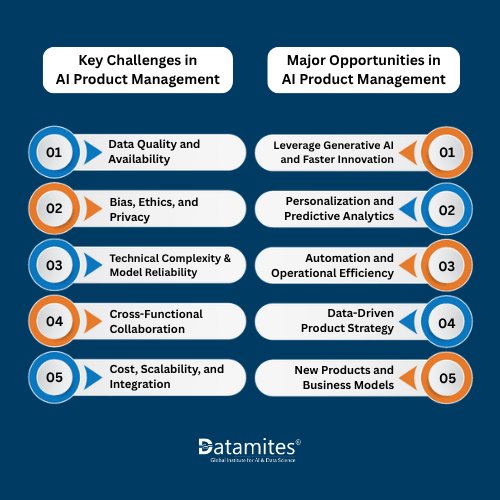
What are the Major Opportunities in AI Product Management
1. Generative AI and Faster Innovation
Generative AI can assist with research synthesis, prototype creation, test-case generation, content drafting, and conversational product experiences.
Product teams can use these capabilities to explore alternatives more quickly and reduce the effort required to produce early concepts.
For customers, generative AI may enable natural-language interfaces that simplify tasks previously requiring multiple screens or complex workflows.
However, faster prototyping does not eliminate the need for customer validation, quality assurance, security reviews, or human judgment. AI-generated material should be reviewed before it is relied on in production.
2. Personalization and Predictive Analytics
AI can identify patterns in customer behaviour and support more relevant experiences. Applications include product recommendations, personalized learning, demand forecasting, and predictive and prescriptive analytics.
For example, a learning platform could recommend resources based on a learner's progress, stated goals, and previous interactions.
Product managers can evaluate personalization by measuring whether it improves outcomes such as task completion, engagement, retention, or customer satisfaction.
Personalization must also respect privacy, user preferences, and appropriate data-use boundaries. More personalization is not automatically better if users find it intrusive or difficult to control.
3. Automation and Operational Efficiency
AI can assist with repetitive tasks such as classifying customer requests, summarizing documents, extracting information, routing support tickets, and drafting responses.
A customer support team, for example, could use AI to categorize incoming requests and suggest relevant knowledge-base articles. Human agents could review the suggestions and handle sensitive or unusual cases.
The opportunity lies in reducing manual effort while preserving service quality.
Product managers should therefore evaluate automation using a combination of efficiency and quality metrics, including handling time, resolution rate, escalation rate, error rate, and customer satisfaction.
4. Data-Driven Product Strategy
AI-powered analytics can help teams investigate product usage, identify recurring problems, and detect patterns that may not be obvious from individual feedback.
These insights can inform feature prioritization, onboarding improvements, and product experiments.
For example, usage data might reveal that many users abandon a setup process at the same step. A product team could investigate the cause through interviews and usability tests before deciding whether an AI-powered intervention is necessary.
Quantitative insights should complement customer research and product judgment rather than replace them.
5. New Products and Business Models
AI enables new approaches to research, content creation, document processing, accessibility, and natural-language data analysis.
Product managers can explore these opportunities by identifying customer problems that existing solutions address poorly or at excessive cost.
A useful starting point is to ask:
- Which customer task is difficult, expensive, or repetitive?
- Could AI improve the outcome compared with an existing approach?
- What data and integrations would the solution require?
- How would its performance and risks be evaluated?
- Would customers or the business receive enough value to justify its costs?
The strongest opportunities emerge when AI creates a clear advantage rather than being added simply because the technology is available.
A Practical Framework for Evaluating AI Product Opportunities
Before committing resources to an AI feature, product managers can evaluate it across five dimensions.
| Dimension | Key question | Example measure |
| Customer value | Does the feature solve a real user problem? | Task completion, satisfaction |
| Model quality | Does it perform the intended task reliably? | Precision, recall, factual accuracy |
| User experience | Can people use it effectively? | Completion time, usability feedback |
| Business viability | Is the value worth the cost? | Cost per successful task, contribution margin |
| Risk and governance | Are the risks acceptable and manageable? | Error severity, privacy and security findings |
These measures are examples, not universal requirements. The appropriate evaluation depends on the intended use, users, operating environment, and consequences of failure.
Case Study: An AI-powered customer support assistant
Evaluating an AI customer support assistant
The following scenario is hypothetical. The calculations and acceptance criteria illustrate a decision-making method; they are not results from a real company.
The problem: A customer support team receives repetitive questions about delivery, returns, and account policies.
The proposed solution: An AI assistant retrieves information from approved knowledge sources and drafts responses for human agents to review.
Step 1: Establish a baseline
Record current response times, resolution rates, escalation rates, customer satisfaction, and handling costs.
Step 2: Define evaluation criteria
Create a test set containing routine questions, ambiguous requests, outdated-policy scenarios, and questions the knowledge base cannot answer.
Evaluate whether responses are accurate, relevant, supported by approved sources, and appropriately cautious.
Step 3: Define illustrative launch thresholds
A product team might establish internal pilot requirements such as:
At least 95% of responses in a defined test set meet its factual correctness standard.
No unresolved critical privacy or security issues.
Human agents can identify and correct unsuitable responses.
Operating costs remain within the approved budget.
Customer service quality does not deteriorate during the pilot.
These numbers are illustrative, not industry standards or universal recommendations. Actual thresholds should be based on risk, baseline performance, test-set limitations, and the intended use.
Step 4: Run a controlled pilot
Begin with a limited group of support agents. Compare the AI-assisted workflow with the existing process using predefined evaluation criteria.
Step 5: Calculate the business impact
Suppose, purely for illustration, that a pilot handles 1,000 cases, reduces average handling time by two minutes per case, and requires an additional 20 hours of review and maintenance.
The gross time saved would be:
1,000 cases × 2 minutes = 2,000 minutes, or approximately 33.3 hours.
After subtracting the additional 20 hours, the net time saving would be approximately 13.3 hours.
This is a simplified illustration. A real business case should also consider implementation costs, ongoing model expenses, error correction, quality changes, and whether saved staff time translates into meaningful business value.
Step 6: Make a scale-up decision
Expand only if the feature meets its predefined quality, risk, and business requirements.
A shorter response time alone does not establish success. If the assistant generates more incorrect answers or creates additional work for agents, the feature may fail to deliver net value.
The key lesson is that an AI product should be evaluated as an end-to-end customer experience, not solely by the performance of its underlying model.
The central lesson is that an AI product should be evaluated as an end-to-end customer experience, not solely by the performance of its underlying model.
How Can AI Product Managers Overcome These Challenges?
A disciplined product development lifecycle helps teams balance innovation with reliability and responsible deployment.
Step 1: Define the customer problem
Identify the target users, the task they need to complete, their existing alternatives, and the outcome they expect.
Set measurable objectives before development begins. Examples include reducing handling time, improving task completion, or increasing recommendation relevance.
Step 2: Validate the need for AI
Compare an AI-based approach with conventional software, rules-based automation, and workflow improvements.
Build a prototype or conduct a limited experiment to test the most important assumptions. Do not scale until there is sufficient evidence of customer value and technical feasibility.
Step 3: Establish responsible AI requirements
Identify potential harms, privacy concerns, security requirements, and relevant legal obligations.
Define how the product will communicate uncertainty, handle unsupported requests, escalate sensitive cases, and respond to incidents. The level of oversight should reflect the consequences of failure.
Step 4: Create an evaluation plan
Specify test data, quality metrics, acceptance thresholds, and launch criteria before release.
For generative AI, test normal requests, ambiguous inputs, adversarial prompts, unsupported questions, and cases requiring refusal or escalation.
Step 5: Launch gradually and monitor performance
Use a pilot or staged rollout where appropriate. Monitor quality, cost, latency, customer satisfaction, and unintended outcomes.
Establish processes for investigating failures, correcting issues, updating evaluation sets, and rolling back changes.
Step 6: Build technical and strategic capabilities
AI product managers benefit from understanding machine learning fundamentals, data analytics, experimentation, model evaluation, generative AI, and AI governance.
They do not necessarily need to build models themselves. They do need enough technical knowledge to assess trade-offs, ask informed questions, and make decisions that connect customer value with engineering realities.
Refer to the articles below:
- The 2026 Guide to Implementing AI in HR Analytics
- Best AI Platform for Finance Data Analysis in 2026
- How to Use AI for Customer Segmentation: Types, Methods, Benefits
AI Product Management Metrics: What Should Teams Measure?
There is no single metric that determines whether an AI product is successful. Product teams should choose a balanced set of measures based on the intended task.
| Metric | What it helps assess |
| Task completion rate | Whether users accomplish their intended goal |
| Precision and recall | Classification or retrieval quality, depending on the use case |
| Factual accuracy and groundedness | Whether generated responses are correct and supported |
| Latency | How quickly the system responds |
| Cost per successful task | Whether the feature is economically sustainable |
| Error and escalation rate | How often the system fails or needs human intervention |
| User satisfaction | Whether the experience meets customer expectations |
| Performance across user groups | Whether quality varies in ways that require investigation |
| Incident and rollback frequency | Whether production issues are being controlled effectively |
Metrics should be interpreted together. A system can achieve high average accuracy while failing on an important user group or a particularly consequential type of request.
Product teams should also distinguish offline evaluation results from real-world performance. A model that performs well on a test dataset may still encounter unexpected behaviour after deployment.
Responsible AI Product Management: A Lifecycle Approach
Responsible AI should be integrated into product planning rather than treated as a final compliance check.
The NIST AI Risk Management Framework offers a useful structure for organizing this work. Its four functions can be applied to AI product management as follows:
- Govern: Establish accountability, ownership, policies, and risk tolerance.
- Map: Understand the intended use, affected users, operating context, and potential harms.
- Measure: Evaluate quality, reliability, fairness-related risks, privacy, and security.
- Manage: Prioritize risks, implement safeguards, monitor outcomes, and address incidents.
For generative AI products, the NIST Generative AI provides additional risk-management guidance. These resources are voluntary frameworks, not substitutes for applicable legal requirements or product-specific expert review.
A practical governance process should document important decisions, identify who is responsible for them, and provide a clear process for responding when the system behaves unexpectedly.
What Is the Future of AI Product Management?
AI product management is likely to evolve as generative AI, AI agents, multimodal systems, and automated workflows develop.
1. AI agents and workflow orchestration
AI systems can be designed to perform sequences of tasks using AI Product Manager tools and information sources. Product managers must define appropriate permissions, approval requirements, error handling, and limits on autonomous actions.
2. Continuous evaluation
Model updates, new data, changing user behaviour, and evolving product requirements make ongoing evaluation essential. Teams will need repeatable testing and monitoring processes rather than relying exclusively on pre-launch assessments.
3. Human-AI collaboration
Many products will combine automated assistance with human judgment. The product challenge will be deciding which tasks can be automated, which require review, and how users can correct errors or challenge decisions.
4. Responsible automation
Organizations will need to balance productivity gains with privacy, security, accountability, and appropriate oversight. The acceptable level of automation will vary according to the task and the consequences of failure.
5. Business-focused AI strategy
Product managers will need to distinguish impressive demonstrations from products that generate sustained customer value. This requires sound discovery, credible evaluation, cost management, and a willingness to discontinue features that do not meet their objectives.
The future of AI product management will emphasize generative AI, automation, and responsible innovation. Developing technical expertise, strategic thinking, and ethical AI skills will help professionals build impactful products.
Refer to the articles below:
- AI Agents vs AI Assistants: What's the Real Difference?
- How Artificial Intelligence is Transforming Digital Marketing
- What is Semantic Networks in Artificial Intelligence
DataMites Institute provides an industry-focused AI Product Manager course designed to develop expertise in AI-powered product strategy and business innovation. The program covers AI for Product Managers, Generative AI, and AI applications in Marketing, Finance, Healthcare, and HR Analytics. Offering live online training, classroom sessions, and assignments, the IABAC certified program is offered in Bangalore, Chennai, Hyderabad, Pune, Mumbai, Delhi, Ahmedabad, and Coimbatore.