Ethical Challenges of Using AI in Human Resources
Explore the ethical challenges of AI in human resources, including bias, privacy, and transparency. Learn how HR professionals can use AI responsibly while ensuring fairness, accountability, and employee trust.
 Prerana B A
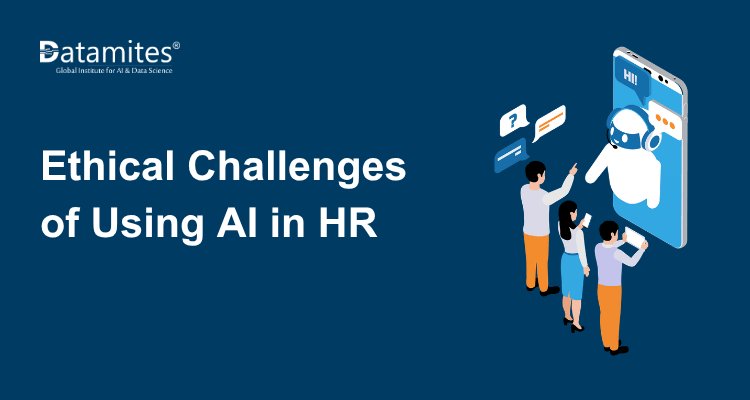
Artificial intelligence is transforming HR through résumé screening, candidate matching, performance evaluation, and workforce planning. However, the challenges of using AI in human resources include bias, privacy, transparency, and accountability. Understanding these challenges helps organizations adopt AI responsibly while protecting fairness, employee rights, and human judgment.
Why AI Ethics Matters in Human Resources
AI in HR management supports recruitment, onboarding, workforce analytics, and performance evaluation, helping teams reduce repetitive tasks and manage information efficiently. However, automation can introduce bias, privacy risks, and accountability challenges.
According to the SHRM State of AI in HR 2026 report, 39% of organizations had implemented AI in their HR functions. This highlights the need for responsible AI practices that protect fairness, personal data, transparency, and employee trust while ensuring compliance with applicable laws.
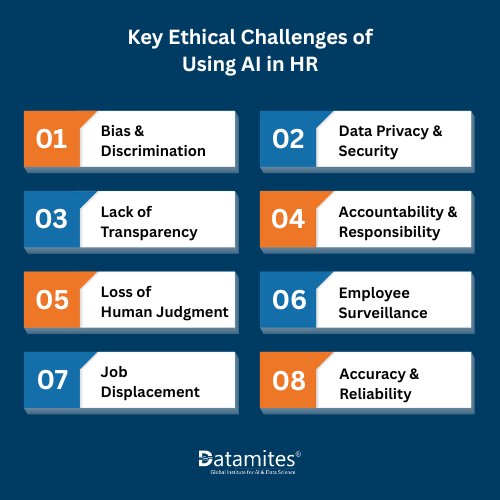
Key Ethical Challenges of Using AI in Human Resources
AI can help HR teams automate repetitive tasks and analyze workforce information. However, its use can create risks for candidates, employees, and employers when appropriate safeguards are missing.
1. Bias and Discrimination
AI bias in recruitment can occur when historical hiring data, biased labels, or proxy variables produce unfair outcomes. These biases may affect résumé screening, candidate ranking, promotions, and performance evaluations, potentially disadvantaging certain groups.
How organizations can address this challenge:
- Conduct regular bias audits before and after deployment.
- Compare outcomes across relevant demographic groups where lawful.
- Use fair, job-related selection criteria.
- Investigate disparities and document corrective actions.
- Provide human review and appeal mechanisms.
Bias audits help identify disparities but do not automatically guarantee fairness or legal compliance.
2. Data Privacy and Security
AI systems may process résumés, employment histories, performance reviews, and workplace communications. Excessive data collection, unauthorized access, or unclear data usage can compromise privacy and employee trust.
How organizations can address this challenge:
- Collect only necessary information for defined purposes.
- Explain how personal data will be used.
- Apply access controls, secure storage, and retention limits.
- Review vendors' data protection practices.
- Comply with applicable privacy laws.
The UK's Information Commissioner's Office (ICO) reported making almost 300 recommendations to AI recruitment tool providers and developers following audits, addressing data protection concerns.
3. Lack of Transparency
AI-driven HR decisions can be difficult to understand when candidates and employees do not know how automated recommendations are produced. This makes errors harder to identify and challenge.
How organizations can address this challenge:
- Disclose meaningful AI involvement in employment decisions.
- Explain the system's purpose and general operation.
- Document key factors influencing consequential decisions.
- Provide channels for clarification and correction.
- Ensure explanations accurately reflect how the system works.
Transparency does not require publishing proprietary source code, but affected individuals should receive meaningful information about AI-assisted decisions.
4. Accountability and Responsibility
When AI produces discriminatory or inaccurate outcomes, unclear responsibilities can delay corrective action. Relying on a vendor does not remove an employer's responsibility to oversee how its systems are used.
How organizations can address this challenge:
- Assign clear ownership for AI deployment and monitoring.
- Document how AI recommendations influence decisions.
- Establish complaint and error-correction procedures.
- Review vendor practices, limitations, and updates.
- Define when human intervention is required.
HR, legal, privacy, and technology teams should understand their respective responsibilities.
5. Loss of Human Judgment
Overreliance on AI can cause HR professionals to overlook individual circumstances, transferable skills, and relevant context. For example, an automated screening tool may rank a qualified candidate poorly because their résumé differs from its training examples.
How organizations can address this challenge:
- Treat AI recommendations as decision support, not final conclusions.
- Train HR teams to identify bias and unreliable outputs.
- Introduce meaningful human review for consequential decisions.
- Allow reviewers to consider relevant individual circumstances.
- Provide ways to challenge automated assessments.
Human oversight is effective only when reviewers have the authority, time, and information to question AI recommendations.
6. Employee Surveillance
AI-powered monitoring tools can analyze attendance, productivity, communications, and workplace behavior. Excessive monitoring may invade privacy, increase employee stress, and weaken trust. Productivity scores may also overlook work quality and task complexity.
How organizations can address this challenge:
- Define legitimate monitoring purposes.
- Inform employees about monitoring practices.
- Collect only necessary and proportionate data.
- Restrict access and establish retention limits.
- Assess effects on employee well-being and privacy.
Monitoring should be justified, proportionate, and consistent with applicable laws.
7. Job Displacement
AI automation can reduce demand for certain tasks and change existing roles, creating uncertainty about job security and career development. Poorly managed transitions can damage employee morale and trust.
How organizations can address this challenge:
- Communicate anticipated workforce changes clearly.
- Consult affected employees where appropriate.
- Identify opportunities to redesign existing roles.
- Provide relevant reskilling and upskilling.
- Develop responsible workforce transition plans.
Organizations should consider how employees can adapt to changing responsibilities alongside the potential efficiency gains of automation.
8. Accuracy and Reliability
AI systems can generate inaccurate or inconsistent recommendations due to poor data, model limitations, or changing workplace conditions. Errors in résumé summaries or performance predictions may affect hiring and career opportunities, highlighting the importance of human oversight for those pursuing a career in AI for HR.
How organizations can address this challenge:
- Validate systems against job-related requirements.
- Verify important outputs using reliable information.
- Monitor accuracy and performance after deployment.
- Assess the effects of system updates.
- Correct errors and review affected decisions.
Organizations should document system limitations and avoid using AI tools for purposes they have not been adequately evaluated to support.
Refer to these articles:
- Can Healthcare Professionals Learn AI Without a Technical Background
- AI in Marketing Funnel Analysis for Effective Decision-Making
- Top AI Product Manager Skills
Real-World Case Studies of AI Ethics in HR
Real-world cases demonstrate how automated employment processes can create ethical and legal risks when organizations fail to address fairness, accountability, and appropriate oversight.
1. Amazon's Experimental Recruitment Tool: Gender Bias
In 2018, Reuters reported that Amazon discontinued an experimental recruitment tool after it showed bias against women. Trained on historical résumés, many from men, the system reportedly penalized certain indicators associated with women.
Key lesson: Test training data and hiring outcomes for bias and ensure selection criteria are job-related.
Source: Reuters: Amazon's Experimental AI Recruiting Tool.
2. iTutorGroup: Age Discrimination
In 2023, the US Equal Employment Opportunity Commission (EEOC) announced a $365,000 settlement with iTutorGroup over allegations that its recruitment software automatically rejected qualified applicants based on age.
Key lesson: Audit automated screening systems for discriminatory outcomes and comply with applicable employment laws.
Source: US EEOC: iTutorGroup Hiring Settlement.
3. New York City's AI Hiring Rules: Transparency and Accountability
New York City's Local Law 144 requires covered automated employment decision tools to undergo independent bias audits and meet specified transparency and notification requirements.
Key lesson: Understand applicable regulations, maintain audit records, and provide required notices to affected candidates and employees.
Source: NYC Department of Consumer and Worker Protection: Automated Employment Decision Tools.
Together, these cases show why AI-assisted hiring requires more than technical efficiency. Fairness testing, meaningful oversight, and clear responsibility must be part of the decision-making process.
Best Practices for Responsible AI Adoption in HR
Organizations can reduce the ethical risks of AI in recruitment and workforce management through the following measures:
- Conduct regular bias audits: Evaluate systems before deployment and periodically afterward to identify disparities across relevant groups.
- Validate selection criteria: Confirm that automated assessments measure skills and qualifications relevant to the role.
- Protect personal information: Apply data minimization, access controls, appropriate retention periods, and privacy safeguards.
- Improve transparency: Inform candidates and employees when AI materially influences consequential decisions, where appropriate.
- Maintain human oversight: Enable qualified HR professionals to review recommendations, correct errors, and handle appeals.
- Establish AI governance: Assign clear ownership, document system limitations, and define escalation procedures.
- Train HR teams: Help recruiters and managers recognize algorithmic bias, unreliable outputs, and inappropriate AI use.
- Monitor vendors: Review testing evidence, privacy practices, system updates, and ongoing performance.
The NIST AI Risk Management Framework offers a practical foundation through four functions: Govern, Map, Measure, and Manage. These help organizations establish accountability, identify risks, evaluate system performance, and respond to potential harm.
Refer to these articles:
- What Are Graph Neural Networks? Simple Guide for Beginners
- Traditional AI vs Generative AI: Key Differences, Examples, and Use Cases
- What is Artificial Narrow Intelligence?
The Future of Ethical AI in Human Resources
The future of AI in HR will depend on balancing automation with human judgment. Risk-based assessments, privacy-conscious design, explainable systems, and clear governance can help organizations adopt technology responsibly. As regulations evolve across jurisdictions, HR leaders must stay informed about applicable legal requirements and regularly review how AI affects candidates and employees. Responsible implementation should remain an ongoing process, not a one-time compliance exercise.
The ethical challenges of using AI in HR include algorithmic bias, data privacy, limited transparency, accountability, and employee trust. Research from SHRM and the ICO highlights the growing relevance of responsible AI practices, while the Amazon and iTutorGroup cases demonstrate the consequences of inadequate safeguards. HR teams should combine regular audits, clear governance, privacy protection, and meaningful human oversight. AI should support fair and transparent employment decisions, never replace human responsibility for their outcomes.
DataMites Institute offers an industry-oriented AI for HR and People Analytics course designed to help HR professionals apply artificial intelligence to workforce planning and data-driven decision-making. The program covers AI fundamentals, people analytics, and practical applications in talent acquisition, employee engagement, performance management, and workforce planning. DataMites also provides specialized AI programs for Product Managers, Healthcare Professionals, Finance and Risk Experts, Marketing Professionals, Business Leaders, and other working professionals.
Learners can choose from flexible learning formats, including online classes, classroom training, and project-based internships that offer practical exposure. The AI for HR courses also offers certification options, including IABAC-accredited certification and the Certified AI Professional in People Analytics certification. With 50+ offline centres across India, DataMites offers classroom and virtual training options to suit different learning needs. Its centres are located in Bangalore, Chennai, Hyderabad, Pune, Mumbai, Ahmedabad, Coimbatore, and Delhi.