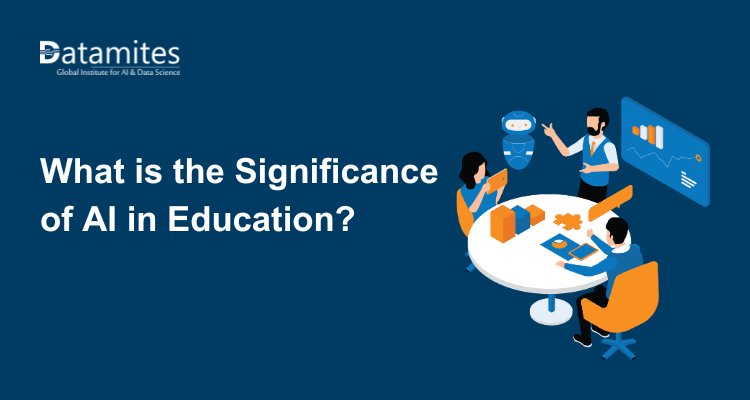
What is the Significance of AI in Education?
AI is transforming education by enabling personalized learning, automating routine tasks, and improving teaching outcomes. It helps educators and students make learning more engaging, accessible, and effective.
 Datamites Team
Artificial Intelligence (AI) isn’t a brand-new technology that emerged just about now. New Technology is introduced from time to time, and when it is, it has an impact on many industries, including education. Though we haven’t seen humanoids replace teachers, AI systems are increasingly being used to teach and guide students in online courses. AI is altering the way people think about education, whether it’s via automating activities or creating individualised training courses based on students’ talents.
According to IMARC Group, the global artificial intelligence market reached USD 143.0 billion in 2025 and is projected to reach USD 949.0 billion by 2034, growing at a CAGR of 22.70% during 2026 to 2034. The market growth is driven by rising data volumes, advancements in computing power and deep learning, and increasing enterprise automation across industries such as healthcare, manufacturing, finance, and retail.
How AI is influencing the educational sector
AI is transforming education by improving learning experiences, supporting teachers, personalizing instruction, and streamlining routine administrative tasks.
Streamlining administrative efforts via task automation
Teachers often spend considerable time grading tests, reviewing homework, filing paperwork, preparing progress reports, arranging lecture resources, and managing teaching materials. These tasks can be time-consuming. Artificial Intelligence can help automate many of these routine activities, allowing teachers to focus more on their core responsibility of teaching. This can help educators use their time more efficiently and create better learning experiences for students.
Students can benefit from personalised learning
In essence, personalised learning is learning what pupils want to learn – what interests and intrigues them. For students, adaptive learning tools, games, and programmes are currently available. This application of Artificial Intelligence in the education sector is likely one of the most significant, as learning is more pleasant, smoother, and cuts beyond personal knowledge. This could be the first step toward building a personalised learning environment where students can grow.
Identifying Students’ Aptitude and Capabilities
The goal of implementing Artificial Intelligence in education is not to replace instructors, but to assist them in better understanding each student’s potential and limitations. AI in schools makes things easier and more convenient for both teachers and pupils. Teachers can create a personalised study plan for each student by first knowing their needs.
Refer to these articles:
- LLM Fine-Tuning vs Prompt Engineering: Which Is Better?
- Top AI Trends That Will Shape 2026
- PyTorch vs TensorFlow: Which is Better?
Creating intelligent content
AI and education are inextricably linked, and new methodologies can help ensure that students achieve their academic goals. Smart content includes the digitization of textbooks and notes, the creation of video lessons and lectures, the development of interactive training sessions, and more. In education, artificial intelligence aids in creating customizable learning interfaces that allow students to learn more easily and understand concepts better.
Expanding Access to Education Beyond Geographical Boundaries
Students from any location can now enrol in a course in any other country thanks to online courses. In terms of online education, physical barriers between countries have been removed. Technology has entitled students to assimilate distinct skills from the best tutors, disregarding their location. That shouldn’t come as a surprise, given that artificial intelligence is ingrained in the sector. Through the application of AI in education, students from all over the world can study from the best teachers.
Providing for the needs of those who are differently-abled
Creating a learning programme for people with special needs has always been a difficult task. Even with numerous special schools being set up for pupils with hearing, speech, and vision impairments, the educational process may have been more effective. People with special needs can now understand and grasp knowledge in a more comfortable environment thanks to artificial intelligence.
Python is the most popular programming language used for AI.
24/7 AI-Powered Learning Support
Teachers aren’t the only ones who have access to a wealth of data thanks to AI. Students do as well. Several AI-powered chatbots have been instigated for the education sector. This implies they can use AI bots to receive help on any topic at any time of day.
Supporting Educators Through AI
Teachers now have access to a wealth of information thanks to artificial intelligence. This helps individuals to stay up to date on stuff they didn’t know before or build on their previous knowledge. They will be more well-rounded and have a more in-depth and comprehensive knowledge foundation to work with students.
Machine learning is an application of artificial intelligence (AI)
Increasing Student Engagement
Artificial intelligence offers a way to make learning more engaging. Artificial intelligence can be used to build interactive modules and classes for a variety of students. A visualization is an excellent tool for helping pupils grasp an idea. Graphs, charts, 3D graphics, and other visual aids keep children interested in studying. Touchscreen-based interactive training is quickly becoming an element of online education.
AI-Powered Assessment and Feedback
This adds a useful modern aspect that is not directly covered by your existing points. AI can help educators assess assignments, identify learning gaps, and provide personalized feedback, making the learning process more responsive and efficient.
Generative AI in Education
Generative AI is expanding how students and educators create, explain, and interact with educational content. AI tools can help generate practice questions, summarize complex topics, provide explanations at different difficulty levels, assist with lesson planning, and support personalized learning activities. However, educators should maintain human oversight because AI-generated content can contain factual errors, reflect biases, or encourage overreliance when used without proper guidance.
Refer to these articles:
- Traditional AI vs Generative AI: Key Differences, Examples, and Use Cases
- Artificial Intelligence Certification Course Fee in 2022
- What is the Salary of a Data Scientist in Indian Cities?
Challenges and Ethical Considerations of AI in Education
While AI can improve education, its use also comes with certain challenges:
- Inaccurate information: AI tools can generate incorrect or misleading answers, so important information should be verified.
- Student privacy: AI platforms may process personal and academic data, making data protection essential.
- Algorithmic bias: Biased training data can result in unfair recommendations, assessments, or learning outcomes.
- Academic integrity: Excessive dependence on AI for assignments may reduce students’ critical thinking and encourage academic misconduct.
- Limited human judgment: AI cannot fully replace teachers’ experience, emotional support, and understanding of individual student needs.
- Digital inequality: Limited access to devices, reliable internet, or AI tools can create gaps between learners.
- Need for supervision: Teachers and institutions should establish clear guidelines and monitor AI use to ensure responsible and effective learning.
According to Mordor Intelligence, the global artificial intelligence market is expected to grow from USD 306.04 billion in 2025 to USD 434.42 billion in 2026 and is forecast to reach USD 2,503.13 billion by 2031, registering a CAGR of 41.95% during 2026 to 2031. The growth is driven by sovereign AI initiatives, enterprise cost optimization, rapid hardware innovation, and the increasing adoption of AI in core production workflows across major industries.
As the demand for Artificial Intelligence continues to grow across industries, gaining practical skills and industry-relevant knowledge has become increasingly important for aspiring professionals. Choosing the right training provider can help learners build the technical expertise needed to pursue careers in this rapidly evolving field.
DataMites is a global training provider for artificial intelligence and machine learning courses. DataMites also provides data science, deep learning, python, tableau, R programming, IoT training courses.
DataMites Artificial Intelligence Course offers a comprehensive 9-month program that combines core AI concepts with practical, industry-focused learning. Through live projects, hands-on assignments, and real-world applications, learners build the skills needed for roles such as AI Engineer, Artificial Intelligence Specialist, and NLP Professional. The program also provides globally recognized IABAC and NASSCOM FutureSkills certifications, helping learners strengthen their professional credibility and prepare for opportunities in the evolving AI industry.
With more than 40 training centers across India, DataMites provides accessible Artificial Intelligence training to learners in multiple locations. Students can pursue Artificial Intelligence Courses in Pune, Chennai, Hyderabad, Bangalore, Mumbai, Coimbatore, Ahmedabad, Nagpur, and Delhi, gaining practical experience through live projects, hands-on training, and expert mentor guidance designed to develop job-ready AI skills.