AI Careers in Malaysia: Job Roles, Salaries and Skills in Demand
Explore AI career opportunities in Malaysia, including popular job roles, average salaries, essential skills and steps to start a career in artificial intelligence in 2026.
 Swagatam Sinha
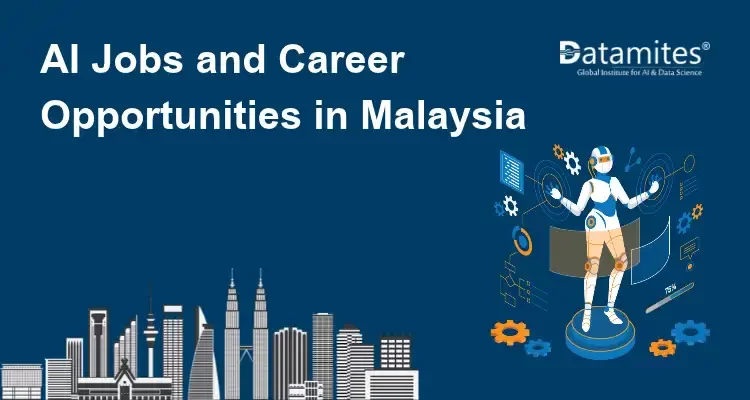
Artificial intelligence is becoming an important part of Malaysia's business environment. Banks use machine learning to detect unusual transactions, manufacturers apply intelligent systems to monitor production, and retailers analyze customer data to improve their services. As more businesses adopt these technologies, the need for professionals with AI and data skills is growing.
Malaysia is also strengthening its position in the AI industry. The National AI Action Plan 2026–2030 focuses on developing local talent, encouraging AI adoption and supporting homegrown technology. Alongside global investment in AI, these initiatives are creating opportunities across software development, data science and other technical fields.
For fresh graduates, IT professionals and people considering a career change, AI offers several career paths. Understanding the responsibilities, skills and salaries associated with these roles can help individuals choose a direction that suits their interests and experience.
Malaysia's AI Industry and Employment Outlook Beyond 2026
Malaysia is gradually expanding its use of artificial intelligence across businesses, public services and established industries. Government initiatives are focused on developing local talent, strengthening research capabilities and creating the infrastructure needed to support AI applications.
The National AI Action Plan 2026–2030, also known as AI Nation 2030, aims to strengthen Malaysia's position in the global AI industry. According to AI Malaysia Berhad (formerly the National AI Office), the plan targets between 300,000 and 500,000 new AI-related jobs by 2030. The Malaysia Digital Action Plan 2030 also aims to create 500,000 high-value digital jobs, reflecting the country's wider focus on technology and digital skills.
These ambitions are supported by growing global investment in artificial intelligence. According to Gartner's September 2026 forecast, worldwide AI spending is expected to reach US$2.7 trillion in 2026. As businesses invest in AI infrastructure, software and applications, countries such as Malaysia have opportunities to strengthen their technology sectors and develop skilled professionals. The Google, Temasek and Bain & Company e-Conomy SEA 2026 report also ranks Malaysia second in Southeast Asia for AI adoption and usage depth, with 68% of its working population using generative AI.
Businesses are increasingly understanding the importance of these technologies. The AWS-commissioned Unlocking Malaysia's AI Potential 2026 study found that 38% of Malaysian businesses consistently used at least one AI tool in 2026, compared with 27% in 2025. However, adopting AI tools is only one part of the process. Companies also need professionals who can develop applications, analyze data, and manage AI systems.
This is reflected in employment trends. According to PwC's 2026 Global AI Jobs Barometer, the share of Malaysian job postings requiring AI-related skills increased by 7.4%. The Aon Human Capital Trends Study 2026 also found that 59% of surveyed Malaysian organizations had deployed or were piloting AI programs, but only 5% were confident about recruiting and retaining enough AI-skilled professionals.
Investment is creating further opportunities for the digital workforce. According to the Malaysia Digital Economy Corporation (MDEC), the country secured RM87.4 billion in approved digital investments in 2025. These investments were expected to generate more than 31,000 high-value jobs, including over 12,600 AI-related roles.
Together, these developments suggest that AI will play a growing role in Malaysia's economy beyond 2026. For graduates and working professionals, building skills in programming, machine learning, data science and generative AI can provide a foundation for exploring opportunities in this developing industry.
For graduates and working professionals looking to develop these skills, an online artificial intelligence course in Malaysia can provide a structured way to understand AI concepts and their practical applications.
Refer to these articles:
Top AI Career Opportunities in Malaysia
AI careers cover different areas, from developing intelligent applications to building and maintaining machine learning systems. Here are seven roles worth exploring.
1. AI Engineer
AI engineers build applications that use artificial intelligence to address real-world business challenges. Their work may include building intelligent assistants, integrating language models and connecting AI services with existing software.
Python, software development, machine learning, APIs and cloud platforms are useful skills for this position.
2. Machine Learning Engineer
Machine learning engineers build, train and deploy models that identify patterns in data and make predictions. Their work can involve recommendation systems, fraud detection and demand forecasting.
Professionals need knowledge of Python, statistics, machine learning algorithms and frameworks such as TensorFlow or PyTorch.
3. Data Scientist
Data scientists analyze large datasets to identify patterns, solve business problems and develop predictive models. They use statistical methods and visualization tools to turn raw information into useful findings.
Python, SQL, statistics, machine learning and Power BI are valuable skills for this role.
4. Generative AI Engineer
Generative AI engineers develop applications that can produce or process text, images and other content. Their work may involve building chatbots, connecting large language models to company information and automating business workflows.
Knowledge of large language models (LLMs), prompt design, Retrieval-Augmented Generation (RAG), APIs and vector databases is useful.
5. Computer Vision Engineer
Computer vision engineers develop systems that interpret images and videos. Their responsibilities include object detection, image classification and automated visual inspection.
This specialization has applications in Malaysia's manufacturing and semiconductor industries. Python, OpenCV and deep learning are useful technical foundations.
6. Natural Language Processing Engineer
Natural Language Processing (NLP) engineers develop systems that understand and process human language. Their work includes text classification, sentiment analysis, translation and conversational applications.
Malaysia's multilingual environment creates opportunities for professionals working with Bahasa Malaysia, English, Mandarin and other languages. Python, NLP libraries and language models are important skills.
7. MLOps Engineer
MLOps engineers help organizations deploy, monitor and maintain machine learning models. They ensure that AI systems continue to perform reliably after development.
Knowledge of Docker, Kubernetes, cloud services, CI/CD pipelines, Python and model monitoring is useful for this role.
AI Professional Salaries in Malaysia in 2026
Salaries for AI professionals in Malaysia vary according to job responsibilities, technical specialization, experience and industry demand. Professionals working in machine learning, data science, generative AI and computer vision may receive different compensation based on their expertise and the complexity of the projects they handle.
According to Indeed Malaysia, the average annual salary for an AI/ML engineer is RM 97,445, equivalent to approximately RM 8,120 per month. Machine learning engineers earn an average of RM 8,017 per month, while data scientists receive around RM 6,701 per month. Indeed also reports an average monthly salary of RM 5,449 for computer vision engineers.
For generative AI engineers, Prosfy reports a median annual salary of RM 69,927 in Malaysia. This estimate is based on salary information collected from job advertisements and reflects the compensation reported for this specialized role.
These salary figures provide an indication of earning potential across selected AI careers in Malaysia in 2026. Actual compensation may differ depending on professional experience, technical capabilities, employer requirements and work location. Knowledge of Python, machine learning frameworks, cloud platforms and AI application development can be valuable for professionals pursuing these career paths.
Which Industries in Malaysia Need AI Skills?
AI is no longer limited to technology companies. Several established industries are using intelligent systems to improve operations and customer services.
- Banking and financial services: Banks use AI for fraud detection, credit risk assessment and customer analytics. The AWS-commissioned 2026 study found that 53% of Malaysian financial services businesses had adopted AI, compared with 38% of businesses overall.
- Manufacturing and semiconductors: Manufacturers use AI for production monitoring, defect detection and predictive maintenance. The Federation of Malaysian Manufacturers (FMM) Business Conditions Survey for the First Half of 2026 found that 49% of manufacturers implementing Industry 4.0 technologies used AI.
- Telecommunications: Companies analyze network and customer data to improve service quality, network planning and customer experience.
- Healthcare: AI applications can support medical research, image analysis and administrative processes. These systems require careful validation and appropriate professional oversight.
- E-commerce and retail: Businesses use recommendation systems, customer analytics and demand forecasting to understand purchasing behavior and manage inventory.
- Energy and oil and gas: AI can help companies monitor equipment, predict maintenance requirements and improve operational efficiency.
The skills required depend on the business. Financial institutions may need professionals with predictive modelling knowledge, while manufacturers may require expertise in computer vision and machine learning.
Refer to these articles:
- How AI is Transforming Cybersecurity
- Understanding Foundation Models in AI
- What Is AI Governance and Why It's Becoming Essential
Skills Malaysian Employers Look For in AI Professionals
AI professionals need more than programming knowledge. Employers generally look for a combination of technical abilities and problem-solving skills.
- Python and SQL: Used for software development, data processing, and database management.
- Mathematics and statistics: Help professionals understand algorithms, evaluate models and interpret results.
- Machine learning and deep learning: Useful for developing predictive models and intelligent applications.
- Generative AI: Knowledge of LLMs, RAG, APIs and prompt design is relevant to newer AI applications.
- Cloud and deployment: AWS, Microsoft Azure, Google Cloud, Docker and Kubernetes are useful for developing and maintaining AI systems.
- Communication and problem-solving: Help professionals understand business requirements and explain technical findings to different teams.
The right combination depends on the role. AI engineers generally need stronger software development skills, while data scientists require more knowledge of statistics and data analysis.
How to Start an AI Career in Malaysia
Starting an AI career becomes easier when you follow a clear learning path rather than trying to master every technology at once.
1. Understand your existing knowledge: Computer science graduates may already have programming experience, while mathematics and engineering graduates can build on their analytical skills. Business and finance professionals can begin with data analytics.
2. Learn the fundamentals: Start with Python, SQL and basic statistics. Practice working with datasets and writing simple programs before moving to advanced AI topics.
3. Choose a specialization: Explore data science, machine learning, AI engineering, computer vision or generative AI. Review Malaysian job descriptions on JobStreet, LinkedIn and Hiredly to understand what employers expect.
4. Build practical projects: Create projects that demonstrate your skills. Examples include a retail sales forecasting model using Malaysian market data, a Bahasa Malaysia sentiment analysis application, or a basic manufacturing defect detection system.
5. Consider professional training: Structured courses and certifications can help learners understand technical subjects in sequence and gain guided project experience. Practical knowledge remains important when applying for jobs. Learners in the capital can also consider an online artificial intelligence course in Kuala Lumpur to build their knowledge while continuing with their existing studies or work commitments.
6. Keep learning: AI technologies continue to change. Follow industry developments, practice with new tools and improve your technical knowledge as you gain experience.
Refer to these articles:
- How to Become an Artificial Intelligence Engineer in Malaysia?
- How Much is the Artificial Intelligence Course Fee in Malaysia?
- How to Become a Data Scientist in Malaysia?
Challenges and Future Opportunities in Malaysia's AI Sector
Although AI offers several career possibilities, entering the industry can be challenging. Specialist roles often require programming, mathematics and practical experience. Fresh graduates may need to demonstrate their abilities through projects or internships before taking on more advanced responsibilities.
Another challenge is developing AI systems that businesses can use reliably. Organizations need professionals who understand data privacy, cybersecurity, model accuracy and responsible AI practices, not just those who know how to use AI tools.
Malaysia's plans for 2030 provide a longer-term direction for the sector. As businesses expand their use of AI, professionals who combine technical knowledge with experience in finance, manufacturing, healthcare and other industries may find different career opportunities.
For people entering the field after 2026, continuous learning will remain important. Programming, statistics, analytical thinking and practical problem-solving provide a useful foundation even as specific AI tools and frameworks change.
AI careers in Malaysia are becoming relevant across banking, manufacturing, healthcare, retail and technology. Roles such as AI Engineer, Machine Learning Engineer, Data Scientist and Generative AI Engineer offer different opportunities depending on a person's interests and technical background.
The 2026 salary estimates indicate that specialized AI and data roles can offer competitive compensation, although actual earnings depend on experience and employer requirements. For anyone considering this career path, the best starting point is to build strong technical foundations, choose a suitable specialization, and gain experience through practical projects.
For learners interested in developing skills in artificial intelligence and data science, choosing a structured learning environment can make it easier to understand technical concepts and apply them to practical problems. DataMites is an established training institute with over 12 years of experience and a global learning community of more than 200,000 learners. Its programs cover areas such as data science, machine learning and artificial intelligence, with learning pathways that include practical projects. The institute's certifications include IABAC and, for eligible NRI learners, NASSCOM FutureSkills.