AI Browsers Explained: How Agentic Browsing is Changing the Internet
AI browsers are transforming online experiences by understanding user intent, automating tasks, and delivering relevant information faster. Agentic browsing enables smarter navigation, content summarization, and multi-step task completion with less manual effort.
 Priyanka BR
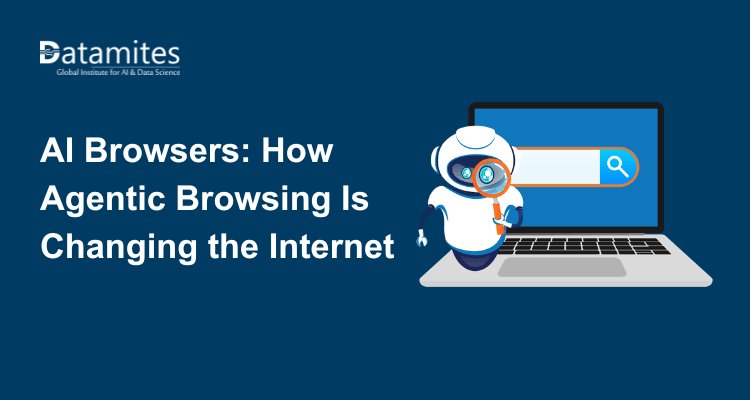
Artificial Intelligence is transforming how people use the web by combining browsing with intelligent assistants that can understand intent, summarize information, navigate websites, and complete tasks. This is driving the growth of agentic browsing, where AI can actively perform actions rather than simply provide answers.
From research and shopping to travel planning and productivity, AI-powered browsers are making online experiences more conversational and automated. As the technology evolves, it may reshape how people search for information, interact with websites, and complete everyday digital tasks.
What Is an AI Browser and How Does It Work?
An AI browser is a web browser enhanced with artificial intelligence to help users search, understand, and interact with online information. Unlike traditional browsers, AI browsers can understand natural-language instructions, summarize webpages, answer questions, and provide context-aware assistance. According to Market.us, the global AI browser market was valued at approximately $4.5 billion in 2024 and is projected to reach $76.8 billion by 2034, at a CAGR of 32.8% from 2025 to 2034.
How Does an AI Browser Work?
AI browsers typically combine large language models (LLMs), natural language processing (NLP), machine learning, and web-access technologies. When a user enters a question or instruction, the AI understands the intent, accesses relevant information, analyzes the content, and generates a response.
Simple process:
User Request → AI Understands Intent → Web Content Is Analyzed → Response Is Generated
Example of an AI Browser
Suppose you want to research AI courses in India. Instead of opening multiple websites and manually comparing course details, you could ask an AI browser:
“Compare these AI courses based on curriculum, duration, projects, and learning format.”
The AI can analyze the available information and organize the key details into an easier-to-understand response.
Difference Between an AI Browser and a Regular Browser?
A regular browser mainly helps users access and navigate websites, while an AI browser adds an intelligent layer that can understand requests, analyze web content, and assist with information-related tasks.
In simple terms, an AI browser combines web browsing with AI-powered understanding to make finding and using online information faster and more interactive.
Refer to these articles:
- Traditional RAG vs Agentic RAG - What’s the Difference?
- LLMs vs. SLMs: Key Differences and How to Choose the Right Model
- AI Sovereignty: The New Mandate for Data Governance in the Cloud Era
What Is Agentic Browsing and How Is It Changing Web Browsing?
Agentic browsing takes AI-assisted browsing a step further by allowing AI agents to work toward a specific goal through a series of actions. Instead of requiring users to decide every step, the agent can determine what needs to be done, execute permitted actions, and adapt when the situation changes.
How Does Agentic Browsing Work?
Think of it as a goal → plan → action → result process.
For example:
You could ask an AI agent to find three suitable hotels for a business trip within a specific budget. The agent may search relevant websites, check prices and amenities, compare the available options, and organize the results according to your requirements.
The important point is that the AI is not simply returning a search result. It is working through multiple steps to achieve the requested objective.
What Makes Agentic Browsing Different?
| Conventional Browsing | Agentic Browsing |
| User controls each step | AI can handle multiple steps |
| Search is the main activity | Task completion is the focus |
| Mostly manual navigation | Greater automation |
| User decides what to do next | AI can determine the next permitted action |
Why Does Agentic Browsing Matter?
This approach changes the role of the user from manually navigating the web to directing an AI agent toward a desired outcome.
It can be particularly useful for tasks involving research, comparisons, planning, data gathering, and repetitive online workflows. However, the level of autonomy varies between systems, and important actions may still require user confirmation.
In short, agentic browsing changes the web from something users primarily navigate themselves into an environment where AI agents can help carry out multi-step goals.
AI Browsers: Key Features, Capabilities, and Use Cases
The capabilities of AI browsers vary by product, but many are designed to make web-based information easier to understand, organize, and use. Their usefulness comes from combining conventional browsing with AI-powered assistance.
Key Features of AI Browsers
- Natural-language interaction: Users can ask questions or give instructions in everyday language.
- Webpage summarization: Long articles and webpages can be condensed into key points.
- Contextual answers: AI can use information from the current browsing context to answer related questions.
- Content analysis: AI can extract, organize, and explain information from webpages.
- Information comparison: Details from different online sources can be structured for easier comparison.
- Personalized assistance: Responses can be adapted to the user's question, context, or preferred format.
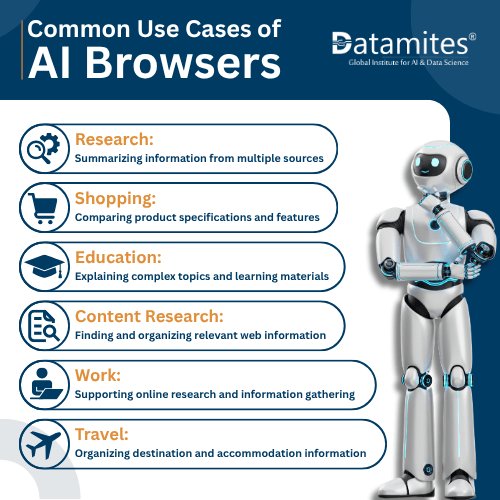
What Are the Limitations of AI Browsers?
AI browsers are not always accurate or fully autonomous. They can misunderstand instructions, produce incorrect summaries, or rely on incomplete or outdated information. Website restrictions, access permissions, privacy settings, and the capabilities of a particular browser can also limit what it can do.
For this reason, users should verify important information and review AI-generated results before relying on them, especially for financial, legal, medical, or other high-stakes decisions.
Overall, AI browsers can make web information easier to understand and work with, but their capabilities and reliability depend on the underlying AI system, available web access, and the task being performed.
Refer to these articles:
- Explainable AI: Why Black‑Box Models Are Losing Trust
- LLM Fine-Tuning vs Prompt Engineering: Which Is Better?
- Advantages and Disadvantages of Artificial Intelligence (AI)
How Agentic Browsing Is Changing Search and the Internet
Agentic browsing is changing how people may use search and interact with the internet. Instead of simply helping users find a list of webpages, AI agents can use information from different websites to help work toward a specific goal.
From Searching for Answers to Getting Things Done
Traditional search usually puts the user in control of every step. You search for something, open a few results, read the information, compare what you find, and then decide what to do next.
Agentic browsing can reduce some of these steps.
For example, rather than searching separately for “best laptops for AI development,” “laptop RAM requirements,” and “laptop prices,” a user could provide the overall requirement to an AI agent. The agent can research the relevant information and organize the findings into a useful response.
This creates a shift from searching for information to using information to complete a task.
How Could Agentic Browsing Change Websites?
Websites have traditionally been designed primarily for people to read and interact with. As AI agents become more capable of navigating the web, websites may increasingly need to make their information clear and easy for both people and machines to understand.
Clear headings, well-organized information, useful content, accurate details, and accessible website structures can help AI systems interpret webpages more effectively.
This does not mean websites should be created only for AI. People remain the primary audience, and useful, trustworthy content is still important.
What Does This Mean for Businesses and Publishers?
The way people discover online information could also change.
Today, a business may compete for visibility by appearing in search results when someone searches for a product or service. With agentic browsing, an AI system could potentially research several sources and present selected information directly to the user.
This creates a new question for businesses and publishers:
Will users visit the website directly, or will they receive the information through an AI interface?
The answer is still developing. However, Google's guidance on AI and machine learning features in Search indicates that existing SEO fundamentals continue to matter for AI-powered search experiences.
Is Agentic Browsing Replacing Search?
Not necessarily. Agentic browsing is better understood as an evolution of how search can be used rather than an immediate replacement for traditional search.
The experience could gradually move from:
Search → Read → Compare → Decide
toward:
Ask → Research → Understand → Act
For users, this could make complex online tasks more convenient. For websites and publishers, it could create new opportunities as well as questions around visibility, website traffic, attribution, and how their content is presented by AI systems.
As AI browsers and agentic browsing continue to develop, the internet may become less about manually navigating from one webpage to another and more about using intelligent systems to find, understand, and organize information.
The Future of AI Browsers and Agentic Browsing
The future of AI browsers is moving toward more intelligent and task-focused web experiences. According to PwC’s 2025 AI Agent Survey, 79% of surveyed US business executives said their companies were already adopting AI agents, while 66% of organizations using AI agents reported productivity improvements. This growing adoption indicates that agentic AI is moving beyond experimentation and into practical business use.
As AI browser technology develops, browsers may become more capable of handling complex online activities with less manual effort. However, accuracy, privacy, security, and human oversight will remain important. Agentic browsing could ultimately make the internet more interactive and efficient by helping users move from simply finding information to getting tasks completed.
Refer to these articles:
- Traditional AI vs Generative AI: Key Differences, Examples, and Use Cases
- What is Artificial Narrow Intelligence?
- Essential AI Skills for Healthcare Professionals
As AI browsers, agentic AI, and other AI technologies continue to evolve, learning the fundamentals of artificial intelligence can help students and professionals understand and work with these technologies. If you are looking for structured AI training, DataMites offers Artificial Intelligence courses covering areas such as Python, machine learning, deep learning, NLP, and related AI concepts.
To help learners build practical expertise, DataMites offers a 9-month Artificial Intelligence course covering TensorFlow, Keras, computer vision, neural networks, AI automation, and generative AI through hands-on projects. We also provide placement support and mock interview preparation. With 2,00,000+ learners trained and 50+ offline centres across India, learners can explore our Artificial Intelligence courses in Delhi, Pune, Bangalore, Hyderabad, Chennai, Coimbatore, Ahmedabad, Mumbai, and other locations.
For learners in Coimbatore looking to build practical AI skills, the Artificial Intelligence course in Coimbatore offers structured learning, hands-on projects, and career-focused support. It provides an opportunity to develop relevant AI skills and prepare for emerging career opportunities in Artificial Intelligence.