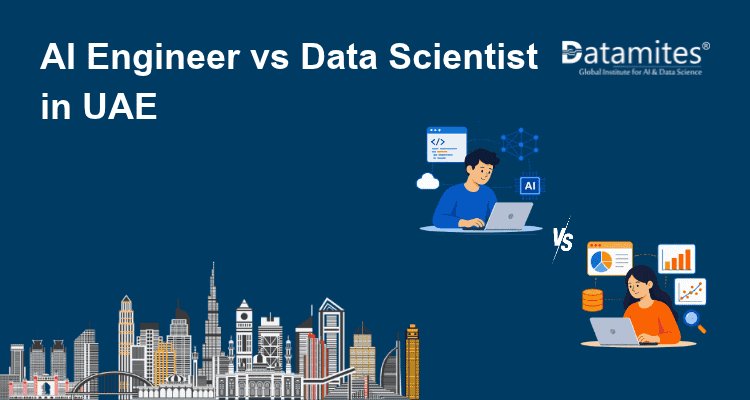
AI Engineer vs Data Scientist in UAE
Compare AI Engineer and Data Scientist careers in the UAE, including salary ranges, required skills, industry demand and career opportunities across Dubai, Abu Dhabi and Sharjah.
 Swagatam Sinha
Artificial intelligence and data analytics are becoming increasingly relevant across the UAE's banking, healthcare, aviation, logistics and energy sectors. Businesses are using machine learning, automation and data-driven systems to improve operations, understand customers and support business decisions.
For students, graduates and working professionals, choosing between an AI engineer and a data scientist requires an understanding of what each role involves. Although both careers use programming and machine learning, they differ in their daily responsibilities, technical requirements and career paths. Comparing their salaries, skills and industry applications can help you decide which option better matches your background and interests.
AI Engineer vs Data Scientist: What Is the Difference?
An AI engineer focuses on developing, testing and deploying artificial intelligence applications. The role involves building systems that can perform tasks such as understanding language, recognizing images, making predictions or automating business processes.
A data scientist works with structured and unstructured data to identify patterns, explain business trends and support decisions. Their work often includes exploring datasets, developing statistical models and presenting findings to business teams.
| Area | AI Engineer | Data Scientist |
| Main focus | Building and deploying AI applications | Analyzing data and generating insights |
| Core skills | Python, machine learning, deep learning and model deployment | Python, statistics, SQL, data analysis, and machine learning |
| Typical work | Developing AI models, APIs and intelligent applications | Data exploration, predictive modelling, and reporting |
| Common tools | TensorFlow, PyTorch, Docker and cloud AI services | Pandas, NumPy, SQL, Tableau and Power BI |
| Main outcome | Working AI-based products and systems | Insights, forecasts and evidence-based recommendations |
There is some overlap between these professions. Both may develop machine learning models, work with large datasets and use Python. However, their priorities differ. AI engineers concentrate on turning models into usable applications, while data scientists focus on understanding data and using it to answer business questions.
Refer to these articles:
- AI Ethics: Navigating the Ethical Challenges of AI Development
- What is an AI Agent? Guide to Intelligent Agents in AI
- Traditional RAG vs Agentic RAG - What’s the Difference?
Industries Hiring AI Engineers and Data Scientists in the UAE
The UAE's diverse economy offers applications for both professions. The type of work depends on the industry, the organization's technology requirements and the problems it wants to solve.
Banking and financial services: Banks in the UAE process large volumes of customer and transaction data to assess credit risk, identify unusual payments and understand customer behavior. Data scientists analyze these records to identify patterns and develop risk models. AI engineers focus on implementing such models in applications, including automated fraud monitoring and intelligent customer service systems.
Healthcare: Hospitals and healthcare providers can use data analytics to study patient trends, manage resources and support operational planning. Data scientists may work with patient and service datasets, while AI engineers can develop applications for medical image analysis, document processing and administrative automation. These applications require careful attention to data privacy and reliability.
Aviation and logistics: Airlines, airports and logistics companies handle substantial operational data. Passenger demand, flight schedules, cargo movement and delivery records can all be analyzed to improve planning. Data scientists can develop forecasting models, while AI engineers may build systems that support route optimization, automated monitoring and operational decision-making.
Energy: Energy companies can use analytics to study equipment performance, estimate demand and plan maintenance. Data Scientists examine operational records to identify patterns that may indicate inefficiencies. AI engineers can develop predictive maintenance applications and intelligent monitoring systems that help organizations respond to unusual operating conditions.
Retail and e-commerce: Retail businesses use customer and sales information to understand purchasing behavior and manage inventory. Data scientists can analyze buying patterns and build demand forecasting models. AI engineers may implement recommendation engines, personalized shopping features and conversational applications that improve the customer experience.
These examples show how the two professions can work together. A data scientist may identify a useful pattern or develop a predictive model, while an AI engineer helps integrate the model into a business application.
AI Engineer vs Data Scientist Salary in UAE
Salary levels in the UAE depend on professional experience, technical specialization, employer and industry. According to SalaryExpert, the average annual gross salary of an AI engineer in the UAE is AED 299,413 as of November 2026. Indeed reports an average annual salary estimate of AED 146,727 for data scientists, based on its reported monthly salary data.
These figures provide an indication of salary opportunities rather than guaranteed earnings. Actual compensation may vary depending on experience, employer, industry and technical expertise. AI engineers with skills in machine learning, deep learning, generative AI and cloud technologies may qualify for higher-paying positions. Data scientists with expertise in statistical analysis, predictive modelling and machine learning can also explore opportunities across finance, healthcare, telecommunications and other industries.
Professionals researching an online data science course in Abu Dhabi should consider the skills and responsibilities associated with each career before making a decision.
Refer to these articles:
- Top 5 Countries with High Demand for Data Scientists
- Difference Between a Data Scientist and Business Analyst
- Does Data Science Require Coding? What Skills You Really Need
Skills Required to Become an AI Engineer or Data Scientist in the UAE
Both career paths require programming and data knowledge, but their advanced technical requirements are different. Understanding how these skills are applied can help learners decide which direction to follow.
Skills for AI Engineers
AI engineers need a strong foundation in Python, machine learning and deep learning. Python is commonly used to prepare data and develop models, while frameworks such as TensorFlow and PyTorch support neural network development.
Knowledge of APIs, Docker, cloud platforms, and software development practices is also important. An AI model needs to be integrated into an application and operate reliably after development. For example, an AI engineer working on a customer support application may use natural language processing and a language model to build a system that understands and responds to customer queries.
Other useful areas include:
- Computer vision for applications involving images and video.
- Natural language processing for text and language-based systems.
- Generative AI for content generation and conversational applications.
- Model deployment and monitoring to maintain application performance.
- Retrieval-augmented generation for systems that use external information when responding to queries.
In the UAE, knowledge of Arabic natural language processing and multilingual applications may also be useful for projects serving diverse populations.
Skills for Data Scientists
Data scientists need a sound understanding of statistics, probability, data cleaning and exploratory data analysis. Python libraries such as Pandas, NumPy and Scikit-learn are commonly used to prepare datasets, analyze information, and develop predictive models. SQL is important for retrieving and managing data stored in databases.
For example, a data scientist working with retail data may examine customer transactions to identify purchasing patterns, estimate future demand and understand which products are performing well. The findings can help business teams make decisions about inventory, pricing and marketing.
Other important skills include:
- Data visualization to present findings clearly.
- Statistical modelling to investigate trends and relationships.
- Predictive modelling to estimate future outcomes.
- Model evaluation to assess the reliability of predictions.
- Business communication to explain technical findings to non-technical teams.
Tools such as Tableau and Power BI can help communicate results to business stakeholders. Professionals with an analytics background can also develop machine learning knowledge to expand their technical capabilities.
UAE AI Industry Growth and Career Opportunities in 2026
The UAE is expanding its use of artificial intelligence across government services, business operations and digital infrastructure. Recent developments in AI adoption and recruitment indicate that technical knowledge is becoming relevant across a wider range of industries.
According to GulfTalent's July 2026 employment analysis, AI-related skills or tools appeared in 3.4% of professional vacancies advertised across the UAE, Saudi Arabia and Qatar during the first half of 2026, compared with 1.2% in 2022. The analysis covered 118,000 employer vacancies published between January 2022 and June 2026. Technology had the highest concentration of AI-related vacancies, with almost one-third of its advertised positions involving AI skills or responsibilities.
The findings also show that AI-related employment is not limited to developing machine learning models. Around one-third of the AI-related vacancies involved using AI tools in regular work, another third focused on implementing AI solutions, and fewer than 10% involved building and training AI models. This suggests that employers are seeking professionals who can both develop AI systems and apply existing technologies to business requirements.
The UAE is also strengthening its public-sector AI capabilities. In October 2026, the UAE Cabinet reviewed progress on FedAI, its national technical ecosystem for agentic AI, and the national capabilities-building program. These initiatives reflect the country's focus on expanding AI applications and developing the workforce needed to implement them.
Abu Dhabi is also investing in AI skills development. In October 2026, its Department of Government Enablement launched the AiNative training programme in collaboration with MBZUAI, OpenAI and Microsoft. The programme aims to train 20,000 government employees by the end of 2026.
For people exploring an online data science course in Dubai, these developments provide useful context about the growing importance of data analysis, machine learning and AI implementation. However, candidates should review actual job descriptions to identify the technical skills and experience required for specific positions.
Refer to these articles:
- How to Become an Artificial Intelligence Engineer in UAE?
- How Much is the Artificial Intelligence Course Fee in UAE?
- How Much is the Artificial Intelligence Course Fee in Dubai?
AI and Data Science Job Opportunities Across Dubai, Abu Dhabi and Sharjah
The UAE's emirates have different business and industry profiles. Understanding these differences can help job seekers identify where their technical interests may fit.
Dubai: Dubai has a diverse business environment spanning finance, aviation, logistics, retail, tourism and technology. Data scientists can contribute to customer analytics, demand forecasting, risk analysis and operational planning. AI engineers may work on business automation, intelligent applications and customer-facing systems. Professionals exploring an online artificial intelligence course in Dubai can look for programs covering machine learning, Python, cloud technologies and practical model development.
Abu Dhabi: The emirate has a strong presence in government, energy, finance and healthcare. Its Government Digital Strategy 2025–2027 includes investment in digital transformation and the development of AI solutions. Professionals with skills in data engineering, machine learning, analytics and AI application development may find these areas relevant to their career interests. An online artificial intelligence course in Abu Dhabi may help aspiring professionals build the technical foundations needed for this field.
Sharjah: Sharjah has activity across education, manufacturing, healthcare, logistics and emerging technology businesses. Data analysis can support operational planning, forecasting and quality monitoring, while AI applications may help automate processes and improve business systems. Those considering an online artificial intelligence course in Sharjah should compare course curricula, practical projects and coverage of industry-relevant tools.
Although these emirates have different industry profiles, opportunities depend on employer requirements, experience and technical skills. Candidates should review individual job descriptions to understand which programming languages, tools and qualifications are expected for specific roles.
AI Engineer vs Data Scientist: Which Career Should You Choose?
Your educational background, existing skills and preferred type of work can help determine which career is more suitable. Neither role is restricted to one degree, but both require technical preparation and regular practice.
- Computer science and IT graduates: Consider AI engineering if you enjoy software development, building applications and deploying machine learning models. Data science may suit you if you prefer analyzing datasets, identifying patterns and developing predictive models.
- Mathematics and statistics graduates: Data science can make good use of your quantitative knowledge. You can apply statistics and probability to real datasets, then develop programming and machine learning skills. AI Engineering is another option if you also enjoy software implementation.
- Finance and business professionals: Data science can help you apply existing industry knowledge to financial analysis, customer behavior, risk assessment and forecasting. Understanding the business context can be useful when interpreting analytical results.
- Career switchers from non-IT fields: Begin with Python, SQL, mathematics and basic data concepts before choosing a specialisation. Your previous work experience can help you identify relevant project topics and business problems.
If you enjoy building and deploying applications, AI engineering may be a better match. If you prefer investigating data, explaining trends and supporting business decisions, Data Science may be more suitable. Reviewing job descriptions and trying small projects in both areas can help you make a more informed choice.
Professionals exploring an online data science course in Sharjah can compare programs based on their coverage of Python, SQL, statistics, machine learning and practical data analysis projects.
Refer to these articles:
- Data Science Job Roles, Salary Structure and Course Fees in the UAE
- How to Become a Data Scientist in the UAE?
- Is Data Science and Artificial Intelligence in Demand in UAE?
How to Start a Career in AI or Data Science in the UAE
Start by identifying the type of work you want to pursue. If you prefer developing applications and deploying models, focus on AI engineering. If you enjoy analyzing information, identifying patterns and explaining business results, data science may be a better fit.
Build a foundation in Python, SQL, statistics and machine learning. Once you understand the basics, work on projects that reflect practical business problems. For example, you could create a demand forecasting model, analyze customer purchase patterns, develop a fraud detection model or build a document classification application.
Your project portfolio should demonstrate more than the final result. Include the problem you wanted to solve, the data preparation process, the tools you used and how you evaluated the model. This gives employers a clearer understanding of your technical approach and problem-solving ability.
Learners comparing an online data science course in UAE should review the curriculum, practical projects, learning format and coverage of current tools. Those considering an online artificial intelligence course in UAE can assess whether a program includes model development, deployment and areas such as generative AI.
For those looking to build skills in these fields, DataMites is a globally recognized training institute with more than 12 years of experience in the training industry and over 200,000 learners globally. It offers AI Engineer and Data Scientist programs covering areas such as Python, machine learning, deep learning, data analysis, and generative AI. Learners can choose between live online and blended learning formats, with practical Real-Time Projects included as part of the programs. Reviewing the curriculum and project work can help learners decide whether the training suits their career interests.
AI engineers and data scientists contribute to the UAE's growing digital economy, but they solve different problems. AI engineers build and deploy intelligent applications, while data scientists analyze information, identify patterns and support business decisions.
The right choice depends on your interests, existing knowledge and preferred type of work. Compare the responsibilities of each role, review current UAE job descriptions and develop practical projects that demonstrate your skills. A clear understanding of these differences can help you choose a career path that matches your professional goals.