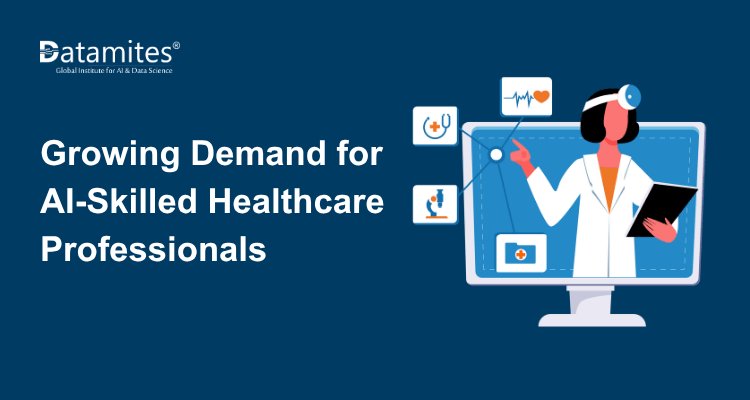
The Growing Demand for AI-Skilled Healthcare Professionals
Discover the growing demand for AI-skilled healthcare professionals and explore how artificial intelligence is transforming patient care, medical research, and hospital operations while creating new career opportunities in healthcare.
 Prerana B A
Artificial intelligence (AI) is transforming how healthcare professionals diagnose diseases, monitor patients, analyse medical information, and manage hospital operations. From medical imaging to clinical documentation, AI tools are becoming increasingly relevant across clinical and non-clinical settings.
Healthcare professionals do not need to become programmers to benefit from these developments. They need to understand how AI tools work, interpret their outputs, recognise their limitations, and use them responsibly alongside their existing expertise. As healthcare organisations adopt these technologies, the demand for AI-skilled healthcare professionals is growing, making practical AI literacy an important part of professional development.
Why Demand for AI in Healthcare Is Growing
Healthcare organisations manage increasing volumes of medical images, electronic health records, laboratory results, and patient monitoring data. The demand for AI in healthcare is growing as organisations use AI to identify patterns, prioritise cases, and reduce repetitive administrative tasks, potentially helping healthcare teams manage staffing challenges and increasing workloads.
The OECD's 2024 report, Artificial Intelligence and the Health Workforce, examines how AI may change healthcare tasks, professional responsibilities, and workforce skills. It highlights potential benefits while recognising challenges involving digital literacy, ethical safeguards, and implementation.
The US Food and Drug Administration (FDA) has also documented the expansion of AI-enabled medical technology. Its AI-enabled medical devices resource tracks authorised devices used in applications such as medical imaging and disease detection.
Growing adoption increases the importance of AI literacy, but device authorisations do not directly measure job creation. Healthcare professionals must understand how these tools work, evaluate their outputs, and integrate them safely into established workflows.
How AI Is Transforming Healthcare Jobs
AI applications are changing daily tasks across clinical and non-clinical healthcare settings.
- Medical imaging and diagnosis: AI can highlight suspicious findings in X-rays, CT scans, mammograms, and retinal images to support clinical assessment.
- Patient monitoring: Predictive systems can analyse vital signs and flag potential deterioration for clinical review.
- Drug discovery and research: Machine learning helps researchers analyse biological data and investigate potential treatments.
- Clinical documentation: AI-assisted tools can summarise consultations and prepare draft records, subject to accuracy and privacy checks.
- Hospital operations: AI can support appointment scheduling, resource planning, and administrative workflows.
- Personalised care: Analysing patient information can help clinicians assess treatment options alongside clinical guidelines and patient preferences.
A notable example is AI-assisted diabetic retinopathy screening. A 2018 clinical study published in npj Digital Medicine evaluated an autonomous AI system in 900 people with diabetes. The researchers reported 87.2% sensitivity and 90.7% specificity for detecting more-than-mild diabetic retinopathy or diabetic macular oedema.
These findings demonstrate the potential of AI for screening in primary care settings. However, performance depends on the intended use and clinical context. Healthcare professionals must understand false-positive and false-negative risks, follow-up requirements, and when further assessment is necessary.
Refer to these articles:
- The Role of AI in Investment and Portfolio Analysis
- How AI Is Creating New Roles in Human Resources
- How to Get Into AI Marketing? A Beginner’s Career Guide
Essential AI Skills for Healthcare Professionals
The AI skills required in healthcare vary depending on an individual's role and responsibilities, but several key capabilities are valuable across different healthcare settings.
- AI fundamentals: Understand machine learning, generative AI, and common healthcare applications.
- Data interpretation: Recognise patterns and understand how incomplete or inaccurate data affect results.
- Critical evaluation: Check AI-generated outputs against reliable evidence and established procedures.
- Privacy and security: Protect patient confidentiality and follow organisational policies when using AI tools.
- Ethical AI use: Recognise potential bias and differences in performance across patient groups.
- Communication: Collaborate with clinicians, IT teams, analysts, and technology providers.
The OECD's workforce research highlights digital literacy and ethical concerns as important considerations in healthcare AI adoption. Professionals can begin with basic AI literacy without advanced programming knowledge. Developing or validating AI models, however, generally requires deeper technical expertise.
Career Opportunities for Healthcare Professionals With AI Skills
A career in AI for healthcare can involve clinical informatics, healthcare data analysis, medical imaging, AI implementation, research, and digital health project management. The right pathway depends on your existing qualifications, technical skills, and professional interests.
- Clinical informatics specialist: Connects clinical workflows with digital health systems and healthcare information.
- Healthcare data analyst: Analyses datasets, prepares reports, and identifies operational or patient-care trends.
- Clinical AI implementation specialist: Supports AI adoption, workflow integration, and staff training.
- Medical imaging AI specialist: Works with imaging technologies and AI-assisted analysis, often requiring relevant clinical or technical qualifications.
- Healthcare AI researcher: Develops or evaluates AI methods for medical applications, usually requiring advanced technical or research skills.
Digital health project professional: Coordinates technology projects involving clinical teams, IT departments, and vendors.
A 2026 analysis published in the Journal of Medical Internet Research examined 1,430 FDA-authorised AI and machine learning medical devices from 1995 to 2025. Of these, 792 (55.4%) were authorised during 2023–2025, indicating substantial recent development activity.
This growth reflects expanding medical technology development, not guaranteed employment growth. Professionals should review local job advertisements and qualification requirements to identify which skills employers actually seek.
How Healthcare Professionals Can Develop AI Skills
A structured learning plan can help professionals develop relevant capabilities:
- Learn AI fundamentals: Understand machine learning, generative AI, and common AI in healthcare applications.
- Understand healthcare data: Explore electronic health records, medical imaging, and clinical measurements.
- Study practical examples: Examine applications such as patient monitoring, diabetic retinopathy screening, and clinical documentation.
- Practise responsible evaluation: Check AI outputs against trusted evidence and recognise when expert review is needed.
- Choose relevant training: Select a course aligned with your background, technical experience, and career goals.
- Stay informed: Follow healthcare regulation, research, privacy requirements, and responsible AI practices.
Professionals seeking structured learning can explore AI for Healthcare courses. Confirm the current syllabus, prerequisites, duration, fees, delivery format, and certification details before enrolling.
Training should complement professional experience, not replace clinical qualifications or guarantee employment. Where possible, practise using approved tools within organisational policies and learn from colleagues involved in digital health implementation.
Refer to these articles:
- Reinforcement Learning: Basics and Applications
- What is the Difference Between AI Engineer and AI Expert Course?
- What is an AI Agent? Guide to Intelligent Agents in AI
Preparing for the Future of AI in Healthcare
AI is becoming increasingly relevant to medical imaging, patient monitoring, research, documentation, and healthcare operations. According to the Philips Future Health Index 2026 India report, 71% of surveyed healthcare professionals in India reported that AI had increased their capacity to see more patients. This highlights AI's potential to support healthcare delivery and improve workflow efficiency.
The future of AI in healthcare will require professionals to combine domain expertise with data interpretation, critical thinking, and responsible technology use. However, increased AI adoption does not automatically translate into more jobs. Career prospects will vary by speciality, employer, and location, making it important for professionals to develop practical AI skills that address real workplace needs while keeping patient safety, privacy, and ethical care at the centre of every decision.
Start by identifying one area of your work where AI could be useful. Learn how the relevant tools operate, understand their limitations, and practise evaluating their outputs within approved workflows. As the demand for AI in healthcare grows, combining AI literacy with professional judgement can help healthcare workers adapt to changing responsibilities while keeping patient safety, privacy, and ethical care at the centre of every decision.
DataMites Institute offers an AI for Healthcare course designed to help healthcare professionals understand AI fundamentals and explore their applications in patient care, hospital operations, and medical research. The institute also offers specialized AI programs in HR and people analytics, finance, marketing, and business management.
Learners can choose from online classes, classroom training, and project-based internships to gain practical experience. The program includes IABAC-aligned certification, leading to the Certified AI Professional in Healthcare & Clinical Operations credential. With 50+ offline centres across India, including Bangalore, Chennai, Hyderabad, Pune, Mumbai, Ahmedabad, Coimbatore, and Delhi, DataMites offers flexible learning options for healthcare professionals and others looking to develop AI skills.