Data Science Career Scope in 2026
Explore the growing scope of data science in 2026, including career opportunities, in-demand skills, salary trends, job roles, and industry applications for aspiring professionals.
 Datamites Team

Data science continues to be one of the most promising technology fields in 2026, helping organizations transform growing volumes of data into actionable insights, improve decision-making, and develop AI-powered solutions. The rapid adoption of artificial intelligence, generative AI, machine learning, cloud computing, and advanced analytics is further expanding opportunities for data science professionals across industries.
The International Data Corporation (IDC) continues to project strong growth in the global datasphere through 2030, reflecting the rising volume of data created, captured, replicated, and consumed worldwide. Meanwhile, the U.S. Bureau of Labor Statistics (BLS) projects employment of data scientists to grow by 33.5% from 2024 to 2034, adding approximately 82,500 jobs. These trends highlight the growing demand for skilled professionals across various data science roles and the strong career potential of the field in 2026.
Why Data Science is the Ideal Career Path
The allure of a career in data science lies not just in its growth but also in its impact. Data scientists are at the forefront of innovation, using their skills to solve complex problems and drive business success.
Key Reasons to Consider a Data Science Career:
High Demand: With every industry looking to harness data, the need for data scientists is unprecedented.
Diverse Opportunities: Data science applications span various fields, including healthcare, finance, retail, and technology.
Lucrative Salaries: Data scientists rank among the top earners in the technology sector.
Moreover, the satisfaction derived from making data-driven decisions that can transform a business’s trajectory makes this career even more appealing. Whether predicting market trends or improving customer experiences, data scientists make a tangible difference.
Read these articles:
- Data Analyst Career Scope in India
- Artificial Intelligence Career Scope in India
- Python Programming Career Scope in India
Is Data Science a Smart Career Choice?
Absolutely, data science is a highly rewarding career path. Its importance is underscored by its role in decision-making processes across sectors. With the increasing reliance on data-driven strategies, businesses need skilled data scientists to analyze trends, extract insights, and drive growth. Additionally, the demand for data professionals is growing, leading to lucrative job opportunities and career advancement potential.
Benefits of a Data Science Career:
A career in data science offers strong growth potential as businesses increasingly rely on data, AI, and analytics to make informed decisions. It also provides opportunities to work across various industries and technologies.
- High Demand: Growing need for data professionals across industries.
- Career Growth: Expanding opportunities with AI and machine learning.
- Competitive Salaries: Attractive earning potential with the right skills.
- Diverse Roles: Opportunities as Data Scientists, Data Analysts, ML Engineers, and AI Engineers.
- Future-Ready Skills: Exposure to AI, cloud computing, big data, and predictive analytics.
Data science offers a rewarding career path with strong demand, diverse opportunities, and long-term growth potential in 2026 and beyond.
Skills required to Become Data Scientist
To thrive in data science, one needs a blend of technical prowess and analytical thinking. Proficiency in programming languages such as Python and R is essential, alongside a strong understanding of statistics and machine learning algorithms. Additionally, expertise in data visualization tools and big data technologies, such as Hadoop and Spark, is highly valuable. Soft skills like problem-solving, effective communication, and a keen business acumen are also crucial for translating complex data insights into actionable strategies.
Core Skills Required:
Programming: Proficiency in languages like Python and R is crucial.
Statistics and Mathematics: A solid foundation in these areas is essential for data analysis and modeling.
Machine Learning: Comprehending algorithms and their practical uses is crucial.
Data Visualization: The ability to present data insights visually using tools like Tableau or Power BI.
Soft Skills Needed:
Problem-Solving: The ability to approach problems methodically and creatively.
Communication: Effectively conveying complex findings to non-technical stakeholders.
Critical Thinking: Evaluating data sources and results critically to ensure accuracy.
Aspiring data scientists should also consider enrolling in a data science course or obtaining a data science certification to bolster their knowledge and credentials.
Read these articles:
- Exploring Core Data Science Concepts
- Is Data Science a Good Career for Freshers?
- Climbing the Data Science Ladder - Data Science Levels
Data Science across in Various Industries
Data science's versatility means it has applications in almost every industry. In healthcare, it aids in predictive analytics for patient care and disease prevention. The finance industry gains advantages from using data-driven methods for detecting fraud and managing risks. In retail, data science enhances customer experience through personalized recommendations. Additionally, sectors like manufacturing, transportation, and entertainment use data science for optimization, predictive maintenance, and audience analysis, respectively.
Industries Leveraging Data Science:
- Healthcare: Predictive analytics for patient outcomes, personalized medicine, and resource management.
- Finance: Detection of fraud, management of risk, and execution of algorithmic trading.
- Retail: Segmentation of customers, management of inventory, and forecasting of sales.
- Technology: Enhancing user experiences, developing AI products, and optimizing system performance.
Case Studies:
- Healthcare: IBM Watson’s use in diagnosing diseases more accurately and quickly.
- Retail: Amazon’s recommendation engine, significantly boosting sales by suggesting products based on user data.
Worldwide Data Scientist Salaries in 2026
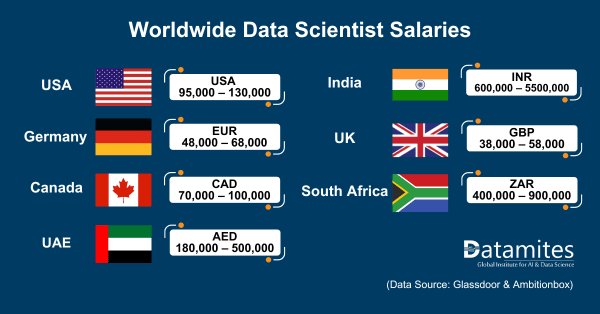
The financial rewards in data science are substantial, reflecting the high demand and specialized skills required. In 2026, the average salary for data scientists has seen a significant increase, with entry-level positions starting at $90,000 annually. Experienced professionals can earn upwards of $150,000, with some senior roles exceeding $200,000. Regions such as North America and Western Europe lead the salary charts, while emerging markets in Asia and South America show promising growth. Additionally, sectors like finance, healthcare, and technology offer the most lucrative opportunities for data scientists.
Global Data Scientist Salary Trends:
- In the United States, starting salaries for entry-level positions begin at approximately $95,000, while seasoned professionals can earn upwards of $130,000 annually (according to Glassdoor).
- Glassdoor reports that the typical data scientist in Germany makes €48,000–€68,000 a year.
- Data Scientists in Canada earn an average annual salary of $70,000–$100,000 ,as reported by Indeed.
- In the United Arab Emirates, the average annual salary for a data scientist is AED 180,000–AED 500,000 according to Indeed.
- According to Indeed, the average annual salary for a data scientist in India is ₹6 LPA–₹55 LPA
- Data scientists in the UK earn an average annual salary of £38,000–£58,000, based on data from Glassdoor.
- In South Africa, data scientists earn an average annual salary of ZAR 400,000–ZAR 900,000, as reported by Indeed.
Factors Influencing Salaries:
- Experience and Education: Advanced degrees and certifications can significantly boost earnings.
- Location: Higher salaries are often found in urban centers and tech hubs.
- Industry: Specialized fields like finance or healthcare may offer premium pay rates.
Refer these articles:
- Data Science Course Fee in Hyderabad
- Data Science Course Fee in Pune
- Data Science Course Fee in Bangalore
Preparing for a Career in Data Science
Successful initiation of a data science career hinges on thorough preparation. It is essential to develop a strong foundation in mathematics and statistics, as these are the core pillars of data science. Familiarizing oneself with programming languages like Python and R, along with mastering tools such as SQL and Hadoop, is crucial. Additionally, gaining practical experience through internships, personal projects, or participating in Kaggle competitions can provide valuable hands-on skills.
Educational Pathways:
- Degrees: A bachelor’s or master’s degree in computer science, statistics, or related fields.
- Certifications: Obtaining a data science certification from prestigious institutions can boost your resume.
- Online Courses: Numerous platforms offer data science courses that provide practical knowledge and skills.
Practical Experience:
- Internships: Gaining hands-on experience through internships can be invaluable.
- Projects: Working on real-world projects, either independently or as part of a course, helps build a strong portfolio.
- Networking: Joining data science communities and attending industry conferences can open doors to job opportunities.
The Evolution of Data Science
Looking ahead, data science is poised to become even more integral to business operations and innovation. With advancements in artificial intelligence and machine learning, data-driven decision-making will become increasingly sophisticated. Businesses will use predictive analytics to predict market trends and understand consumer behavior. The integration of big data with IoT devices will provide real-time insights, revolutionizing industries from healthcare to finance.
Emerging Trends:
- AI and Automation: Increased integration of AI in data science processes.
- Data Privacy: Enhanced focus on ethical data usage and privacy protection.
- Interdisciplinary Applications: Growing intersection of data science with fields like genomics, climate science, and social sciences.
Impact on Careers:
- New Roles: Emergence of specialized roles like data ethics officers and AI trainers.
- Expanded Opportunities: Greater demand for data science skills in non-traditional sectors.
Data scientists can continue to excel in this changing environment by staying knowledgeable and flexible. The future of data science offers vast opportunities for those eager to innovate and evolve, regardless of whether you're an experienced expert or just starting out.
DataMites Institute provides top-notch education in data science and AI, offering comprehensive training programs. They provide certifications recognized by IABAC (International Association of Business Analytics Certification) and aligned with NASSCOM FutureSkills, ensuring students gain relevant skills for the industry. With branches in Bangalore, Pune, Hyderabad, Chennai, Mumbai, Coimbatore, and Ahmedabad, DataMites Institute makes it easy for aspiring professionals across India to access quality education in cutting-edge technologies like data science.