The Role of AI in Personalized Medicine
Artificial Intelligence is transforming personalized medicine by analyzing vast health data to deliver tailored treatments, improve diagnosis accuracy, predict disease risks, and enhance patient outcomes.
 Prerana B A
Healthcare is rapidly evolving with advances in artificial intelligence (AI), genomics, and data science, moving beyond the traditional one-size-fits-all approach to more personalized care. AI in personalized medicine enables healthcare providers to analyze complex patient data, including genetic information, medical history, and lifestyle factors, to deliver more accurate diagnoses and tailored treatment plans.
The growing impact of this field is reflected in its market growth. According to Grand View Research, the global artificial intelligence in precision medicine market was valued at USD 2.29 billion in 2024 and is expected to reach USD 14.53 billion by 2030, growing at a CAGR of 36.23%. By supporting early disease detection, predicting treatment outcomes, and accelerating drug discovery, AI is helping improve patient outcomes while making healthcare more efficient and personalized.
What Is Personalized Medicine?
Personalized medicine, often referred to as Precision Medicine, is a healthcare approach that tailors prevention, diagnosis, and treatment strategies to an individual's unique characteristics. According to the National Human Genome Research Institute, precision medicine aims to tailor medical treatment based on individual variability in genes, environment, and lifestyle. This approach helps healthcare providers deliver more targeted and effective care.
Rather than applying a one-size-fits-all treatment model, personalized healthcare considers factors such as:
- Genetic makeup
- Family history
- Lifestyle habits
- Environmental influences
- Medical history
- Biomarker data
Evolution of Personalized Healthcare
The concept of personalized healthcare has evolved significantly over the last two decades. Advances in genomic sequencing, healthcare data analytics, and biotechnology have enabled clinicians to understand diseases at a molecular level.
The completion of the Human Genome Project marked a major milestone, opening new possibilities for Genomic Medicine and targeted therapies. Today, AI is accelerating this evolution by helping healthcare professionals process and interpret increasingly complex datasets.
Refer to these articles:
- LLM Fine-Tuning vs Prompt Engineering: Which Is Better?
- Top AI Trends That Will Shape 2026
- PyTorch vs TensorFlow: Which is Better?
Understanding AI in Personalized Medicine
Artificial intelligence refers to computer systems capable of performing tasks that typically require human intelligence, such as learning, reasoning, prediction, and decision-making. The World Health Organization recognizes artificial intelligence as a key technology for improving healthcare delivery, disease diagnosis, and clinical decision-making, particularly in data-intensive areas such as medical imaging and personalized care.
In healthcare, AI processes massive volumes of data from:
- Electronic health records (EHRs)
- Medical imaging systems
- Genomic databases
- Wearable devices
- Clinical trial data
- Laboratory results
How AI Works in Healthcare
AI algorithms analyze patterns across diverse healthcare datasets to generate actionable insights.
Key AI technologies include:
| Technology | Healthcare Application |
| Machine Learning | Disease prediction and treatment optimization |
| Deep Learning | Medical imaging analysis |
| Natural Language Processing | Clinical documentation analysis |
| Predictive Analytics | Risk assessment and preventive care |
| Generative AI | Drug discovery and clinical research |
Key Applications of AI in Personalized Medicine
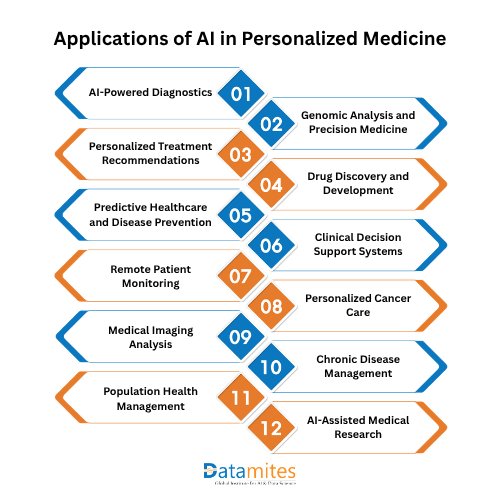
Artificial intelligence is revolutionizing personalized medicine by enabling more precise, efficient, and patient-focused healthcare. Some of the key applications include:
AI-Powered Diagnostics
AI analyzes medical images, pathology reports, and clinical data to support faster and more accurate disease detection.
Genomic Analysis and Precision Medicine
AI helps interpret genetic data, identify disease-causing mutations, and support personalized treatment strategies.
Personalized Treatment Recommendations
By combining patient history, genetics, and clinical data, AI helps physicians select the most effective treatments.
Drug Discovery and Development
AI accelerates the identification of drug candidates, predicts drug interactions, and optimizes clinical trials.
Predictive Healthcare and Disease Prevention
AI uses predictive analytics to identify health risks early and enable preventive interventions.
Clinical Decision Support Systems
AI provides healthcare professionals with evidence-based insights to improve diagnosis and treatment planning.
Remote Patient Monitoring
AI analyzes data from wearable devices and remote monitoring systems to track patient health in real time.
Personalized Cancer Care
AI helps identify targeted therapies by analyzing tumor genetics and predicting treatment responses.
Medical Imaging Analysis
AI enhances the interpretation of X-rays, MRIs, CT scans, and other imaging studies for improved diagnostic accuracy.
Chronic Disease Management
AI supports personalized care plans for conditions such as diabetes, heart disease, and hypertension through continuous monitoring and risk assessment.
Population Health Management
Healthcare organizations use AI to identify high-risk patient groups and deliver targeted interventions.
AI-Assisted Medical Research
AI analyzes large healthcare datasets to uncover new insights, accelerate research, and support the development of innovative therapies.
These applications highlight how AI in Personalized Medicine is driving precision healthcare, improving patient outcomes, and transforming the future of medical treatment.
Benefits of AI in Personalized Healthcare
The integration of AI into healthcare delivers substantial advantages for patients, providers, and healthcare systems.
Faster Diagnosis
AI systems can analyze medical data in seconds, significantly reducing diagnostic delays.
Improved Patient Outcomes
Personalized interventions improve treatment effectiveness and patient satisfaction.
Cost Reduction
Early detection and targeted therapies reduce unnecessary tests, hospitalizations, and ineffective treatments.
Better Treatment Accuracy
AI helps identify the most appropriate therapies based on patient-specific characteristics.
Enhanced Clinical Decision-Making
Advanced Clinical Decision Support Systems provide physicians with evidence-based recommendations.
Real-World Examples of AI in Personalized Medicine
AI is already making a significant impact across healthcare organizations, research institutions, and pharmaceutical companies. Here are some notable examples:
Hospitals
Leading healthcare institutions are using AI to support precision healthcare initiatives.
Examples include:
- AI-assisted cancer diagnosis
- Personalized treatment planning
- Predictive patient monitoring
- Clinical decision support tools
Research Organizations
Research centers worldwide use AI to analyze genomic datasets and accelerate medical discoveries.
Key focus areas include:
- Cancer genomics
- Rare diseases
- Neurological disorders
- Precision therapeutics
Pharmaceutical Companies
Major pharmaceutical organizations leverage AI to improve:
- Drug target identification
- Clinical trial recruitment
- Biomarker discovery
- Treatment optimization
AI Healthcare Platforms
Modern AI Healthcare Solutions integrate:
- Electronic health records
- Genomic data
- Medical imaging
- Wearable device data
These platforms provide healthcare professionals with a unified view of patient health and support more informed treatment decisions.
Organizations such as Mayo Clinic and Cleveland Clinic are exploring AI-driven diagnostic and precision medicine initiatives to improve treatment planning and patient outcomes.
Challenges and Ethical Considerations of AI in Personalized Medicine
While AI in personalized medicine offers significant benefits, it also presents several challenges that healthcare organizations must address to ensure safe, ethical, and reliable implementation.
- Data Privacy and Security: AI relies on sensitive patient data, making strong privacy protections and cybersecurity measures essential.
- Algorithm Bias and Fairness: Biased or incomplete datasets can lead to inaccurate predictions and unequal treatment recommendations, highlighting the need for diverse and representative data.
- Regulatory Compliance: AI healthcare solutions must meet strict regulatory requirements and undergo rigorous validation before clinical use.
- Explainability and Transparency: Healthcare professionals need clear insights into how AI systems make decisions to ensure trust and effective clinical adoption.
- Patient Trust and Acceptance: Patients are more likely to embrace AI when healthcare providers are transparent about data usage and AI-driven recommendations.
- Human Oversight and Accountability: AI should support healthcare professionals, not replace them. Final medical decisions should always remain under clinical supervision.
Addressing these challenges will be essential for ensuring that AI in personalized medicine remains ethical, trustworthy, and capable of delivering long-term benefits for patients and healthcare systems.
Refer to these articles:
- Supervised vs. Unsupervised Learning: What’s the Difference?
- Generative AI and Predictive AI: Key Differences Explained
- Guide to Artificial Intelligence Career
Future Trends of AI in Personalized Medicine
The future of personalized medicine will be shaped by increasingly sophisticated AI technologies.
Generative AI in Healthcare
Generative AI is expected to support:
- Medical documentation
- Clinical research
- Drug design
- Treatment planning
This technology can accelerate innovation while reducing administrative burdens.
Digital Twins
Digital twins are virtual replicas of patients that simulate disease progression and treatment responses.
Potential applications include:
- Personalized treatment testing
- Surgical planning
- Predictive disease management
Predictive Genomics
Future AI systems will combine genomic information with real-world patient data to predict disease risks with unprecedented accuracy.
This could enable:
- Earlier interventions
- Personalized prevention strategies
- Improved long-term health outcomes
Wearable Health Technology
Wearables are generating vast amounts of real-time health data.
AI can analyze:
- Heart rate
- Sleep patterns
- Activity levels
- Blood glucose measurements
This continuous monitoring supports proactive and personalized healthcare.
AI-Assisted Clinical Research
AI Medical Research is transforming clinical trials through:
- Faster patient recruitment
- Automated data analysis
- Improved study design
- Enhanced treatment discovery
As these innovations mature, the future of personalised medicine will become increasingly data-driven, predictive, and patient-centered.
The rise of AI in personalised medicine is reshaping modern healthcare by combining artificial intelligence, genomics, and predictive analytics to deliver more precise, patient-specific treatments. It improves diagnosis, treatment accuracy, and overall healthcare efficiency while supporting earlier disease detection and better outcomes. Despite challenges like privacy, bias, and regulation, AI continues to drive innovation in patient-centered care and the future of medicine.
As artificial intelligence continues to reshape the healthcare sector, professionals need the right skills to effectively apply these emerging technologies. DataMites offers a specialized AI in Healthcare courses designed to provide practical knowledge of AI applications in healthcare, including healthcare data analytics, clinical decision support systems, patient care enhancement, and operational efficiency.
The program combines comprehensive training with hands-on projects, enabling participants to gain practical experience in applying AI to real healthcare challenges. Available through flexible online and classroom learning formats, the course also offers the globally recognized Certified AI Professional for Healthcare & Clinical Ops certification from IABAC®. Whether you are a healthcare professional, researcher, administrator, or aspiring AI practitioner, this program equips you with the skills needed to stay ahead in the rapidly evolving healthcare technology landscape.