AI Product Innovation: Strategy, Process & Business Impact
Discover how AI product innovation works, from strategy and development to real-world applications, business impact, risk management, and success metrics.
 Kriti Maurya
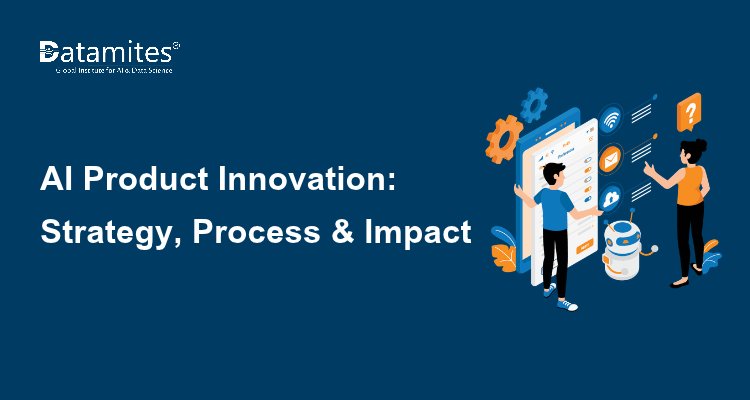
AI product innovation is the process of using artificial intelligence (AI) to develop new products or improve existing ones to solve customer problems and deliver measurable business value. It combines customer research, data analysis, machine learning, and product management to create products that can recognize patterns, generate content, make predictions, and personalize user experiences.
Unlike conventional software, which often relies on predefined rules, AI-powered products can use data and trained models to produce predictions or responses. Their performance depends on data quality, model selection, evaluation methods, and the environment in which they operate.
Examples include personalized shopping recommendations, predictive maintenance systems, fraud detection tools, and generative AI assistants. These applications demonstrate how artificial intelligence product development can improve existing services and create new customer experiences.
The fundamental principle is simple: AI should solve a meaningful problem. Adding a sophisticated model without improving usability, efficiency, or customer outcomes does not necessarily create a successful product.
Why is AI Product Innovation Important?
AI product innovation helps businesses respond to changing customer expectations, improve operational efficiency, and develop data-informed services. When implemented effectively, AI can support personalization, automate repetitive activities, and help users make decisions more efficiently.
For example, an e-commerce business can recommend products based on browsing behavior and purchase history. A customer service platform can use generative AI to summarize support requests and suggest relevant responses.
AI can also help organizations identify patterns that are difficult to detect through manual analysis. However, the benefits depend on the quality of implementation, the relevance of available data, and the ability to manage risks.
Businesses should evaluate AI initiatives against measurable objectives, including customer satisfaction, task completion, operating costs, error rates, and retention. These metrics help distinguish genuine business value from technology adoption alone.
Refer to the article below:
- The Role of AI in Investment and Portfolio Analysis
- Essential AI Skills for Marketing Professionals in 2026
- How AI Helps HR Teams Predict Workforce Needs
What are the Key Strategies for Successful AI Product Innovation?
An effective AI product strategy connects customer needs, technical feasibility, and business objectives. Product teams should consider the following priorities before investing in product development.
1. Start With Customer Problems
Successful product innovation begins with understanding the people who will use the product. Interviews, surveys, support tickets, usability testing, and behavioral analytics can help teams identify recurring challenges.
Product managers should define the problem clearly before choosing a technology. This prevents teams from building AI features that appear innovative but offer limited practical value.
2. Evaluate Data Readiness
AI systems depend on suitable data. Before product development strategy, teams should assess data quality, availability, relevance, representativeness, privacy requirements, and potential bias.
They should also determine whether the business has permission to use the data and whether sensitive information requires additional protection.
If the available data cannot support the desired outcome, the team may need to improve data collection or choose a simpler solution.
3. Align AI Features With Business Goals
Every AI initiative should have a defined purpose. A recommendation engine might aim to improve relevant product discovery, while a support assistant might aim to reduce the time required to resolve routine questions.
Establish baseline measurements and target outcomes before implementation. This makes it easier to evaluate whether the product delivers meaningful improvements.
4. Choose the Right Technology
Not every problem requires machine learning or generative AI.
Traditional automation may be sufficient for predictable, rule-based tasks. Machine learning is useful for prediction, classification, anomaly detection, and personalization when appropriate data is available. Generative AI can support content creation, summarization, and natural-language interactions.
Choosing the simplest technology that meets user needs can reduce development costs, complexity, and operational risk.
5. Build Responsible AI Into Product Design
Responsible AI practices should be considered from the beginning rather than added after deployment. Product teams should assess privacy, fairness, security, transparency, accessibility, and the need for human oversight.
Clear user expectations and appropriate safeguards help establish trust while reducing the likelihood of harmful or misleading outputs.
What are the Steps in the AI Product Development Process?
The AI product development process is iterative. Teams may revisit earlier decisions when testing reveals new requirements, data limitations, or unexpected risks.
Step 1: Problem Discovery
Identify the target audience, customer pain points, and business opportunity. Define the problem statement and determine how the proposed product could improve the current experience.
For example, a company might investigate why customers struggle to find relevant products through its existing search function.
Step 2: Feasibility Assessment
Evaluate data availability, technical requirements, integration complexity, infrastructure, development costs, and potential risks.
The team should also determine whether AI provides a meaningful advantage over conventional software. This stage helps establish whether the project is technically achievable and commercially worthwhile.
Step 3: Prototype Development
Build a minimum viable product (MVP) that tests the most important assumption. The prototype should focus on the core user problem rather than unnecessary features.
Representative users can evaluate whether the solution is understandable, useful, and sufficiently reliable. Early testing helps teams identify weaknesses before committing to a large-scale launch.
Step 4: Testing and Validation
Evaluate technical performance and user experience using predefined criteria. Depending on the application, these may include accuracy, precision, recall, response time, reliability, task completion, and user satisfaction.
Generative AI product development requires top AI product manager skills along with additional testing for fabricated information, inappropriate responses, sensitive-data exposure, and inconsistent outputs.
Step 5: Deployment and Continuous Improvement
After validation, deploy the product with appropriate monitoring and support processes. Track real-world performance, collect user feedback, investigate failures, and update the system when necessary.
The AI product lifecycle continues after launch because data distributions, user expectations, models, and business requirements can change over time.
Refer to the article below:
- Ethical Challenges of AI in Healthcare
- Top AI Skills for Finance Professionals in 2026
- Top AI Career Opportunities in Finance for Future Professionals
What are the Real-World Applications of AI Product Innovation?
AI-powered product innovation supports different industries, although the level of required validation and oversight varies by use case.
AI Product Innovation in Healthcare Sector
AI product manager tools can assist clinicians with medical image analysis, information retrieval, and the identification of patterns that warrant further investigation. Clinical use requires appropriate validation, privacy protection, and professional oversight.
AI Product Innovation in Finance Sector
Machine learning systems can identify unusual transaction patterns and flag potentially fraudulent activity for investigation. Performance should be evaluated against false positives, missed detections, and operational costs.
AI Product Innovation in Retail and E-Commerce Industry
Recommendation engines can personalize product discovery using relevant customer and product data. Predictive models can also support inventory planning and demand forecasting.
Businesses should monitor whether recommendations improve customer outcomes without creating excessive repetition or reinforcing unwanted patterns.
AI in Customer Service
AI assistants can help customers navigate support resources, summarize requests, and find answers to routine questions. More complex or sensitive cases may require escalation to a human representative.
Evaluation should include answer quality, resolution rates, customer satisfaction, and the frequency of incorrect responses.
AI Product Innovation in Manufacturing Industry
AI systems can analyze equipment data to identify patterns associated with potential failures. These insights can support maintenance planning and help reduce unexpected downtime when the system is appropriately validated.
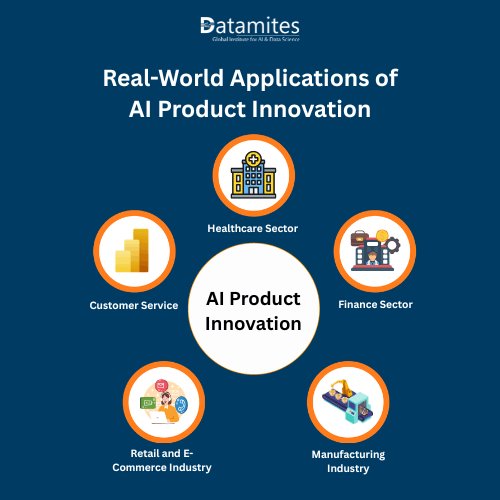
These applications illustrate possible uses of AI; actual business results depend on implementation quality, operating conditions, and evaluation methods.
How to Choose the Right AI Technology for a Product Manager
Choosing the right technology is an important part of AI product strategy. Product teams should compare potential solutions based on business value, data availability, complexity, and risk.
| Business requirement | Recommended approach | Key consideration |
| Automate predictable, rule-based tasks | Traditional automation | Define clear rules and exceptions |
| Predict customer behavior | Machine learning | Evaluate data quality and predictive performance |
| Recommend relevant products | Recommendation systems | Measure relevance and customer outcomes |
| Generate summaries or draft responses | Generative AI | Validate factual accuracy and protect sensitive information |
| Support high-impact decisions | AI with appropriate human oversight | Assess risks, reliability, and accountability |
This framework is a starting point rather than a universal rule. The final choice should depend on user needs, technical feasibility, operating costs, and the consequences of incorrect outputs.
How can Businesses Measure AI Product Success?
AI product management Career and it should connect customer outcomes, technical performance, and business results. No single metric is sufficient for every product.
1. Identifying Customer Metrics
Relevant measures include customer satisfaction, adoption, retention, task completion, and usability. These indicators help teams determine whether the product solves the intended problem.
2. Analyzing Technical Metrics
Depending on the application, teams may track model accuracy, precision, recall, error rates, latency, uptime, and reliability. Generative AI products may also require evaluations of factual accuracy, relevance, and appropriate refusal behavior.
3. Business Metrics associated with Product Success
Organizations can measure operating costs, conversion rates, revenue contribution, support costs, and return on investment.
Compare results against pre-launch baselines and, where practical, a control group. This helps identify whether observed improvements are associated with the AI feature rather than unrelated changes.
Teams should also monitor costs that continue after launch, including model inference, infrastructure, human review, maintenance, and evaluation.
How to Validate an AI Product Before Launch
Before releasing an AI-powered product, teams should define acceptance criteria and test the system against representative user scenarios. Evaluation should cover output quality, reliability, privacy, security, and failure handling.
Teams should document known limitations, establish procedures for escalating high-risk cases, and monitor performance after deployment. Where relevant, they should compare results with an existing workflow or control group to determine whether the product delivers measurable benefits.
The level of testing should reflect the product's intended use and the potential consequences of errors. Products supporting high-impact decisions require more rigorous safeguards than low-risk convenience features.
What are the Main Challenges in AI Product Innovation?
AI product development introduces technical, operational, and ethical challenges that must be managed throughout the product lifecycle.
- Data privacy: Products may process sensitive or personal information. Data minimization, access controls, retention policies, and appropriate security measures can reduce exposure.
- Algorithmic bias: Unrepresentative training data or unsuitable evaluation methods can produce unequal outcomes. Testing across relevant user groups can help identify disparities.
- Inaccurate outputs: AI systems can make incorrect predictions or generate plausible but false information. Verification, confidence-aware workflows, and human review can reduce the impact of errors.
- Integration complexity: Connecting AI systems to existing products can require changes to infrastructure, workflows, and security controls.
- Ongoing costs: Model usage, infrastructure, monitoring, and maintenance can affect the financial viability of a product.
The NIST AI Risk Management Framework provides guidance for incorporating trustworthiness and risk management into AI design, product development, deployment, and evaluation.
Product teams can apply risk management through documented evaluation criteria, representative testing, data protection controls, incident response procedures, human oversight, and continuous monitoring.
How can Businesses Start an AI Product Innovation Project?
Businesses can begin with a structured, low-risk approach.
- Identify a specific customer problem supported by research.
- Determine whether AI offers an advantage over conventional software.
- Evaluate data readiness, costs, privacy requirements, and technical feasibility.
- Build a small prototype and test it with representative users.
- Define success metrics and compare results with a baseline.
- Address identified risks before expanding deployment.
- Monitor performance and improve the product using real-world feedback.
For example, a company considering an AI support assistant could first test it on a limited set of routine questions. Before expanding its use, the team could evaluate answer correctness, escalation behavior, response time, and cost per resolved query.
This approach supports evidence-based decisions and helps businesses avoid scaling a feature before demonstrating its value.
What is the Future of AI Product Innovation?
AI product innovation is likely to continue evolving as organizations explore generative AI, machine learning, and AI-assisted workflows. These technologies may create new opportunities for personalization, decision support, automation, and product experiences.
According to Grand View Research, the global enterprise artificial intelligence market is projected to reach USD 155.2 billion by 2030, growing at a compound annual growth rate (CAGR) of 37.6% from 2025 to 2030. This growth highlights the increasing business focus on AI-powered products, intelligent automation, and data-driven innovation.
However, long-term success will depend on more than adopting emerging tools. Businesses will need to demonstrate reliability, protect user information, manage operating costs, and maintain appropriate human oversight.
Refer to the article below:
- What is Semantic Networks in Artificial Intelligence
- How Does AI Work? A Simple Explanation for Beginners
- The Impact of AI on Various Industries: Current and Future Trends
Product teams that combine customer research, responsible implementation, and continuous measurement will be better positioned to identify valuable opportunities and adapt products as needs change.
AI product innovation combines customer-focused design, a clear AI product strategy, iterative pproduct development, measurable outcomes, and responsible risk management. Businesses that validate their assumptions, evaluate performance, and improve products through feedback can build AI-powered solutions that address genuine customer needs.
DataMites Institute offers an industry-oriented Best AI Product Manager Course that equips professionals with skills in AI-driven product strategy, innovation, and business decision-making. The program includes live online classes, offline training, internships, and practical case studies. Its IABAC-accredited Certified AI Professional in Product Management certification supports professional development. DataMites also offers specialized AI programs and maintains a presence in Hyderabad, Ahmedabad, Chennai, Bangalore, Pune, Mumbai, and Coimbatore.