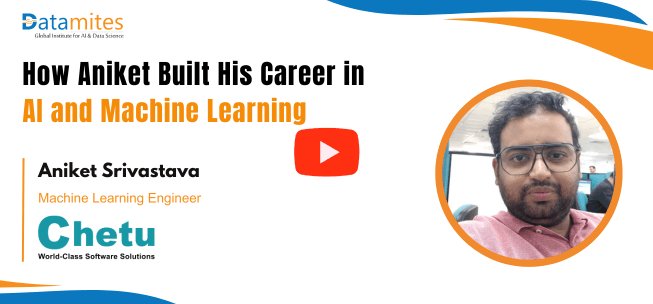
How Aniket Built His Career in AI and Machine Learning
Aniket’s journey shows how focused learning, practical experience, and continuous skill development can shape a successful career in AI and Machine Learning. His story highlights the steps, challenges, and opportunities that helped him grow into an AI professional.
 Priyanka BR
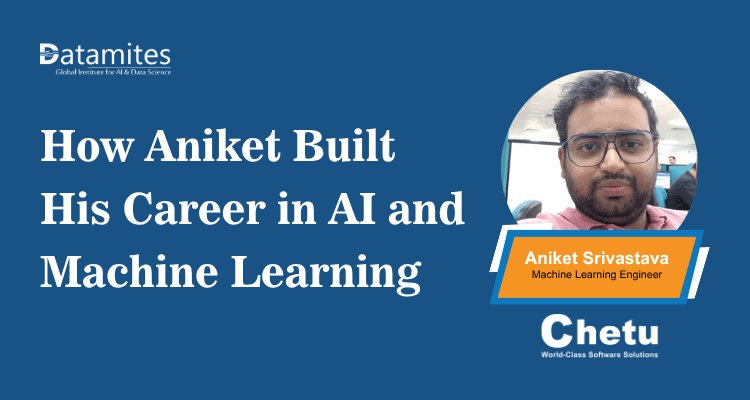
Have you ever wondered how a data analyst can gradually build expertise and transition into Machine Learning and Artificial Intelligence? Meet Aniket, a data science professional who began his career in data analysis and progressed to becoming a Machine Learning Engineer at Chetu India.
Aniket’s journey started with Excel, SQL, Power BI, and Tableau, where he developed a strong foundation in data analysis and client reporting. After gaining practical experience, he moved into classical Machine Learning and worked on projects involving algorithms such as Random Forest and K-Means clustering.
Today, Aniket is exploring Agentic AI while continuing to expand his expertise in Artificial Intelligence. In this alumni interaction, he shares his professional journey, experiences with real-world projects and clients, the importance of Exploratory Data Analysis, teamwork, and why aspiring AI professionals should follow a step-by-step approach to building their skills.
How Aniket Transitioned from Data Analysis to ML and Agentic AI
Aniket’s journey from a data analyst to a Machine Learning Engineer highlights the value of continuous learning and practical experience. His transition into Machine Learning and Agentic AI reflects his commitment to building skills in the evolving field of Artificial Intelligence.
Q1: Can you briefly introduce yourself and your professional background?
My name is Aniket Srivastava. I completed my B.Tech in 2017 from Sathyabama University, Chennai. I started my professional journey as a Junior Data Scientist at Innovative Business Solution, where I worked on more than five projects involving data analysis and client requirements. Later, I moved into a Machine Learning Engineer role at Chetu India, where I have worked on three machine learning projects and am currently involved in an Agentic AI project.
Q2: How did your journey in data science begin?
My journey began with data analysis and reporting. In my first role, I worked with Excel, pivot tables, Power BI, Tableau, and SQL to understand business data and generate useful insights. After gaining around two and a half years of experience in data analysis, I gradually moved toward classical machine learning and started working with machine learning algorithms and projects.
Q3: What kind of work did you perform as a data analyst?
As a data analyst, I was responsible for analyzing client data and preparing reports. I initially used Excel and pivot tables before moving to Power BI and Tableau. SQL was also important for extracting data from databases. The objective was to understand customer behavior, sales patterns, product performance, and other business metrics and present them clearly to clients.
Q4: How did Excel, SQL, Power BI and Tableau help you build your foundation?
These tools helped me understand data analysis and reporting. Excel supported basic analysis, SQL helped with data extraction, and Power BI and Tableau helped create clear visualizations. This foundation made my transition into machine learning easier.
Q5: Why is Exploratory Data Analysis important in a data science project?
EDA helps understand the dataset, identify patterns and missing values, and choose the right machine learning algorithm based on the business requirement.
Q6: How does data analysis support machine learning?
Data analysis helps identify patterns, customer behavior, and trends, which provide the right input for building accurate machine learning models.
Q7: What type of customer analysis have you worked on?
I have worked on customer purchasing behavior and churn analysis. This involved identifying regular customers, customers who stopped purchasing, and possible reasons for customer churn.
Q8: How did you communicate your findings to clients?
Client communication was an important part of my role. Clients could request weekly or monthly reports related to sales, future expectations, customer behavior, or product performance. I learned that reports need to be clear, structured, and easy to understand. Good data visualization combined with meaningful insights and recommendations can reduce confusion and help clients understand the findings more effectively.
Q9: What did you learn from your first client interaction?
I learned that simply presenting data is not enough. Reports should include clear insights, observations, and recommendations so clients can easily understand the findings and make informed decisions.
Q10: How should a data analyst structure a business report?
A business report should follow a clear sequence, starting with product or customer counts, followed by sales, revenue, customer behavior, and churn analysis. It should conclude with key findings and practical recommendations.
Q11: Why are recommendations important in data analysis?
Recommendations convert analysis into actionable business information. A client may understand that customer churn is increasing, but they also need to know what could be causing the problem and what actions can be considered. Therefore, a strong data analysis project should not stop at graphs and statistics. It should identify important observations and, where appropriate, provide recommendations based on the available data.
Q12: What was your experience working with different team members?
Teamwork involves understanding each member’s skills, experience, and strengths. Assigning tasks accordingly and learning from experienced teammates can help solve project challenges more effectively.
Q13: How can professionals improve their teamwork skills in data science?
Professionals can improve teamwork by first understanding their team members' skills and working styles. Once that understanding develops, tasks can be assigned according to individual strengths. It is also important to communicate openly when facing a problem. Experienced team members can often provide valuable solutions, so being comfortable asking for guidance can contribute to both project success and professional development.
Q14: What machine learning experience have you gained so far?
I have worked on three classical machine learning projects, applying different techniques to business requirements. This experience taught me the importance of data preparation, analysis, model selection, and understanding client needs.
Q15: How are changes in AI influencing your career choices?
AI is evolving rapidly, making continuous learning essential. I prefer to progress step by step, from data analysis and classical machine learning to NLP, generative AI and agentic AI, while building a strong foundation at each stage.
Q16: What advice would you give to aspiring data science professionals?
My advice is to learn data science step by step and focus on building strong fundamentals. Do not rush directly into advanced AI technologies without understanding data analysis, machine learning, and the underlying processes. Practical projects are equally important because they teach you how to handle real datasets, business requirements, client communication, and unexpected problems. Continuous learning and hands-on experience can help you become more confident in the industry.
Refer to these articles:
- Top AI Trends That Will Shape 2026
- Why Agentic AI Is the Most In-Demand Skill for Data Scientists in 2026
- Will AI Agents Replace Your Next Coworker? Exploring the Future of Work
Aniket’s Key Takeaways on Building a Career in Data Science and AI
Aniket’s journey shows how strong fundamentals, practical experience, and continuous learning can help professionals progress in Data Science, Machine Learning, and Artificial Intelligence.
- Background: Aniket completed his B.Tech in 2017 and began his career in data analysis.
- Career Journey: He progressed from data analysis to Machine Learning Engineering.
- Early Skills: He gained experience with Excel, SQL, Power BI, and Tableau.
- Data Analysis: He worked on customer behavior, sales, revenue, and churn analysis.
- Practical Experience: He worked on multiple data analysis and Machine Learning projects.
- Machine Learning: He gained experience with classical ML techniques such as Random Forest and K-Means.
- Client Interaction: He learned the importance of presenting clear insights and recommendations to clients.
- Teamwork: He emphasizes understanding team members’ skills and working collaboratively.
- Current Role: He currently works as a Machine Learning Engineer at Chetu India.
- AI Learning Path: He recommends progressing from data analysis and classical ML to NLP, Generative AI, and Agentic AI.
- Career Advice: He encourages aspiring professionals to build strong fundamentals and avoid shortcuts in Data Science.
Refer to these articles:
- How Safeer Landed His First AI Engineer Job as a Fresher
- How Kanchi Built Her Career in Artificial Intelligence and Automation
- Surender's Journey to Becoming a Senior Generative AI Manager
Aniket’s journey shows how strong fundamentals, continuous learning, and practical experience can help professionals progress in Data Science and Artificial Intelligence. He built his foundation through data analysis and gained experience with Excel, SQL, Power BI, and Tableau, before moving into Machine Learning and working on real-world projects. His journey highlights the value of practical learning for those exploring Artificial Intelligence Courses in Chennai.
DataMites Institute offers career-focused programs designed to help learners develop practical skills in Data Science, Machine Learning, and Artificial Intelligence. Through structured training, hands-on projects, expert guidance, and industry-oriented learning, learners can build knowledge in Python, Machine Learning, Deep Learning, and other emerging AI technologies.
As Artificial Intelligence continues to evolve, developing strong fundamentals and practical expertise is essential for aspiring professionals. DataMites Institute provides classroom-based Artificial Intelligence Courses in Hyderabad, Ahmedabad, Coimbatore, Bangalore, Pune, Mumbai, and Delhi, helping learners develop relevant skills and prepare for AI-driven career opportunities.