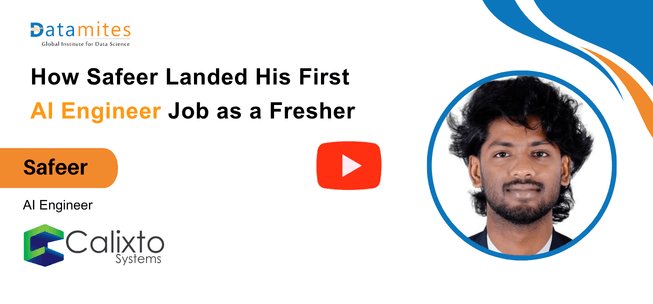
How Safeer Landed His First AI Engineer Job as a Fresher
Discover how Safeer transformed his skills, built impactful AI projects, and secured his first AI Engineer role as a fresher through consistent learning and practical experience.
 Priyanka BR
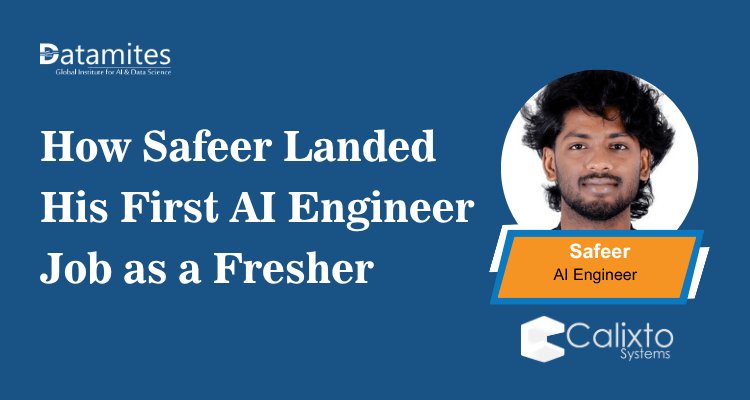
Have you ever wondered how a Computer Science graduate can land their first AI Engineer job? Meet Muhammad Safeer, who transformed his passion for Artificial Intelligence into a successful career through continuous learning, hands-on projects, and determination.
Although Safeer had a foundation in Machine Learning, he faced challenges while learning Data Science and statistics. With consistent practice, real-world projects, and mock interviews, he developed the practical skills and confidence needed to succeed.
If you're an aspiring AI Engineer, Safeer's journey shows how structured training, project experience, and interview preparation can help you secure your first job in the rapidly growing field of Artificial Intelligence.
How Safeer Started His AI Engineer Career with DataMites
Muhammad Safeer's journey from a Computer Science graduate to an AI Engineer highlights how continuous learning, hands-on projects, and perseverance can lead to a successful career in Artificial Intelligence. His story offers valuable insights and practical advice for freshers aiming to secure their first Artificial Intelligence job.
Q1. Could you please introduce yourself?
My name is Safeer. I completed my Bachelor of Technology in Computer Science and Engineering from Kerala Technological University. After graduation, I pursued a certification course in Data Science, where I learned both theoretical concepts and practical implementation through hands-on projects. Later, with the guidance of mentors and placement support, I secured a position as an AI Engineer at Calixto Systems.
Q2. Why did you choose to learn Data Science after completing Computer Science Engineering?
Although I had a Computer Science background and some exposure to Machine Learning during college, I wanted to gain deeper practical knowledge. The certification course helped me understand Data Science concepts thoroughly while providing hands-on experience through real-world projects.
Q3. Did your Computer Science background help you learn Machine Learning?
Yes. During my engineering studies, I completed several Machine Learning projects, so I already understood the basics. However, Data Science introduced many new concepts, especially in statistics, which were completely new to me.
Q4. Was learning statistics difficult?
Initially, statistics was challenging because I had very little understanding of its importance in Data Science. Over time, by studying consistently and practicing regularly, I gradually understood the concepts and realized how essential statistics is for building Machine Learning models.
Q5. How important is statistics in Machine Learning and Data Science?
Statistics forms the foundation of AI and Data Science. Many Machine Learning algorithms depend on statistical principles, making it essential for understanding data patterns, model performance, and prediction accuracy.
Q6. Did you continue learning Artificial Intelligence after completing Data Science?
Yes. After completing the Data Science course and several practical projects, I enrolled in an AI Engineer course. This allowed me to move into more advanced topics, including Deep Learning and Artificial Intelligence applications.
Q7. Which AI domain interests you the most?
I enjoy both Computer Vision and Natural Language Processing (NLP). Currently, my professional role focuses mainly on Computer Vision, but I remain interested in exploring both domains.
Q8. What was your interview process like?
The recruitment process consisted of two interview rounds. The first round focused heavily on one of my Computer Vision projects. The interviewers asked about the models I used, the project workflow, and the technical decisions behind the implementation.
During the second round, they discussed the same project in greater depth and presented several practical use cases, asking how I would approach solving those problems.
Q9. How important were your projects during the interview?
Projects played a major role. Most interview questions revolved around my project work rather than only theoretical concepts. Since I understood every stage of my projects thoroughly, I was able to explain my work confidently.
Q10. Did you complete your projects individually or in a team?
I completed all my Data Science and Artificial Intelligence projects individually. Working independently helped me gain complete ownership of every project, from planning and development to implementation and evaluation.
Q11. How helpful were mock interviews in your placement preparation?
Mock interviews were extremely valuable. During my first mock interview, I was very nervous and struggled to answer questions confidently. I improved during the second mock interview and successfully cleared the third one. Each mock interview introduced different technical and behavioral questions, allowing me to prepare comprehensively for the actual interview.
Q12. What study routine helped you prepare for AI and Deep Learning?
In the beginning, I studied for around four to five hours every day to build a strong understanding of Deep Learning concepts using multiple learning resources. After completing each topic, I spent one to two hours daily revising concepts and working on small practical projects, such as experimenting with different models and tuning their performance.
Q13. How many interviews did you attend before getting selected?
This was my third client interview. Each interview helped me understand employer expectations better and improved my confidence for the next opportunity.
Q14. What advice would you give to freshers preparing for AI careers?
Focus on building strong fundamentals, especially in Machine Learning, Deep Learning, and statistics. Practice consistently, work on real projects, revise concepts regularly, and understand every project thoroughly. Practical knowledge combined with consistent preparation significantly improves interview performance.
Refer to these articles:
- Supervised vs. Unsupervised Learning: What’s the Difference?
- Generative AI and Predictive AI: Key Differences Explained
- What is Artificial Narrow Intelligence?
Safeer's Key Takeaways on Starting a Career in AI
Safeer's journey demonstrates how continuous learning, practical experience, and persistence can help fresh graduates launch a successful career in Artificial Intelligence.
- Academic Foundation: He earned his B.Tech in Computer Science and Engineering from Kerala Technological University.
- Upskilling for AI: After graduation, he enrolled in Data Science and AI certification programs to gain industry-focused knowledge.
- Learning Beyond Theory: The transition introduced him to advanced topics like statistics, deep learning, and AI, expanding his technical expertise.
- Building Practical Skills: By completing individual AI and Data Science projects, he developed confidence in applying concepts to real-world problems.
- Growing Through Challenges: Instead of being discouraged by difficult subjects like statistics, he improved through regular practice and revision.
- Interview Preparation: Repeated mock interviews helped him overcome nervousness and sharpen his technical communication skills.
- Standing Out in Interviews: His ability to clearly explain project workflows, model selection, and problem-solving approaches impressed interviewers.
- Learning Discipline: A consistent study schedule, daily revision, and continuous experimentation helped reinforce his understanding of AI concepts.
- Career Milestone: His dedication paid off when he secured his first role as an AI Engineer at Calixto Systems, specializing in Computer Vision.
- Long-Term Vision: He plans to deepen his industry expertise, grow into a Senior AI Engineer, and eventually take on leadership responsibilities.
- Message to Freshers: Focus on understanding concepts instead of memorizing them, build meaningful projects, and keep improving through practice.
- Success Formula: Safeer's story proves that structured learning, perseverance, and hands-on experience are the key ingredients for launching a successful AI career.
Refer to these articles:
- How Lakshmi Secured Her First Python Developer Job as a Fresher
- How Surya Started His AI Developer Career as a Fresher
- From Fresher to Python Developer: Amit’s Inspiring Career Journey
Muhammad Safeer's journey shows how strong fundamentals and practical learning can lead to a successful AI career. With the growing demand for IT courses and AI professionals, DataMites equipped him with industry-ready skills, helping him secure his first AI Engineer role with confidence.
DataMites Institute offers a 9-month Artificial Intelligence program featuring specialized learning paths, including AI Engineer, Artificial Intelligence Expert, AI for Managers, AI Foundation, and Certified NLP Professional. With hands-on projects, industry-focused training, and globally recognized IABAC and NASSCOM FutureSkills certifications, the program prepares learners for successful careers in Artificial Intelligence.
With 40+ offline training centers across India, DataMites Institute offers industry-focused Artificial Intelligence programs in major cities. Learners in Karnataka can enroll in the Artificial Intelligence Course in Bangalore, with training centers located in Kudlu Gate, BTM Layout, Marathahalli, and Rajajinagar, gaining practical experience through live projects, hands-on learning, and expert mentorship.
As Artificial Intelligence continues to transform businesses across industries, the demand for skilled professionals with practical AI expertise is growing rapidly. DataMites provides industry-focused learning opportunities through Artificial Intelligence courses in Pune, Coimbatore, Hyderabad, Chennai, Mumbai, Ahmedabad, and Delhi, helping learners develop career-ready skills with hands-on training, real-world projects, and practical AI applications.