How Did Jayanth Transition into an AI & ML Engineer Career?
Jayanth’s journey from learning AI and Machine Learning fundamentals to becoming an AI & ML Engineer highlights the importance of practical skills, hands-on projects, and continuous learning in building a successful career in artificial intelligence.
 Priyanka BR
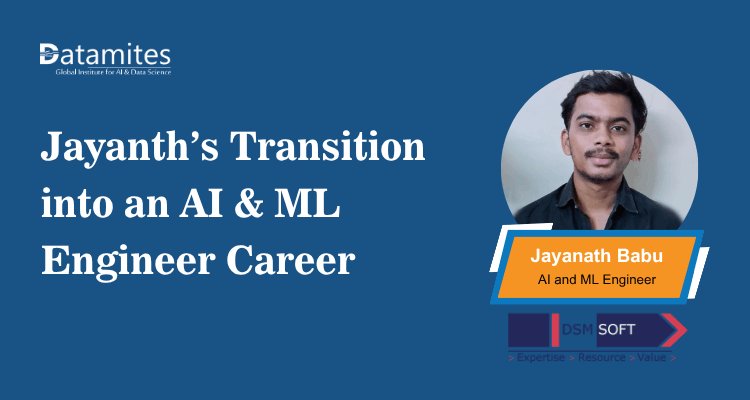
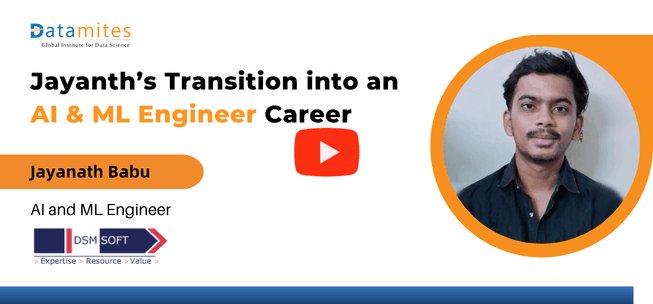
Have you ever wondered how a Statistics graduate with limited technical exposure can build a career in AI and Machine Learning? Meet Jayanth, who turned his interest in technology into a career through practical learning, mentorship, and consistent effort. Despite limited coding experience and a career gap, he kept learning and improving through interviews and hands-on projects.
His experience with DataMites training and internship helped him explore technologies such as RAG, LLMs, and vector databases. Today, Jayanth works as an AI/ML Specialist at DSM Soft, contributing to geospatial, text extraction, AI, and automation projects. His journey proves that with the right guidance, practical exposure, and learning mindset, a strong AI career is possible.
How DataMites Played a Role in Jayanth’s Journey to Becoming an AI/ML Engineer
This Q&A highlights Jayanth’s journey from a Statistics graduate with limited technical exposure to becoming an AI/ML Engineer. He shares his experience with DataMites training, mentor guidance, practical projects, interview preparation, and continuous learning. His journey also shows how he handled a career gap and adapted to new AI, database, Linux, and geospatial technologies after entering the industry.
1. Can you briefly introduce yourself?
My name is Jayanth. I completed my graduation in Statistics and had limited technical exposure when I started learning data science. After joining DataMites, I developed my technical skills with mentor support and practical learning. After completing my course, I faced a career gap and initially worked as a Recruitment Analyst. Later, I joined DSM Soft as an AI/ML Specialist, where I currently work in the geospatial and text extraction domain.
2. Why did you choose Data Science and AI after completing your Statistics degree?
I chose Data Science and AI because my Statistics background created an interest in working with data. I wanted to move into a technical career, so I decided to strengthen my skills through structured learning. DataMites helped me understand data science concepts and gain practical exposure.
3. How was your learning experience at DataMites Institute?
My learning experience at DataMites Institute was very helpful. Since I came from a Statistics background, many technical concepts were new to me. My mentors explained the topics clearly and patiently answered my questions whenever I needed help. Their guidance gave me confidence to continue learning.
4. How did you learn Python and coding without a technical background?
I learned Python through mentor guidance and regular practice. After my training sessions, I practiced coding problems at my PG and worked on LeetCode questions. I also practiced interview questions regularly. This hands-on practice helped me become more comfortable with coding.
5. How did you handle the career gap after completing your course?
I used the career gap to understand and improve my weak areas. I attended several interviews and observed the concepts I was struggling with. Instead of only attending more interviews, I decided to work on a practical project to strengthen my skills and gain more confidence.
6. Why did you decide to work on a practical project during your career gap?
I wanted to do more than just write code and learn concepts. I wanted to solve a real business problem using AI. So, I started an agriculture related project focused on empowering farmers. I used datasets from Kaggle and information collected through agriculture related contacts to develop the idea.
7. How did your project help you during your AI/ML interview?
My project helped me explain my practical knowledge during the interview. The interviewers asked why I created the project, how it was different from existing applications, and what business problem it solved. I explained my use of Retrieval-Augmented Generation (RAG) and LLMs and how local language support could benefit farmers.
8. What AI technologies did you discuss during your interview?
I discussed RAG, LLMs, vector databases, and AI based automation during my interview. I explained how I used these concepts in my project and how they could support the overall solution. The project helped me discuss these technologies with practical examples.
9. How important were projects in strengthening your resume?
Projects were very important for strengthening my resume. After facing several rejections, I realized that practical experience could give me an advantage. Working on a business problem helped me demonstrate my problem solving ability and gave me strong points to discuss during interviews.
10. How did you learn technologies that were completely new to you?
I started by researching the technology and understanding its basic concepts. In one of my projects, I worked on text extraction and explored a new model. I spent time understanding how it worked, how to integrate it, and how to move it toward production and automation.
11. What tools are you currently working with?
I currently work with Linux, PostgreSQL, QGIS, and technologies related to text extraction and AI. Some of these tools were completely new to me when I joined the organization. Learning them has helped me understand how different industry requirements can be from classroom learning.
12. How important is hands-on practice for becoming an AI/ML professional?
Hands-on practice is very important because it helps me understand how theoretical concepts work in real situations. I practiced coding regularly and worked on projects to strengthen my knowledge. This experience also helped me explain my skills more confidently during interviews.
13. What qualities should companies look for when hiring AI/ML professionals?
I believe companies should look for technical knowledge along with a willingness to learn. Candidates should be curious, ready to research new technologies, and capable of understanding business requirements. Knowing everything from day one is not necessary, but having the right learning attitude is important.
14. What is the biggest lesson you learned from your AI/ML journey?
The biggest lesson I learned is that I should never stop learning. I started with a Statistics background and limited technical exposure, but I gradually improved through mentoring, practice, projects, and interviews. My journey taught me to stay consistent, learn from rejections, and keep improving my skills.
Refer to these articles:
- Generative Adversarial Networks (GANs): How are GANs Transforming AI?
- Learn about the Types of Machine Learning Algorithms
- What is a Confusion Matrix in Machine Learning?
Jayanth’s Key Takeaways on Building a Career in AI and Machine Learning
His journey highlights how mentorship, practical learning, consistent effort, and continuous skill development can help build a career in Artificial Intelligence and Machine Learning.
- Background: Jayanth holds a degree in Statistics and initially had limited technical and coding exposure.
- Career Goal: He wanted to transition from Statistics into the growing fields of Artificial Intelligence and Machine Learning.
- Training Choice: He joined DataMites to build structured knowledge in data science, AI, and related technical concepts.
- Mentorship Impact: DataMites mentors patiently guided him, cleared his doubts, and helped him gain confidence.
- Coding Development: He improved his Python and coding skills through regular practice, LeetCode, and interview questions.
- Career Challenge: After completing his course, he faced a career gap and used multiple interviews to identify and improve his weak areas.
- Practical Learning: He focused on practical projects to strengthen his skills beyond theoretical concepts and coding exercises.
- Agriculture Project: He developed an AI-based agriculture project using RAG, LLMs, and vector databases to make useful information more accessible to farmers.
- Resume Advantage: His projects and DataMites internship experience helped demonstrate his practical knowledge during interviews.
- Career Breakthrough: He eventually joined DSM Soft as an AI/ML Specialist, working in areas such as geospatial technology, text extraction, AI, and automation.
- Continuous Learning: He learned new industry tools such as Linux, PostgreSQL, and QGIS after entering the professional environment.
- Advice for Learners: Jayanth encourages aspiring AI professionals to practice consistently, work on real-world projects, learn from challenges, and maintain a continuous learning mindset.
Jayanth joined DataMites to transition from Statistics into Artificial Intelligence and Machine Learning. Exploring the best IT courses helped him gain practical exposure to Python, AI, machine learning, and real-world projects. His internship and agriculture-focused project using RAG, LLMs, and vector databases strengthened his skills. With mentor guidance and consistent practice, he built confidence and began his career as an AI/ML Specialist.
Refer to these articles:
- How Aniket Built His Career in AI and Machine Learning
- Surender's Journey to Becoming a Senior Generative AI Manager
- Vishal’s Journey to Becoming a Senior Machine Learning Engineer
DataMites Training Institute provides practical AI and Machine Learning training across Bangalore, Hyderabad, Pune, Chennai, Ahmedabad, Coimbatore, Mumbai, and Delhi, covering Python, AI concepts, real-world projects, RAG, and LLMs. The programs also offer IABAC and NASSCOM FutureSkills certifications, along with mentor guidance, internship exposure, and career-focused learning. Jayanth’s journey from a Statistics graduate to an AI/ML Specialist reflects the value of structured training, hands-on practice, and continuous learning.
Students and professionals in Maharashtra can enroll at DataMites for an artificial intelligence course in Pune. DataMites has two branches in Pune, located in Baner and Kharadi, offering classroom training with hands-on learning, industry-focused projects, mentor guidance, and career support to help learners build practical AI skills and prepare for professional opportunities.
Students and professionals can explore artificial intelligence courses in Delhi to develop practical skills in Python, machine learning, deep learning, and real-world AI applications. With hands-on projects, expert mentorship, internship exposure, and career-focused training, learners can build industry-relevant knowledge and prepare for opportunities in the growing field of Artificial Intelligence.