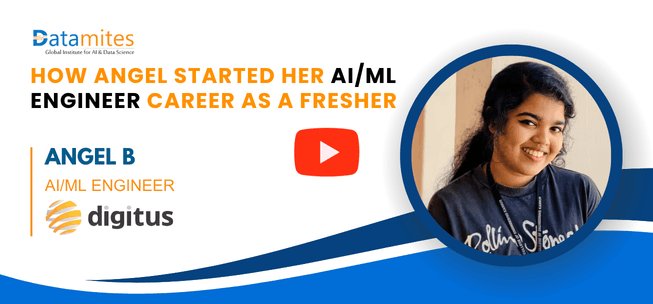
How Angel Started Her AI/ML Engineer Career as a Fresher
Angel's journey from a fresher to an AI/ML Engineer highlights how dedication, practical learning, and hands-on projects can open doors to a successful career in artificial intelligence. Discover how she built industry-ready skills and secured her first AI/ML role with confidence.
 Priyanka BR
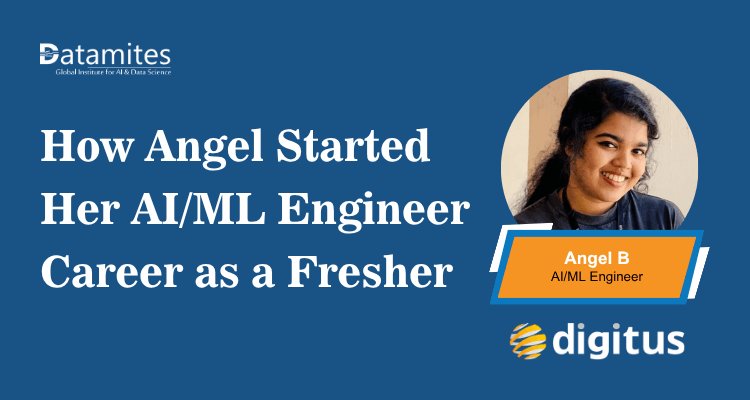
Breaking into the Artificial Intelligence industry can seem challenging, especially for fresh graduates looking to build a career in one of the fastest-growing technology domains. Angel's inspiring journey proves that with the right learning approach, hands-on projects, consistent practice, and interview preparation, securing an AI role is achievable. A Computer Science and Engineering graduate from Kerala, Angel strengthened her technical skills through an Artificial Intelligence Engineer program and successfully earned an AI/ML Engineer position at Digitus Business Solutions. In this interview, she shares her learning experience, project work, interview process, placement preparation, and practical advice for aspiring AI professionals who want to build a successful career in Artificial Intelligence and Machine Learning.
How Angel Started Her AI/ML Engineer Career with DataMites
Angel's journey from a Computer Science graduate to an AI/ML Engineer shows how consistent learning, hands-on projects, and expert mentorship can help freshers build a successful career in Artificial Intelligence with the right training and guidance.
1. Could you introduce yourself to our readers?
My name is Angel, and I'm from Kerala. I completed my Computer Science and Engineering degree in 2023. After graduation, I wanted to build my career in Artificial Intelligence, so I enrolled in an AI Engineer program. Recently, I got placed as an AI/ML Engineer at Digitus Business Solutions, and I'm really excited to begin my professional journey in the AI domain.
2. Could you tell us about your current role?
Thank you. I have been selected as an AI/ML Engineer, and my role will involve working on Machine Learning models and AI solutions. Since many organizations are now deploying AI applications into production, I'm looking forward to working on real-world AI projects and gaining hands-on industry experience.
3. What made you choose Artificial Intelligence after engineering?
After completing my Computer Science degree, I knew I wanted to continue my career in the AI and Machine Learning domain. Artificial Intelligence is evolving rapidly, and I wanted to build skills that are relevant to the future. That's why I decided to pursue specialized training and prepare myself for AI-related roles.
4. Since you come from a Computer Science background, did it help during your learning journey?
Yes, definitely. My Computer Science background gave me a good understanding of programming, especially Python and coding fundamentals. At the same time, my AI learning journey helped me strengthen concepts like statistics, Machine Learning algorithms, and practical implementation, which became very useful during interviews.
5. Which technical skills helped you the most during your interview?
Python and SQL helped me a lot throughout the interview process. Since I was already comfortable with programming, I could focus on solving technical problems and answering coding-related questions confidently. These skills played a major role in helping me perform well.
6. What kind of questions were you asked during your AI/ML interview?
Most of the questions were based on the projects I had mentioned in my resume. Apart from that, I was asked about Machine Learning algorithms, Python, SQL, Large Language Models, Natural Language Processing, and whether I was interested in working on Generative AI-related projects. The interviewers mainly wanted to understand my practical knowledge rather than just theoretical concepts.
7. Did the interviewers focus more on projects than theory?
Yes, they did. They went into detail about every project mentioned in my resume. They asked why I chose certain algorithms, how I prepared the data, what challenges I faced, how I evaluated the models, and how I would deploy those projects in a real-world environment. So, understanding your own projects thoroughly is extremely important.
8. Could you share some of the projects you included in your resume?
I included several Data Science projects such as Car Price Prediction, Customer Transaction Prediction, Finance Analytics, Gaming Analytics, and Healthcare projects. I had also worked on AI projects like Pneumonia Classification, Dog Breed Classification, Indian Sign Language Recognition, Recommendation Systems, and Emotion Detection, which helped demonstrate my practical experience.
9. How did you prepare your resume for interviews?
Initially, I had created my own resume, but the placement team helped me improve it significantly. They advised me to explain every project in more detail instead of writing only one or two lines. They also suggested mentioning the technologies, algorithms, and skills used in each project, which made my resume much stronger.
10. Which technical topics should freshers prepare before attending AI interviews?
I would recommend building strong fundamentals in Python, SQL, Machine Learning algorithms, DataFrames, feature engineering, deployment concepts, and model evaluation techniques. Interviewers usually begin with basic questions and gradually move toward advanced discussions, so having clear fundamentals makes a big difference.
11. Between Python and SQL, which one is more important for an AI Engineer?
Both are important, but I feel Python carries slightly more importance because it is used throughout the AI workflow, including model building, training, deployment, and automation. However, SQL is equally important for handling data, so both skills should be developed together.
12. Apart from your course, what resources did you use to continue learning?
I regularly watched Krish Naik's YouTube videos, explored GitHub repositories, read Medium articles, practiced using Kaggle datasets, and maintained my own notes. These resources helped me revise concepts, build projects independently, and stay updated with the latest developments in AI.
13. How helpful were the mock interviews during your placement preparation?
Mock interviews were extremely valuable because they gave me confidence before attending actual company interviews. They helped me understand the interview pattern, identify areas where I needed improvement, and prepare for frequently asked technical questions. The feedback I received made a noticeable difference in my performance.
14. What advice would you give to students who are preparing for AI interviews?
My biggest advice is to understand every project you mention in your resume because interviewers will definitely ask about it. Focus on strengthening Python, SQL, and Machine Learning fundamentals, practice coding regularly, and stay updated with emerging technologies like Generative AI, NLP, and Computer Vision. Consistent practice is much more valuable than simply completing multiple courses.
15. Many students worry that AI will replace programming jobs. What is your opinion?
I don't think AI will replace skilled professionals. Instead, I believe AI will change the way we work. We should learn how to use AI tools effectively, understand the logic behind them, and continuously update ourselves with new technologies. Those who keep learning will always have opportunities in this field.
16. Where do you see yourself in the next five years?
I see myself continuing my career in Artificial Intelligence while specializing in exciting areas like Generative AI, Computer Vision, and Natural Language Processing. I also hope to grow into a leadership role where I can manage projects, mentor team members, and contribute to building innovative AI solutions.
Refer to these articles:
- What is a Confusion Matrix in Machine Learning?
- Supervised vs. Unsupervised Learning: What’s the Difference?
- Generative AI and Predictive AI: Key Differences Explained
Angel’s Key Takeaways on Becoming an AI/ML Engineer
Angel’s journey shows that strong fundamentals, practical projects, and consistent preparation can help fresh graduates build a successful career in Artificial Intelligence.
- Background: Completed Computer Science and Engineering in 2023 and specialized in Artificial Intelligence.
- Career Start: Secured an AI/ML Engineer role at Digital Business Solution.
- Core Skills: Built strong expertise in Python, SQL, Machine Learning, and AI fundamentals.
- Projects: Completed multiple Data Science, AI, and client projects across different domains.
- Resume: Improved project descriptions with placement team guidance to increase interview shortlisting.
- Interview Preparation: Focused on Python, SQL, Machine Learning, deployment, and project-based learning.
- Mock Interviews: Gained confidence and improved technical communication through mock interviews.
- Learning Resources: Used YouTube, GitHub, Medium, Kaggle, and personal notes for continuous learning.
- Key Advice: Understand every project thoroughly and strengthen your technical fundamentals.
- Career Goal: Plans to specialize in Generative AI, NLP, and Computer Vision while growing into a leadership role.
- Outcome: Consistent learning and practical experience helped her successfully launch her career as an AI/ML Engineer.
Angel's journey shows that success in Artificial Intelligence comes from consistent learning, hands-on projects, and strong technical fundamentals. Her experience proves that with the right guidance, practical exposure, and persistence, fresh graduates can build rewarding AI careers. For aspiring professionals exploring the Top IT courses, an industry-focused AI program can be the ideal first step toward a successful future in technology.
Refer to these articles:
- How Safeer Landed His First AI Engineer Job as a Fresher
- How Kanchi Built Her Career in Artificial Intelligence and Automation
- Surender's Journey to Becoming a Senior Generative AI Manager
If you're looking to build a career in Artificial Intelligence like Angel, DataMites offers industry-focused AI training with hands-on projects, expert mentorship, mock interviews, resume support, and placement assistance. The program helps learners develop practical AI and Machine Learning skills required to succeed in today's competitive job market.
DataMites Institute also offers comprehensive Artificial Intelligence Courses in Bangalore, Mumbai, Pune, Ahmedabad, Chennai, Coimbatore, and Hyderabad. The program covers Python, Machine Learning, Deep Learning, Data Analytics, Generative AI, and other in-demand technologies through hands-on projects, expert mentorship, and dedicated placement support. Learners also earn globally recognized certifications from IABAC and NASSCOM FutureSkills, helping them enhance their credibility and prepare for successful careers in the rapidly growing AI industry.
Learners from Kerala who prefer classroom training can enroll at the DataMites Kochi Center, where they can gain hands-on experience through expert-led classroom sessions, real-world projects, internship opportunities, mock interviews, resume-building support, and dedicated placement assistance. The Kochi center provides aspiring AI professionals with practical skills and career guidance to confidently begin their journey in Artificial Intelligence and Machine Learning.