How AI Is Creating New Roles in Human Resources
AI is creating new roles in human resources by transforming recruitment, employee engagement, workforce analytics, and HR automation. Explore emerging AI in HR careers, key skills, and how professionals can prepare for these opportunities.
 Prerana B A
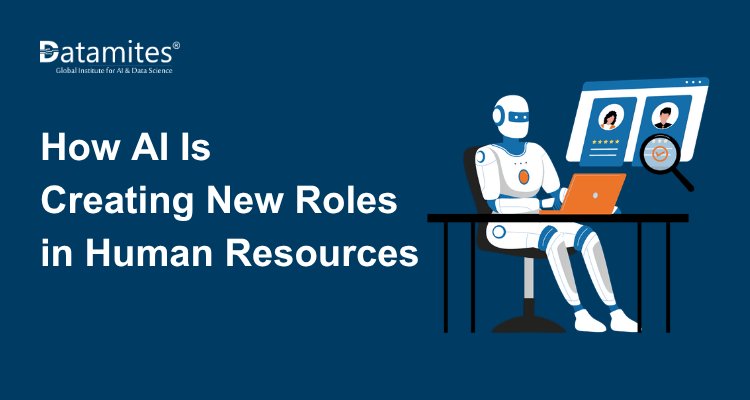
Artificial intelligence is changing how organizations recruit employees, manage workforce data, improve employee experiences, and plan training. As businesses adopt AI-powered tools, HR professionals are taking on responsibilities that combine human resource management, data analysis, automation, and technology.
AI in human resources is creating opportunities in people analytics, AI-assisted recruitment, HR automation, and responsible AI governance. While some organizations are developing specialized positions, others are incorporating AI-related responsibilities into existing HR roles.
For HR professionals, fresh graduates, and career switchers, developing practical AI for HR skills can help prepare them for evolving career opportunities.
How Is AI Changing the HR Industry?
AI helps HR teams process information, identify patterns, and manage repetitive tasks. In recruitment, AI tools can help organize applications and draft job descriptions. Employee support assistants can answer routine questions about company policies, while people analytics tools help identify workforce trends and skill gaps.
AI also supports personalized learning recommendations, employee onboarding, and administrative automation. For example, an HR team could use AI to prepare onboarding documents and automate reminders for new employees. HR professionals must still verify the information and protect employee data.
According to SHRM's The State of AI in HR 2026, published in March 2026, research involving 1,908 HR professionals examined AI adoption and its effects on HR responsibilities. The findings highlight the importance of understanding how AI tools can support HR operations while maintaining appropriate human oversight.
These applications create opportunities for professionals who can connect HR requirements with suitable AI solutions.
Refer to these articles:
- AI for Doctors: Transforming Patient Care
- AI in Marketing Funnel Analysis for Effective Decision-Making
- Top AI Product Manager Trends Shaping 2030
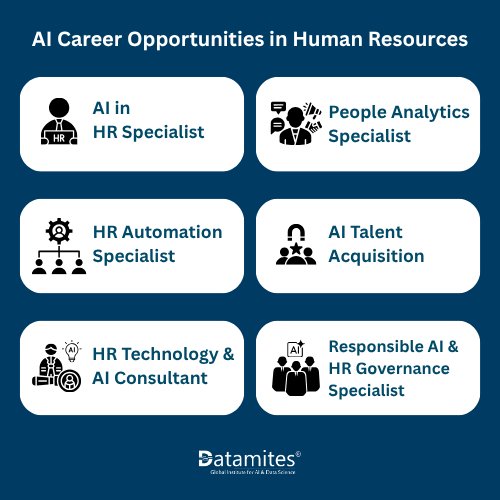
AI Career Opportunities in Human Resources
AI adoption is creating new responsibilities across recruitment, analytics, automation, and workforce management. Some roles are established HR technology positions, while others are emerging specializations. Job titles and responsibilities vary between organizations.
AI in HR Specialist
An AI in HR specialist helps HR teams introduce and manage AI tools across recruitment, onboarding, employee support, and workforce management. Key skills include HR fundamentals, generative AI tools, prompt writing, and workflow design.
People Analytics Specialist
People analytics specialists analyse workforce data to understand employee engagement, retention, performance, and skill gaps. They help HR managers make informed decisions about workforce planning and employee development. Useful skills include Excel, SQL, statistics, and dashboard reporting.
HR Automation Specialist
HR automation specialists identify repetitive tasks and develop workflows that reduce manual effort. Examples include automating onboarding notifications, document management, and employee reminders. Knowledge of HR information systems and automation platforms is valuable.
AI Talent Acquisition Specialist
AI talent acquisition specialists use AI-assisted recruitment tools to support candidate sourcing, job descriptions, applicant tracking, and recruitment reporting. Relevant skills include recruitment, applicant tracking systems, and bias awareness.
HR Technology and AI Consultant
HR technology and AI consultants help organizations evaluate HR software, select appropriate AI solutions, integrate systems, and train employees. This role benefits from HR knowledge, project management, and technology evaluation skills.
Responsible AI and HR Governance Specialist
This emerging specialization focuses on the fair and responsible use of AI in employment decisions. Responsibilities may include reviewing potential bias, assessing risks, and supporting compliance. Relevant skills include data privacy, AI ethics, and risk assessment.
According to SHRM, 24% of surveyed organizations reported creating new roles following AI implementation, while 39% reported changes in job responsibilities. These findings indicate that AI can reshape responsibilities and create specialized opportunities, although they do not establish a specific growth rate for AI-related HR jobs.
Skills Required for AI Careers in HR
Building a career in AI for HR requires a combination of HR knowledge, technical proficiency, and analytical thinking. As organizations adopt AI-powered tools, professionals need to use these technologies effectively while maintaining employee trust and data privacy. The following skills can help HR professionals, fresh graduates, and career switchers prepare for emerging opportunities in AI-driven human resource management.
- HR Fundamentals: Understand recruitment, onboarding, employee engagement, performance management, and workforce planning.
- Generative AI and Prompt Writing: Use AI tools in HR to draft job descriptions, summarize HR policies, and support routine tasks.
- Data Analysis: Interpret workforce data to identify employee trends, skill gaps, and retention patterns.
- Excel and Dashboard Reporting: Organize HR data and present insights through reports and visualizations.
- HR Technology and Automation: Understand HR information systems and automation tools to simplify repetitive workflows.
- Data Privacy and AI Ethics: Protect employee information, recognize potential bias, and promote responsible AI use.
- Communication and Critical Thinking: Evaluate AI-generated recommendations, communicate findings, and make informed decisions.
- Change Management: Help HR teams and employees adapt to new AI tools and workplace processes.
According to the World Economic Forum's Future of Jobs Report, 39% of workers' core skills are expected to change by 2030, highlighting the importance of continuous learning and adapting to emerging technologies.
Challenges and Responsible Use of AI in HR
Although AI can improve HR efficiency, its use also brings challenges related to data privacy, algorithmic bias, transparency, and employee trust. HR professionals need to understand these risks before using AI for recruitment, performance reviews, or workforce planning.
Key considerations include:
- Data privacy: Protect sensitive employee information and follow applicable data protection requirements.
- Bias and fairness: Regularly review AI-generated recommendations to identify potential bias in hiring and employee evaluations.
- Human oversight: Keep HR professionals involved in important decisions rather than relying entirely on automated outputs.
- Transparency: Explain how AI tools are used in HR processes and communicate their limitations to employees.
- Responsible implementation: Evaluate AI tools for accuracy, security, and suitability before introducing them into HR workflows.
As AI adoption grows, HR professionals who understand responsible AI practices can help organizations balance technological efficiency with fairness and employee well-being.
Refer to these articles:
- Why Agentic AI Is the Most In-Demand Skill for Data Scientists in 2026
- LLM Fine-Tuning vs Prompt Engineering: Which Is Better?
- Top AI Trends That Will Shape 2026
How to Prepare for an AI Career in HR
Building a career in AI for HR requires a combination of HR knowledge, AI skills, and data analysis. HR professionals, fresh graduates, and career switchers can prepare for these roles by following a few steps:
- Learn HR fundamentals: Understand recruitment, employee engagement, and workforce planning.
- Develop AI skills: Explore generative AI tools and HR automation.
- Build analytical skills: Learn Excel, dashboards, and people analytics.
- Gain practical experience: Work on projects involving recruitment and workforce data.
- Learn responsible AI: Understand data privacy, fairness, and human oversight.
A specialised AI for HR and People Analytics course can help learners develop these skills through structured training and practical projects.
LinkedIn's Workplace Learning Report found that 71% of learning and development professionals were exploring, experimenting with, or integrating AI into their work. This finding highlights the relevance of AI skills in employee training and development. Beginners can practise with sample data, while working HR professionals can apply these skills to existing responsibilities without exposing confidential employee information.
AI in human resources is changing how organizations recruit, develop, support, and manage employees. It is also creating opportunities in people analytics, HR automation, AI-assisted recruitment, HR technology consulting, and responsible AI governance.
These changes do not guarantee more jobs or eliminate the need for traditional HR expertise. However, professionals who combine HR knowledge with practical AI skills, analytical thinking, and ethical judgment can better prepare for evolving career opportunities.
DataMites Institute offers an industry-focused AI for HR and People Analytics course that helps HR professionals use artificial intelligence to make smarter, data-driven workforce decisions. The program covers AI fundamentals, people analytics, and practical applications in talent acquisition, employee engagement, workforce planning, and performance management. DataMites also offers AI programs for product managers, healthcare professionals, finance and risk experts, marketing professionals, business leaders, and other working professionals across industries.
Learners can choose flexible learning options, including online classes, classroom training, and real-time, project-based internships to gain practical experience. This AI for HR course also offers globally recognized certifications, including IABAC-accredited certification and the Certified AI Professional in People Analytics certification.
With more than 50+ offline centres across India, DataMites provides career-oriented training in classroom and virtual formats. Its centres include locations in Chennai, Bangalore, Hyderabad, Pune, Mumbai, Ahmedabad, Coimbatore, and Delhi.