How to Use AI for Customer Segmentation: Types, Methods, Benefits & Guide
Learn how AI customer segmentation works, explore its types and algorithms, understand its benefits, and discover practical steps to implement it responsibly.
 Kriti Maurya
Understanding customer needs is essential for businesses that want to improve marketing performance, increase customer retention, and deliver more relevant experiences. However, as customer interactions expand across websites, mobile applications, social media, e-commerce platforms, and subscription services, identifying meaningful patterns can become increasingly complex.
Traditional customer segmentation typically relies on predefined rules, such as age groups, geographic locations, purchase frequency, or spending levels. These methods remain useful, but they may struggle to capture complex relationships between customer characteristics and changing behavior.
AI customer segmentation uses artificial intelligence (AI) and machine learning to identify patterns in customer data and group customers according to shared characteristics, preferences, behaviors, or predicted outcomes. These insights can help businesses develop targeted marketing campaigns, improve customer experiences, and make more informed decisions.
For example, an online retailer might distinguish between frequent buyers, customers who browse products without purchasing, and customers whose purchasing activity has declined. The business can then test different strategies for each group instead of sending identical promotions to everyone. According to Statista, the global AI in marketing market was projected to reach $47 billion in 2025 and exceed $107 billion by 2028, reflecting the rapid adoption of AI-driven marketing solutions and their growing influence across industries.
This guide explains the main types of customer segmentation, how AI-powered methods work, their business benefits, practical applications, and the steps organizations can follow to implement customer segmentation responsibly.
What Is AI Customer Segmentation?
AI customer segmentation is the process of using AI techniques, statistical analysis, and machine learning to identify meaningful groups within a customer base.
Customers may be grouped according to purchasing behavior, product usage, engagement patterns, demographic characteristics, geographic information, or estimated customer lifetime value.
Unlike purely rule-based segmentation, machine learning can identify relationships across multiple variables without requiring businesses to define every customer category in advance.
For example, a subscription business may discover that customers with similar subscription plans behave differently depending on how frequently they use a product, which features they adopt, and how long they have been subscribed. AI can help identify these behavioral patterns and support more relevant onboarding or retention strategies.
Depending on the business objective, relevant data may include:
- Transaction histories and purchase frequency.
- Website interactions and product views.
- Subscription activity and product usage.
- Responses to marketing campaigns.
- Customer service interactions.
- Voluntarily provided preferences and relevant demographic information.
Businesses should collect and use these data only when appropriate for the intended purpose and permitted by applicable privacy requirements.
Traditional vs. AI-Driven Customer Segmentation
| Feature | Traditional segmentation | AI-driven segmentation |
| Group creation | Often based on predefined rules | Can discover patterns using machine learning |
| VariablesVariables | Frequently uses a limited set of attributes | Can analyze multiple relevant variables together |
| Segment updates | Often performed manually or periodically | Can be refreshed through automated workflows |
| Pattern discovery | Depends heavily on predefined assumptions | Can identify less obvious relationships |
| Evaluation | May rely on business rules and manual analysis | Can combine statistical metrics with business outcomes |
| Complexity | Often easier to explain and maintain | May require additional validation and monitoring |
Neither approach is universally superior. A small business that wants to distinguish new customers from repeat purchasers may not need a sophisticated AI model.
AI becomes more valuable when datasets are large, customer behavior is complex, and the organization can demonstrate that more advanced segmentation with the help of AI marketing tool improves decisions.
Refer to the articles below:
- Advantages and Disadvantages of Artificial Intelligence
- What’s the Difference Between Gen AI, Agentic AI and AI Agents
- What Is AI? Know Everything About Artificial Intelligence
What Are the Main Types of Customer Segmentation?
Customer segmentation can be organized around several dimensions. AI can analyze these dimensions independently or combine them to develop more detailed customer profiles.
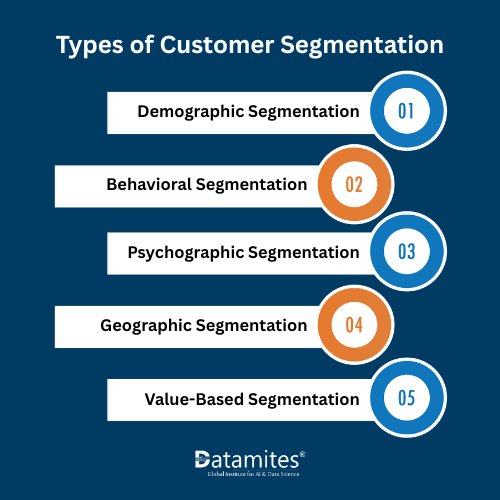
1. Demographic Segmentation
Demographic segmentation groups customers using characteristics such as age range, occupation, income range, or household composition, where the information is appropriately available.
Example: An education provider might examine whether working professionals, recent graduates, and career changers show different preferences for course schedules or learning formats.
AI can help identify associations between demographic characteristics and customer engagement. However, demographic attributes should not be treated as definitive indicators of an individual's interests, abilities, or purchasing intentions.
Businesses should also assess whether collecting or using particular demographic information is necessary, proportionate, and lawful.
2. Behavioral Segmentation
Behavioral segmentation groups customers according to how they interact with a business.
Relevant variables may include:
- Purchase frequency and recency.
- Product browsing and cart activity.
- Feature adoption and usage frequency.
- Responses to previous campaigns.
- Changes in engagement over time.
Example: An e-commerce company might identify frequent buyers, first-time purchasers, customers who repeatedly abandon their carts, and customers who have not purchased recently.
Each group may require a different approach. Repeat purchasers might benefit from relevant complementary products, while new customers may need onboarding information or assistance understanding product features.
Behavioral segmentation is particularly useful because it connects observable customer actions to specific business opportunities. However, businesses should avoid interpreting limited behavioral signals as proof of a customer's intentions.
3. Psychographic Segmentation
Psychographic segmentation groups customers according to interests, motivations, preferences, and lifestyle-related characteristics.
Example: A travel company could distinguish customers who voluntarily express an interest in adventure travel from those who prefer cultural experiences, wellness holidays, or family trips.
AI may help analyze voluntarily provided preferences and relevant interactions to identify patterns. Nevertheless, psychological characteristics are often difficult to infer reliably from digital behavior.
Businesses should not present inferred preferences as confirmed facts or use sensitive personal characteristics in ways that create unnecessary privacy or fairness risks.
4. Geographic Segmentation
Geographic segmentation groups customers according to location, such as country, state, city, or broader region.
Example: A retailer might identify regional differences in demand for seasonal products and adjust inventory planning or local promotions accordingly.
AI can combine appropriately collected geographic information with sales trends and seasonal patterns to improve forecasting.
The level of geographic detail matters. Broad regional information may be sufficient for inventory planning, while precise location histories may introduce unnecessary privacy risks.
Organizations should use location data only when justified by a legitimate business purpose and applicable requirements.
5. Value-Based Segmentation
Value-based segmentation groups customers according to their economic contribution or estimated future value.
Common measures include:
- Average order value.
- Purchase frequency.
- Gross margin.
- Customer acquisition cost.
- Customer lifetime value (CLV).
Customer lifetime value estimates the economic value a business expects to generate from a customer over the relationship's duration. The estimate depends on assumptions about future purchases, retention, margins, and costs.
Example: A subscription company might distinguish customers with consistent renewals from customers whose engagement and renewal patterns suggest a greater likelihood of cancellation.
AI models can help estimate future customer value, but these estimates are uncertain. Businesses should validate them against actual results and avoid assuming that customers with lower predicted value deserve inferior service.
Combining Different Segmentation Types
A customer may belong to several meaningful groups simultaneously.
For example, a retailer could identify a customer as geographically local, behaviorally active, and valuable based on historical contribution margin. These dimensions may inform different decisions, such as local inventory planning, product recommendations, or loyalty campaigns.
The objective is not to create the largest possible number of segments. It is to identify groups that differ in ways that support useful, measurable, and responsible business actions.
How Does AI Work in Customer Segmentation?
AI customer segmentation generally involves collecting relevant data, preparing it for analysis, selecting an appropriate method, interpreting the results, and evaluating whether the resulting insights improve business decisions.
The method should be selected according to the business question rather than the popularity of a particular algorithm.
1. Clustering Algorithms
Clustering is an unsupervised machine learning approach that groups observations according to similarities in their characteristics. Unlike supervised learning, clustering does not require predefined customer labels.
Three commonly used methods are K-means, hierarchical clustering, and DBSCAN.
K-means clustering
K-means divides observations into a specified number of clusters by assigning them to the nearest cluster center and updating those centers iteratively.
It can be useful for structured numerical data, such as purchase frequency, average order value, and product usage.
However, the number of clusters must be selected, and results can be affected by feature scaling, outliers, and the shape of the underlying data.
Hierarchical clustering
Hierarchical clustering builds a hierarchy of groups that can be examined at different levels of detail.
It may be useful when analysts want to explore relationships between customer groups without immediately committing to a single segmentation level.
Its computational cost can become a consideration for large datasets, depending on the implementation.
DBSCAN
DBSCAN identifies dense groups of observations and can classify some observations as noise rather than forcing every customer into a cluster.
It may be useful when clusters have irregular shapes or when unusual observations need to be identified. Its performance depends on the density structure of the data and the selected parameters.
Practical consideration: Before clustering, businesses should check missing values, remove irrelevant variables, address extreme values where appropriate, and scale numerical features when the selected algorithm requires it.
For example, annual spending might range into thousands while purchase frequency ranges from one to ten. Without appropriate scaling, spending could dominate a distance-based clustering model.
Technical documentation from scikit-learn's clustering guide provides further information about these methods and their limitations.
2. Predictive Analytics
Predictive analytics uses historical data to estimate the likelihood of future outcomes.
Businesses can use supervised machine learning models to estimate customer churn risk, purchase propensity, renewal likelihood, or response to a particular offer.
Example: A subscription service might use changes in product usage, renewal history, and feature adoption to estimate which customers have a higher probability of cancelling.
The resulting predictions can be used to develop actionable customer groups, such as customers who need onboarding assistance or customers whose engagement has declined.
However, a high predicted churn probability does not establish that a customer will cancel. Models can produce false positives and false negatives, and their performance may change over time.
Businesses should evaluate predictions against actual outcomes and determine whether an intervention provides measurable benefits.
3. Recommendation and Personalization Models
Recommendation systems analyze customer interactions, product characteristics, and other relevant information to suggest products, services, or content.
These systems complement segmentation but perform a different function.
Segmentation identifies groups of customers, whereas recommendation models often select relevant items for individual users.
For example, a retailer might use broad customer segments to determine campaign themes and a recommendation system to choose relevant products for each customer.
Organizations should evaluate whether recommendations improve useful outcomes, such as customer satisfaction or incremental purchases, rather than assuming that greater personalization is always beneficial.
4. RFM Analysis and Customer Lifetime Value Modeling
RFM analysis is an established customer analytics technique based on three measures:
- Recency: How recently a customer purchased.
- Frequency: How often a customer purchased during a defined period.
- Monetary value: How much the customer spent during that period.
RFM analysis can help identify recent purchasers, frequent buyers, and customers whose purchasing activity has declined.
Businesses can begin with transparent RFM rules and later explore whether machine learning identifies additional useful patterns.
Customer lifetime value modeling can extend this analysis by estimating future customer contribution using assumptions about repeat purchases, retention, revenue, and margins.
Neither technique requires AI in every implementation. Their value comes from selecting appropriate measures and using the results to improve decisions.
Refer to the articles below:
- How AI-Driven Strategies Transforming Traditional Finance
- AI Trends That Will Transform Marketing and Advertising
- The 2026 Guide to Implementing AI in HR Analytics
How Should Businesses Evaluate Segmentation Quality?
A segmentation model should be assessed using both statistical and business criteria.
1. Silhouette score
The silhouette score measures how similar an observation is to its assigned cluster compared with other clusters. Values range from -1 to +1.
Values closer to +1 generally indicate better separation, values around zero suggest overlapping clusters, and negative values can indicate potentially unsuitable assignments.
However, a high silhouette score does not establish that a segmentation is useful for AI marketing guide.
2. Segment interpretability
Marketing and business teams should be able to explain what distinguishes each segment, identify its likely needs, and determine which actions are appropriate.
3. Business performance
Relevant metrics may include incremental revenue, conversion rates, customer retention, contribution margin, and campaign costs.
4. Stability and usefulness
Teams should evaluate whether segments remain meaningful across appropriate time periods and whether their size and characteristics support practical action.
For example, a model might produce several statistically distinct groups, but some may be too small to reach efficiently or too similar to justify separate campaigns. Where feasible, controlled experiments can help establish whether segment-based actions actually improve outcomes.
The central principle is that a statistically distinct cluster is not necessarily a commercially valuable customer segment.
What Are the Benefits of AI Customer Segmentation?
When implemented appropriately, AI customer segmentation can support marketing, customer experience, product development, and business planning.
1. Improved Personalization
AI can help businesses identify differences in customer behavior analysis and tailor messages, offers, content, and product recommendations. For example, first-time customers may benefit from onboarding guidance, while repeat purchasers may respond to relevant complementary products or loyalty rewards.
2. More Efficient Marketing Spending
Segmentation can help marketing teams allocate resources to audiences that are relevant to specific campaign objectives. By comparing acquisition costs, conversion rates, incremental revenue, and contribution margins, businesses can assess which approaches deserve further investment.
3. Deeper Customer Insights
Machine learning can identify relationships among purchasing behavior, product usage, and engagement that may be difficult to detect through manual analysis. These insights can inform marketing strategy, product planning, inventory management, and customer support.
4. Better Customer Retention
Predictive models can help identify customers whose engagement is declining or whose behavior is associated with a higher likelihood of cancellation. Businesses can test appropriate interventions, including onboarding assistance, product education, relevant service improvements, or customer support.
5. More Relevant Customer Experiences
When applied responsibly, customer insights can help people receive communications that better match their interests and stage in the customer journey. Businesses should respect communication preferences, provide suitable opt-out mechanisms, and avoid excessive targeting.
6. Faster Adaptation to Changing Behavior
Customer preferences can change because of seasonal demand, product launches, economic conditions, and individual circumstances.
However, segments should not be updated continuously without a reason. Refresh schedules should reflect how quickly customer behavior changes and how frequently business decisions need to be made.
AI Customer Segmentation: Real-World Applications
The following examples illustrate practical applications of AI customer segmentation. They are hypothetical scenarios, not verified case studies or claims of measured results from specific companies.
1. E-Commerce: Identifying Different Purchasing Behaviors
An online retailer wants to improve the relevance of its marketing campaigns without sending identical promotions to every customer.
A clustering model identifies groups with different purchasing patterns. These might include frequent purchasers, shoppers who repeatedly browse without completing purchases, and customers whose activity has declined.
The marketing team develops different approaches for each group:
- Offer relevant complementary product recommendations to repeat buyers.
- Test helpful product information or reminders for eligible customers who abandon carts.
- Test relevant re-engagement messages for inactive customers.
- The business then compares the results against an appropriate control group. Useful measures include conversion rates, incremental revenue, contribution margin, unsubscribe rates, and customer complaints.
This approach helps determine whether segmentation creates meaningful improvements rather than merely increasing the number of marketing messages sent.
2. Subscription Services: Understanding Declining Engagement
A subscription business wants to identify customers who may need additional assistance before their renewal dates. The organization analyzes appropriate indicators, such as login frequency, feature adoption, subscription tenure, renewal history, and changes in product usage.
For example, one segment might contain new subscribers who have not completed onboarding. Another might contain established users whose activity has recently declined.
The company can test targeted onboarding guidance, product education, or customer support for these groups. A high churn-risk score is not a definitive judgment about a customer. Teams should avoid automatically penalizing customers or assuming that a predicted outcome will occur.
3. Banking and Financial Services: Responsible Customer Engagement
A financial services provider may analyze appropriately governed transaction patterns and product interactions to understand general service needs or improve customer education.
For example, aggregate trends may help identify which financial education resources customers use most frequently.
Financial information is sensitive, and certain financial decisions can have significant consequences. Organizations therefore need appropriate controls for access, fairness, explainability, and permitted use.Segmentation should not be used to justify discriminatory treatment or inappropriate targeting.
How Can Businesses Implement AI Customer Segmentation?
Businesses do not need to build a sophisticated AI platform immediately. A focused pilot can establish whether segmentation solves a meaningful problem before further investment.
The following seven steps provide a practical implementation framework.
Step 1: Define the Business Objective
Begin with a specific business question rather than choosing an algorithm first.
Potential objectives include:
- Improving repeat purchases.
- Identifying customers who need onboarding support.
- Understanding customer lifetime value.
- Reducing subscription churn.
- Improving the relevance of product recommendations.
Define the baseline, the desired outcome, and the measurement period.
For example, a retailer might investigate whether a targeted retention campaign increases repeat purchases compared with its existing marketing approach.
A clearly defined objective helps determine which data is necessary, which method is appropriate, and how success should be evaluated.
Step 2: Collect and Prepare Relevant Data
Identify the minimum information required to address the business objective.
Potential sources include customer relationship management systems, transaction records, website analytics, Marketing Funnel Analysis, customer feedback, and product usage data.
Prepare the data by:
- Removing duplicate and irrelevant records.
- Addressing missing values and inconsistent formats.
- Checking whether the dataset represents the intended customer population.
- Scaling numerical variables where required by the chosen algorithm.
- Identifying outliers and investigating whether they represent genuine behavior or data errors.
- Reviewing data permissions, retention policies, and applicable privacy requirements.
Combining datasets may improve analysis, but more data does not automatically produce better results. Poor-quality or unnecessary information can introduce noise, bias, and privacy risks.
Step 3: Select the Appropriate Analytical Method
Choose a method according to the business question and available data.
| Business objective | Potential approach |
| Discover groups with similar purchasing behavior | K-means or hierarchical clustering |
| Identify dense groups and unusual observations | DBSCAN |
| Estimate customer churn risk | Supervised classification |
| Estimate future customer value | Customer lifetime value modeling |
| Analyze purchase recency and frequency | RFM analysis |
| Recommend relevant products | Recommendation systems |
| Build a simple, explainable starting point | Business-defined rules |
These methods can be combined when justified, but organizations should begin with the simplest approach that answers the business question effectively. A complex model is not automatically more accurate, interpretable, or commercially useful than a straightforward alternative.
Step 4: Build and Interpret the Segments
Apply the selected method to the prepared data and examine the resulting groups.
For each segment, document:
- Its defining characteristics.
- Its size and business relevance.
- Its likely needs or observable behaviors.
- The action the business proposes to test.
- The limitations and uncertainty associated with the analysis.
Avoid creating segments that are statistically distinct but too small to reach effectively, difficult to interpret, or impossible to serve meaningfully. Where practical, validate the segments with domain experts, customer research, or subsequent campaign results.
Step 5: Test Segment-Based Campaigns
Use the resulting segments to design targeted campaigns, then compare outcomes with an appropriate baseline or control group.
Relevant metrics include:
- Conversion rate.
- Repeat purchase rate.
- Customer retention and churn.
- Customer acquisition cost, where applicable.
- Incremental revenue and contribution margin.
- Unsubscribe and complaint rates.
Whenever feasible, use controlled experiments to determine whether the campaign caused an improvement.
For example, if a targeted campaign produces more conversions but also requires substantially higher discounts, it may not improve profitability. Businesses should evaluate the complete outcome rather than relying on a single favorable metric.
Step 6: Monitor and Refine the Model
Customer behavior, products, and market conditions change over time. Monitor data quality, segment stability, predictive performance, and business outcomes.
Review the model when:
- Customer behavior changes materially.
- Predictive performance declines.
- Data sources or definitions change.
- The business objective evolves.
- Campaign outcomes no longer justify maintaining the segmentation.
Document important changes so that teams understand why segments have been updated and how campaign decisions are affected. A model should be retained because it continues to provide value, not simply because it was successful when first deployed.
Step 7: Establish Privacy and AI Governance
Responsible implementation helps protect customers and maintain trust.
Businesses should:
- Collect only information appropriate and necessary for the intended purpose.
- Follow applicable privacy and data protection requirements.
- Restrict access to customer information.
- Assess models for bias and unintended discriminatory outcomes.
- Provide suitable human oversight for consequential decisions.
- Document model limitations and monitoring procedures.
- Establish clear accountability for model use and business decisions.
The NIST AI Risk Management Framework provides a useful reference for organizations seeking to incorporate considerations such as reliability, transparency, privacy, and fairness into AI development and deployment.
Refer to the articles below:
- Top AI Product Manager Skills
- The Role of AI in Investment and Portfolio Analysis
- Popular AI Tools in Healthcare
The appropriate safeguards depend on the application, the data involved, the affected individuals, and the potential consequences of errors. However, successful implementation requires more than selecting a machine learning algorithm. Businesses need clear objectives, reliable data, appropriate evaluation methods, measurable outcomes, and safeguards for privacy and fairness.
DataMites Institute offers training programs in areas including Data Science, Artificial Intelligence, Machine Learning, and Business Analytics. DataMites helps marketing and business professionals develop industry-relevant skills through its AI Marketing Course. The program combines expert-led training, practical case studies, and internship opportunities to help learners understand how artificial intelligence can enhance marketing strategies and decision-making. Learners can pursue the Certified AI Professional in Marketing Analytics course, with certification associated with IABAC and aligned with relevant EU competency frameworks.
DataMites also has training centers across major Indian cities, including Bangalore, Pune, Hyderabad, Chennai, Delhi, Kolkata, Coimbatore, Ahmedabad, and Chandigarh, offering learning opportunities for professionals looking to strengthen their expertise in AI-driven marketing.