Career Transition from Non-IT to Data Analyst in Lucknow
Explore how professionals in Lucknow can successfully make a career transition from non-IT backgrounds to data analytics. Learn about essential skills, learning pathways, industry opportunities, and practical steps to build a rewarding career as a data analyst.
 Kriti Maurya
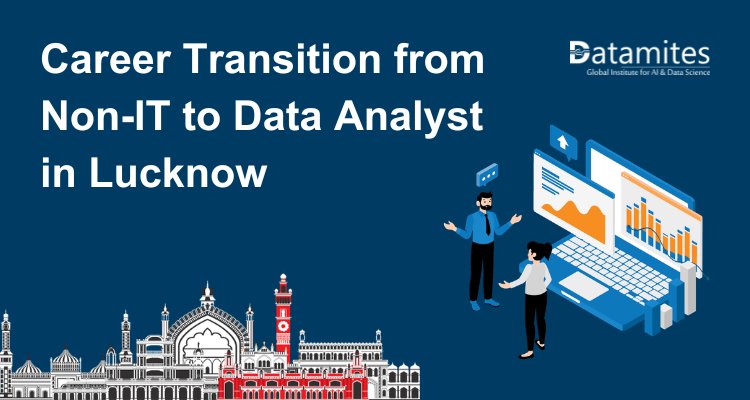
Lucknow, the capital city of Uttar Pradesh, is emerging as a promising destination for technology and analytics careers. With the expansion of IT services, startups, government-backed digital initiatives, and educational institutions, many aspiring professionals are looking to transition from Non-IT to Data Analysts in Lucknow and build successful careers in the analytics domain.
According to the India Data Analytics Market Report by IMARC Group, the Indian data analytics market was valued at USD 3.3 billion in 2025 and is projected to reach USD 28.9 billion by 2034, growing at a CAGR of 26.37%. This rapid expansion reflects the increasing adoption of analytics across industries and is generating strong demand for skilled professionals pursuing a Data Analyst Career in Lucknow.
Why Non-IT Professionals Are Choosing Data Analytics in Lucknow
Data analytics has emerged as one of the most accessible career options for professionals looking to transition from non-IT backgrounds. In Lucknow, growing digital adoption across industries such as healthcare, banking, retail, education, and business services is creating strong demand for data-driven decision-making. As a result, interest in IT Courses in Lucknow has increased among professionals from finance, sales, operations, customer service, and teaching who are looking to build successful careers in analytics.
Lucknow's expanding technology ecosystem is making it easier for non-IT professionals to acquire industry-relevant skills and enter the analytics workforce. As organizations increasingly rely on data to improve efficiency and customer experiences, the demand for skilled analysts continues to grow.
According to the Uttar Pradesh IT & ITeS Policy, the state is actively promoting digital transformation, technology adoption, and skill development across industries. These initiatives are creating new opportunities for professionals from non-IT backgrounds to upskill and transition into high-demand roles, making it easier to become a Data Analyst in Lucknow through structured training and practical learning pathways.
The widespread adoption of cloud computing, artificial intelligence, and business intelligence tools has further increased the need for analytics talent. Since many data analyst roles emphasize problem-solving, business understanding, and analytical thinking, professionals from non-IT backgrounds can successfully transition into the field with the right training.
By enrolling in Data Analytics courses in Lucknow, aspiring analysts can develop practical skills in Excel, SQL, Python, Power BI, and Tableau while gaining hands-on experience through real-world projects and case studies. This combination of growing demand and accessible learning pathways is encouraging more non-IT professionals to pursue a Data Analyst Career in Lucknow.
Refer to these Articles:
- Data Analytics in the Age of Big Data & Machine Learning
- Future of Data Analytics: What Skills Will Matter by 2030
- Essential Technical vs Non-Technical Skills for Data Analysts
Career Opportunities in Data Analytics in Lucknow
The analytics field offers multiple career paths depending on an individual's skills, interests, and experience level. According to AmbitionBox salary insights, analytics professionals in India earn competitive salaries based on their skills, experience, industry, and location.
- Data Analyst - Data Analysts collect, clean, analyze, and interpret data to help organizations make informed business decisions. The average Data Analyst salary in India ranges from ₹4 lakh to ₹8 lakh per annum, depending on skills, experience, and industry.
- Business Analyst - Business Analysts bridge the gap between business objectives and data-driven solutions by identifying opportunities for process improvement. The average Business Analyst salary in India ranges from ₹6 lakh to ₹12 lakh per annum.
- Reporting Analyst - Reporting Analysts create dashboards, reports, and performance metrics that help management monitor business performance. The average Reporting Analyst salary in India ranges from ₹4 lakh to ₹7 lakh per annum.
- Financial Analyst - Financial Analysts use data to evaluate investments, forecast business outcomes, and support financial planning activities. The average Financial Analyst salary in India ranges from ₹5 lakh to ₹10 lakh per annum.
- Marketing Analyst - Marketing Analysts examine customer behavior, campaign performance, and market trends to optimize marketing strategies. The average Marketing Analyst salary in India ranges from ₹5 lakh to ₹9 lakh per annum.
- Operations Analyst - Operations Analysts leverage data to improve business efficiency, reduce costs, and streamline organizational processes. The average Operations Analyst salary in India ranges from ₹5 lakh to ₹9 lakh per annum.
The average entry-level analytics professional can find opportunities across banking institutions, healthcare organizations, retail companies, educational technology firms, consulting companies, and emerging startups operating in and around Lucknow.
How Non-IT Professional Can Become a Data Analyst in Lucknow
Transitioning into analytics becomes easier when approached through a structured learning path. The following roadmap can help aspiring professionals build the skills needed for a successful Data Analyst Career in Lucknow.
Step 1: Understand Data Analytics Fundamentals
Begin by learning core concepts such as data collection, data cleaning, statistics, data interpretation, and business problem-solving. A strong foundation helps in understanding how data supports organizational decision-making.
Step 2: Master Excel for analysis
Excel remains one of the most widely used analytical tools in business environments. Learning formulas, Pivot Tables, dashboards, and data visualization techniques can significantly improve analytical capabilities.
Step 3: Learn SQL for data management
SQL (Structured Query Language) is essential for working with databases. It enables analysts to retrieve, filter, and manipulate large datasets efficiently.
Step 4: Develop Python Skills for programming
Python is widely used in analytics due to its simplicity and powerful libraries. Learning Python helps professionals automate tasks, clean data, and perform advanced analysis.
Step 5: Learn Data Visualization Tools
Tools such as Tableau and Power BI allow analysts to create interactive dashboards and present insights in an easily understandable format for business stakeholders.
Step 6: Work on Real-World Data Analyst Projects
Practical projects help learners apply theoretical knowledge to real business scenarios. Building a portfolio of analytics projects demonstrates problem-solving abilities to potential employers.
While exploring learning pathways, candidates often evaluate a suitable Data Analyst course in Lucknow and compare the data analyst course fee in Lucknow to identify programs that offer practical training, real-world projects, internships, and placement support for successful career growth.
Refer to these Articles:
- How to Become a Data Analyst in Noida
- How to Choose Best Institute for Data Analytics in Noida
- Data Analyst Career Scope in Noida
DataMites Institute emphasizes industry-focused certifications and hands-on learning to help individuals build successful careers in the data domain. Its training programs are aligned with globally recognized bodies such as IABAC and NASSCOM FutureSkills, offering comprehensive learning pathways through Data Analytics courses in Lucknow, along with specialized programs in Data Science, Machine Learning, Artificial Intelligence, Python, Tableau, and MLOps. Learners can also pursue advanced certifications, including Certified Data Scientist, AI for Managers, and Computer Vision Expert.
The institute also offers a Data Analyst course in Lucknow, while maintaining offline training centers across major cities such as Bangalore, Pune, Hyderabad, Chennai, Delhi, Kolkata, Coimbatore, Ahmedabad, Chandigarh, and more. These programs focus on classroom-based learning, practical projects, internship opportunities, and dedicated placement support, helping learners develop job-ready skills and gain real-world industry exposure.